Why does it matter for long-term health and wellbeing?
Folate is essential for synthesising and repairing DNA, supporting red blood cell formation, and regulating homocysteine, an amino acid linked to cardiovascular risk when elevated. Even mildly low folate can quietly affect mood, cognitive sharpness, and cellular renewal before any obvious symptoms appear. Adequate folate is particularly critical during pregnancy to support foetal neural development, but its role in neurological function, heart health, and healthy ageing makes it relevant across all life stages. Monitoring folate through a blood test provides an early signal for deficiency that dietary recall alone can miss.
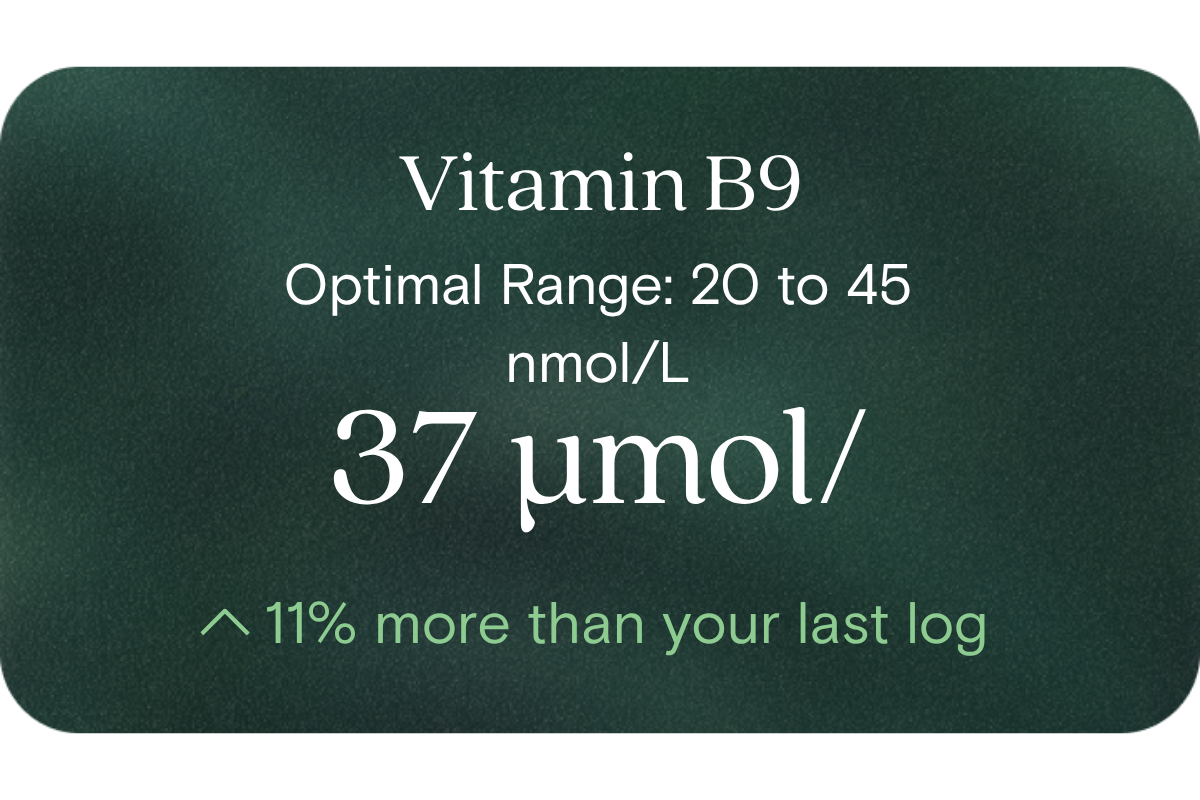
What's an optimal level of Vitamin B9 (Folate)?
- Laboratory reference: 7 to 45 nmol/L (serum folate)
- Optimal (as per your framework): 20 to 45 nmol/L
- Note: many Australian pathology labs use a lower cut-off of 7 nmol/L to define deficiency, but emerging evidence supports higher functional levels for optimal cognitive and cardiovascular health.
What influences folate levels?
- Dietary intake (leafy greens, legumes, wholegrains, and fortified foods such as bread)
- Absorption capacity (gut health, coeliac disease, inflammatory bowel conditions)
- Alcohol consumption (known to impair folate absorption and accelerate depletion)
- Genetic variation in the MTHFR gene, which affects how efficiently the body converts folate to its active form
- Certain medications (e.g. methotrexate, metformin, some anticonvulsants) that interfere with folate metabolism
- Increased physiological demand (pregnancy, rapid cell turnover)
What does it mean if folate is outside the optimal range?
- Below optimal / < 20 nmol/L: Folate reserves may be insufficient to support optimal DNA repair, red blood cell production, and homocysteine regulation, even if frank deficiency has not yet developed.
- Very low (< 7 nmol/L): Suggests folate deficiency, which may contribute to megaloblastic anaemia, elevated homocysteine, and neurological symptoms. This range is typically flagged by Australian pathology labs.
- Above optimal / very high: Typically not a concern with dietary folate. Persistently very high levels in the context of supplementation, particularly in those with MTHFR variants, may warrant review with a healthcare practitioner.
How to improve folate to a healthy level?
- Increase dietary sources of naturally occurring folate (dark leafy vegetables such as spinach and kale, legumes, avocado, broccoli, and asparagus)
- Take advantage of Australia's mandatory folic acid fortification in bread and certain cereals as a baseline dietary contribution
- Limit or reduce alcohol intake, which significantly impairs folate absorption and utilisation
- Consider an activated form of folate (methylfolate) if you have a known MTHFR gene variant affecting conversion efficiency
- Address gut health issues that may limit absorption, particularly if inflammatory bowel conditions or coeliac disease are present
- Retest folate alongside B12 and homocysteine to build a complete picture of methylation and cardiovascular risk
This information is provided for general health and wellness purposes only and does not replace medical advice.
References
- Food Standards Australia New Zealand. (2009). Folic acid fortification of bread-making flour. Canberra, ACT: FSANZ.
- Molloy, A. M., & Scott, J. M. (2001). Folates and prevention of disease. Public Health Nutrition, 4(2B), 601–609.
- Crider, K. S., Bailey, L. B., & Berry, R. J. (2011). Folic acid food fortification — its history, effect, concerns, and future directions. Nutrients, 3(3), 370–384.
- National Health and Medical Research Council. (2006). Nutrient Reference Values for Australia and New Zealand: Folate. Canberra, ACT: NHMRC.
- Moll, S., & Varga, E. A. (2015). Homocysteine and MTHFR mutations. Circulation, 132(1), e6–e9.














.png)


.svg)