★★★★★
Trusted by 30,000+ Australians
Blood Testing

Free testosterone Blood Test: What Low, High and Optimal Free testosterone Levels Mean.

Free Testosterone is the unbound fraction of testosterone that is biologically active at target tissues, measured as part of a hormone panel (androgen testing) alongside total testosterone and SHBG. Low Free Testosterone levels may be seen with male hypogonadism, pituitary dysfunction, obesity, insulin resistance or chronic illness, while high Free Testosterone levels can suggest androgen excess (including PCOS in women) or exogenous androgen exposure. This matters because Free Testosterone is linked to measurable outcomes such as fatigue, libido, mood, muscle strength, body composition and exercise recovery. A Free Testosterone blood test is best interpreted with total testosterone, SHBG, LH/FSH and prolactin to identify likely underlying drivers.

Vively's health team can help you test Free testosterone. Start with Vively's Baseline Health Check first - only $99 today.
Dr Michelle Woolhouse
July 1, 2026
Book My Test
Book My Test
Same-day pathology referral | 4,000+ Testing Locations in AU | Results in 2-3 days
Order My CGM

What is Free Testosterone?

Free testosterone is the fraction of testosterone in your bloodstream that is not bound to carrier proteins (primarily SHBG and albumin). Because it is unbound, it is immediately bioavailable to tissues and thus considered a more accurate indicator of androgenic activity than total testosterone alone.

Why does it matter for long-term health and wellbeing?

Free testosterone influences muscle strength, lean mass, metabolic rate, fat distribution, mood, libido, and energy. Over the long term, maintaining a healthy level as seen on a testosterone blood test supports recovery, metabolic resilience, and preservation of functional capacity with ageing. Deviations from the optimal range on a testosterone blood test provide early signals for lifestyle adjustment before downstream effects accumulate.

What’s an optimal level of Free Testosterone?

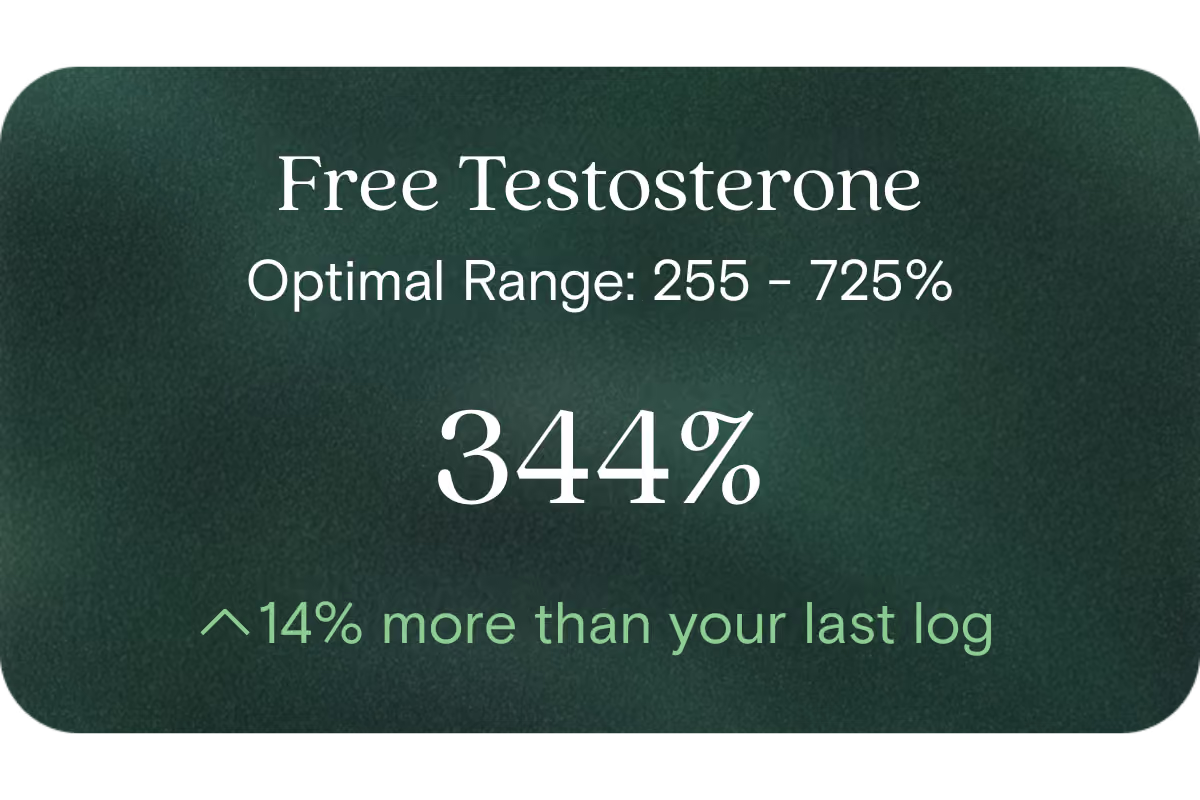
  • Laboratory (reference) range (Australian typical): ~ 260 to 740 pmol/L in adult males (based on the Alfred Pathology handbook)
  • Some sources suggest that values down to ~ 140 pmol/L may be observed with age, though this is outside the young-healthy reference window
  • In research using equilibrium dialysis, normative ranges in healthy, non-obese men are ~ 229 to 1,070 pmol/L (2.5th to 97.5th percentile)
  • Optimal targets may sit comfortably in the upper half of the reference zone (e.g. ~ 400–700 pmol/L in younger men), but optimal ranges should always be interpreted in the context of age, symptoms, SHBG, and individual goals.

What influences Free Testosterone levels?

Free testosterone is shaped by production (gonadal function), clearance, and binding dynamics (primarily SHBG levels). Key modulators include:

  • Age: free testosterone declines with age, partly via increases in SHBG.
  • Body composition (BMI, adiposity): higher BMI and adiposity tend to lower free testosterone, especially beyond a threshold.
  • Lifestyle factors: physical activity, quality sleep, dietary fat intake, alcohol use, stress and insulin sensitivity all have impacts on testosterone and SHBG.
  • SHBG alterations: anything that raises SHBG (e.g. thyroid shifts, certain hormonal states) reduces free fraction; anything lowering SHBG (e.g. obesity, insulin resistance) may mask a drop in free testosterone even if total remains “normal.”

What does it mean if Free Testosterone is outside the optimal range?

  • If free testosterone is below the optimal (or reference) range: this suggests there may be insufficient androgenic drive at the tissue level. You might experience decreased energy, difficulty building or maintaining muscle, shifts in fat mass, or declines in motivation or libido.
  • If it is above the optimal range: it may indicate androgen excess, possibly leading to adverse effects like acne, accelerated hair thinning, or undesired hormonal strain.
  • Importantly: a value outside your lab’s reference or your own optimal zone is a signal for lifestyle review, not a diagnosis. It invites adjustments — earlier, more precise, and personalised interventions.

How can I support healthy Free Testosterone levels?

You can influence free testosterone through lifestyle choices:

  • Strength training and resistance exercise: stimulate androgenic responses and preserve lean mass.
  • Maintain lean body composition: reducing excess adiposity, especially visceral fat helps minimise hormonal suppression.
  • Adequate dietary energy and healthy fats: extremely low-fat diets may reduce testosterone.
  • Optimal sleep and circadian health: poor sleep or shift patterns can blunt testosterone rhythms.
  • Stress management and insulin sensitivity: chronic stress and insulin resistance increase SHBG perturbations and metabolic interference.
  • Avoid excess alcohol, smoking, or endocrine disruptors: these can interfere with hormonal balance.
  • Regular monitoring: periodic testing helps you see trends, not just snapshots, enabling early corrective action.

This information is provided for general health and wellness purposes only and does not replace medical advice.

References

  1. Bhasin, S., Wang, C., & Handelsman, D. J. (2022). Accurate Measurement and Harmonized Reference Ranges for Circulating Testosterone: A Critical Step toward Identifying Hypogonadism in Men. The Journal of Clinical Endocrinology & Metabolism.
  2. Glanville, E. et al. (2022). Reference intervals for free testosterone in adult men measured using a standardized equilibrium dialysis procedure (11:1). Andrology.
  3. Whittaker, J., & Wu, K. (2022). Low-fat diets and testosterone in men: Systematic review and meta-analysis of intervention studies. Preprint (arXiv).
  4. Yeap, B. B., & Endocrine Society of Australia. (2016). Endocrine Society of Australia position statement on male hypogonadism — Part 1: Assessment. Medical Journal of Australia.


Ready to understand your [marker name] in context?  

Vively's Baseline Health Check reviews [marker name] alongside iron studies, full blood count, inflammation, liver health, metabolic markers and 70+ other biomarkers, then turns your results into a personalised plan.  Start My Baseline Health Check

What we measure

 70+ biomarkers analysed, each one tells you something specific about how your body is functioning right now, not just whether you're "sick" or "not sick"

Understand markers linked to healthy aging

A reflection of how your body is aging at the cellular level, linked to age risks and longevity.

  • Biological Age
  • Speed of Aging

Understand how your body regulates energy

Review glucose, insulin and lipid markers associated with metabolic balance.

  • Fasting Glucose
  • Fasting Insulin
  • Haemoglobin A1c (HbA1c) IFCC mmol/m
  • Haemoglobin A1c (HbA1c) NGSP/DCCT %
  • HOMA-IR
  • Uric Acid/HDL-C (UHR)
  • TyG index
  • Sodium/Potassium Ratio
  • hs-CRP / HDL Ratio

See how your blood supports oxygen and energy

Key blood indicators like hemoglobin, inflammation, and oxygen transport for overall health.

  • Mean Cell Volume (MCV)
  • Red Blood Cell (RBC) Count
  • Haemoglobin
  • Haematocrit
  • Red cell distribution width (RDW)
  • Mean Cell Haemoglobin (MCH)
  • Mean Cell Haemoglobin Concentration (MCHC)
  • Platelet count

Review advanced cardiovascular risk markers

Analyse lipid balance and related markers linked to long-term heart and vascular wellbeing.

  • Total Cholesterol
  • LDL Cholesterol
  • HDL Cholesterol
  • Non-HDL Cholesterol
  • Cholesterol Ratio
  • Triglycerides
  • Cholesterol/HDL Ratio
  • Total Cholesterol/HDL Ratio
  • LDL/HDL Ratio
  • Triglyceride/HDL Cholesterol (Molar Ratio)
  • Non-HDL Cholesterol/Total Cholesterol (Mass Ratio)
  • Atherogenic Index of Plasma (AIP)

See how your immune system is functioning

Review white blood cell markers that reflect immune activity and response.

  • White Blood Cell (WBC) Count
  • Neutrophils
  • Lymphocytes
  • Eosinophils
  • Basophils
  • Neutrophil-to-Lymphocyte Ratio
  • Neutrophil-to-HDL Cholesterol Ratio (NHR)
  • Platelet/Lymphocyte Ratio
  • Monocytes

Identify markers linked to systemic inflammation

Assess signals associated with inflammatory balance and overall physiological stress.

  • High-Sensitivity C-Reactive Protein (hs-CRP)
  • CRP/Albumin Ratio (CAR)
  • Systemic Inflammation Index (SII)

Monitor markers related to kidney function

Review indicators that reflect how efficiently your kidneys filter and regulate fluids.

  • Chloride
  • Bicarbonate
  • Sodium
  • Potassium
  • Urea
  • Creatinine
  • BUN/Creatinine Ratio
  • Estimated Glomerular Filtration Rate (eGFR)
  • Anion Gap

Assess markers connected to liver health

Understand enzymes and related markers linked to metabolic processing and detoxification pathways.

  • Alkaline Phosphatase
  • Bilirubin
  • Aspartate aminotransferase (AST)
  • Gamma-glutamyl Transferase (GGT)
  • Alanine Aminotransferase (ALT)
  • Globulin
  • Total Protein
  • NAFLD FIB-4
  • Albumin/Globulin Ratio
  • Albumin

Check your thyroid function

Helps identify thyroid issues linked to energy, mood and weight.

  • Thyroid Stimulating Hormone (TSH)

Check key nutrient levels that support daily function

Assess essential vitamins and minerals linked to energy production, recovery and overall wellbeing.

  • Iron
  • Phosphate
  • Magnesium
  • Transferrin
  • Ferritin
  • Transferrin saturation
  • TIBC
  • Vitamin D
Get my baseline for $99
Why us?

What a standard check often leaves out

Your GP isn't the problem. The current health system isn't built for optimal health.

Vively
Standard GP check
Markers analysed
70+ markers
10-15 markers
Optimal ranges included
Biological age
Results reviewed with on-demand practitioner support
Personalised plan built around your results
Ongoing retesting and health trends reporting
How it works

Just 3 simple steps to get started

If needed, we'll recommend further testing to investigate potential issues based on your results

01

Take the test

One simple test to understand where your health stands. Visit one of 4,000 collection centres across Australia at your earliest convenience and take one easy blood draw.
02

Review your results

Meet with a registered health professional to identify what looks fine, what’s worth watching, and what (if anything) needs attention. If nothing needs changing, we’ll tell you that too.
03

Stay confident as life changes

After your baseline, Vively continues as ongoing guidance — helping you stay on track, adjust when something changes, and re-test every 3 months to see progress over time.
Get your health baseline
What's included

All of this, for only $99/month

Everything below is included from day one. Cancel anytime.

Practitioner support

  • Test reviews and guidance from a registered nurse trained in optimal health
  • Dietitian support for nutrition and lifestyle changes
  • Plan updates whenever your results change

Ongoing monitoring

  • A full Baseline available every 3 months
  • See every marker trend over time
  • Programs matched to your results

All-in-one mobile app

  • Unlimited AI health intelligence
  • Food tracking and wearables integrations
  • Cycle tracking, journal, and insights
  • Member pricing on additional tests

FAQs

Does this include a blood test?
How do I take the blood test in Australia?
What if I just want the Baseline and don't want a membership?
Can't I just ask my GP to order these tests?
What happens after my Baseline?
What if nothing's wrong?
How long does it take?
Are all markers included for every person?
How does the 100% Money Back Guarantee work?
What happens to my data?
How often do I get retested?