



Among 3,310 Vively members, median TSH was 1.4 to 1.6 mIU/L in women and men of every age, apart from women 60 and over, where it was 1.9. About 2% to 4% had a TSH above 4 mIU/L until 60, rising to 8% of women 60 and over. Median free T4 stayed at 15 to 17 pmol/L at every age.
TSH (thyroid stimulating hormone) is the first test doctors use to check your thyroid. It comes from the pituitary gland in your brain and tells the thyroid how hard to work, so it rises when the thyroid is underactive and falls when it is overactive. Free T4 is the main hormone the thyroid makes.
This guide shows TSH and free T4 by age and sex from the first blood test of 3,310 Vively members, next to the ranges Australian labs use, and explains what a result outside the range usually means.
TSH is one of 70+ markers in the Baseline Health Check, read with your cholesterol, iron and metabolic markers, which thyroid problems often affect.
Median and middle 50% (in brackets), and the share outside common TSH cut-offs. 2,101 women with TSH, 1,094 with free T4.
| Age | Women | TSH (mIU/L) | TSH above 4 | TSH under 0.4 | Free T4 (pmol/L) |
|---|---|---|---|---|---|
| 18 to 29 | 163 | 1.4 (1.2 to 2.0) | 3% | 1% | 16.0 (14.5 to 17.7) |
| 30 to 39 | 580 | 1.5 (1.1 to 2.1) | 3% | 1% | 15.7 (14.0 to 17.0) |
| 40 to 49 | 670 | 1.6 (1.1 to 2.2) | 3% | 2% | 15.3 (14.0 to 17.0) |
| 50 to 59 | 460 | 1.5 (1.1 to 2.2) | 4% | 3% | 15.9 (14.0 to 17.0) |
| 60 and over | 228 | 1.9 (1.3 to 2.6) | 8% | 3% | 15.8 (14.0 to 17.0) |
Range used in the Vively app: TSH 0.5 to 4.0 mIU/L (Vively optimal 1.0 to 2.5), free T4 10 to 25 pmol/L (Vively optimal 12 to 22). Ranges vary between labs.
Median and middle 50% (in brackets), and the share outside common TSH cut-offs. 1,209 men with TSH, 598 with free T4.
| Age | Men | TSH (mIU/L) | TSH above 4 | TSH under 0.4 | Free T4 (pmol/L) |
|---|---|---|---|---|---|
| 18 to 29 | 156 | 1.5 (1.0 to 2.0) | 2% | 0% | 16.9 (15.1 to 18.0) |
| 30 to 39 | 370 | 1.5 (1.1 to 2.0) | 3% | 1% | 17.0 (15.3 to 18.6) |
| 40 to 49 | 374 | 1.5 (1.1 to 2.2) | 2% | 1% | 16.9 (15.0 to 18.0) |
| 50 to 59 | 199 | 1.5 (1.2 to 2.1) | 4% | 2% | 16.7 (15.1 to 18.0) |
| 60 and over | 110 | 1.6 (1.1 to 2.2) | 4% | 3% | 16.0 (15.0 to 18.0) |
Range used in the Vively app: TSH 0.5 to 4.0 mIU/L (Vively optimal 1.0 to 2.5), free T4 10 to 25 pmol/L (Vively optimal 12 to 22). Ranges vary between labs.
Median TSH sat between 1.4 and 1.6 mIU/L until 60 in both sexes, then rose in women. The line is the median at each age. The darker band is the middle 50%, the lighter band the middle 90% of members. The dotted line is the median for the other sex. 3,310 members.
| Group (mIU/L) | Members | 5th | 10th | 25th | Median | 75th | 90th | 95th |
|---|---|---|---|---|---|---|---|---|
| Women 18 to 29 | 163 | 0.65 | 0.80 | 1.16 | 1.41 | 1.99 | 2.80 | 3.30 |
| Women 30 to 39 | 580 | 0.62 | 0.85 | 1.10 | 1.50 | 2.10 | 2.80 | 3.40 |
| Women 40 to 49 | 670 | 0.63 | 0.83 | 1.10 | 1.56 | 2.20 | 2.89 | 3.50 |
| Women 50 to 59 | 460 | 0.57 | 0.71 | 1.10 | 1.53 | 2.20 | 3.00 | 3.78 |
| Women 60+ | 228 | 0.55 | 0.77 | 1.30 | 1.85 | 2.60 | 3.70 | 4.80 |
| Men 18 to 29 | 156 | 0.67 | 0.74 | 1.04 | 1.47 | 1.95 | 2.50 | 3.32 |
| Men 30 to 39 | 370 | 0.64 | 0.84 | 1.09 | 1.47 | 1.99 | 2.75 | 3.54 |
| Men 40 to 49 | 374 | 0.68 | 0.84 | 1.10 | 1.51 | 2.16 | 3.01 | 3.60 |
| Men 50 to 59 | 199 | 0.76 | 0.91 | 1.17 | 1.54 | 2.10 | 2.90 | 3.40 |
| Men 60+ | 110 | 0.49 | 0.81 | 1.10 | 1.60 | 2.20 | 2.69 | 3.60 |
A TSH above 4 mIU/L was uncommon until 60, when it reached 8% of women.
% with TSH above 4 mIU/L
| Women | Men | |
|---|---|---|
| 18 to 29 | 3% (n=165) | 2% (n=156) |
| 30 to 39 | 3% (n=586) | 3% (n=374) |
| 40 to 49 | 3% (n=676) | 2% (n=378) |
| 50 to 59 | 4% (n=464) | 4% (n=201) |
| 60+ | 8% (n=230) | 4% (n=111) |
% with TSH under 0.4 mIU/L
| Women | Men | |
|---|---|---|
| 18 to 29 | 1% (n=165) | 0% (n=156) |
| 30 to 39 | 1% (n=586) | 1% (n=374) |
| 40 to 49 | 2% (n=676) | 1% (n=378) |
| 50 to 59 | 3% (n=464) | 2% (n=201) |
| 60+ | 3% (n=230) | 3% (n=111) |
Type your TSH to see where it sits among Vively members of your sex and age.
| Group (mIU/L) | Members | 5th | 10th | 25th | Median | 75th | 90th | 95th |
|---|---|---|---|---|---|---|---|---|
| Women 18 to 29 | 163 | 0.65 | 0.80 | 1.16 | 1.41 | 1.99 | 2.80 | 3.30 |
| Women 30 to 39 | 580 | 0.62 | 0.85 | 1.10 | 1.50 | 2.10 | 2.80 | 3.40 |
| Women 40 to 49 | 670 | 0.63 | 0.83 | 1.10 | 1.56 | 2.20 | 2.89 | 3.50 |
| Women 50 to 59 | 460 | 0.57 | 0.71 | 1.10 | 1.53 | 2.20 | 3.00 | 3.78 |
| Women 60+ | 228 | 0.55 | 0.77 | 1.30 | 1.85 | 2.60 | 3.70 | 4.80 |
| Men 18 to 29 | 156 | 0.67 | 0.74 | 1.04 | 1.47 | 1.95 | 2.50 | 3.32 |
| Men 30 to 39 | 370 | 0.64 | 0.84 | 1.09 | 1.47 | 1.99 | 2.75 | 3.54 |
| Men 40 to 49 | 374 | 0.68 | 0.84 | 1.10 | 1.51 | 2.16 | 3.01 | 3.60 |
| Men 50 to 59 | 199 | 0.76 | 0.91 | 1.17 | 1.54 | 2.10 | 2.90 | 3.40 |
| Men 60+ | 110 | 0.49 | 0.81 | 1.10 | 1.60 | 2.20 | 2.69 | 3.60 |
Type your free T4 to see where it sits among Vively members of your sex and age.
| Group (pmol/L) | Members | 5th | 10th | 25th | Median | 75th | 90th | 95th |
|---|---|---|---|---|---|---|---|---|
| Women 18 to 29 | 72 | 11.3 | 13.0 | 14.5 | 16.0 | 17.7 | 18.9 | 19.3 |
| Women 30 to 39 | 280 | 12.1 | 13.0 | 14.0 | 15.7 | 17.0 | 18.1 | 19.7 |
| Women 40 to 49 | 347 | 11.9 | 12.6 | 14.0 | 15.3 | 17.0 | 18.0 | 19.0 |
| Women 50 to 59 | 259 | 11.6 | 12.3 | 14.0 | 15.9 | 17.0 | 18.9 | 20.0 |
| Women 60+ | 136 | 12.0 | 13.0 | 14.0 | 15.8 | 17.0 | 18.6 | 19.1 |
| Men 18 to 29 | 70 | 13.0 | 14.2 | 15.1 | 16.9 | 18.0 | 20.0 | 20.5 |
| Men 30 to 39 | 170 | 13.0 | 14.0 | 15.3 | 17.0 | 18.6 | 20.0 | 21.0 |
| Men 40 to 49 | 186 | 13.0 | 14.0 | 15.0 | 16.9 | 18.0 | 19.9 | 21.3 |
| Men 50 to 59 | 113 | 12.8 | 14.0 | 15.1 | 16.7 | 18.0 | 19.0 | 19.9 |
| Men 60+ | 59 | 13.0 | 14.0 | 15.0 | 16.0 | 18.0 | 19.7 | 23.0 |
These are Vively members who chose to have a blood test, so they may not represent all Australians. Some take thyroid medicine, which we can't exclude. Fewer members had free T4 than TSH. A member median is not a target or a normal range.
In Vively members, TSH barely moved with age until 60. The median was 1.4 to 1.6 mIU/L in women and men from 18 to 59, and the middle half of members sat between about 1.1 and 2.2 mIU/L. In women 60 and over, the median rose to 1.9 mIU/L and 8% had a TSH above 4 mIU/L, against 2% to 4% in the younger groups.
Free T4 stayed flat. The median was 15 to 16 pmol/L in women and 16 to 17 pmol/L in men in every age group.
Larger studies show the same rise in TSH with age. In the US NHANES survey, the upper end of TSH in people with no thyroid disease rose from about 3.6 mIU/L in people in their 20s to about 7.5 mIU/L at 80 and over. A TSH a little above the range is therefore more common, and often less meaningful, in older people.
Most Australian labs report an adult TSH range of about 0.4 or 0.5 to 4.0 mIU/L, and a free T4 range of about 10 to 25 pmol/L. Ranges differ between labs, so read your result against the range on your report. The ranges used in the Vively app are:
| Range used in the Vively app | Vively optimal range | |
|---|---|---|
| TSH | 0.5 to 4.0 mIU/L | 1.0 to 2.5 mIU/L |
| Free T4 | 10 to 25 pmol/L | 12 to 22 pmol/L |
About a third of Vively members (31% to 43% across age groups) had a TSH outside the optimal range of 1.0 to 2.5 mIU/L. Only 3% to 7% had a free T4 outside 12 to 22 pmol/L.
The optimal range is what we aim for to support long-term health. It is not a diagnostic cut-off. A TSH between 2.5 and 4.0 mIU/L with a normal free T4 is normal by lab standards and doesn't call for thyroid medicine on its own.
Do you need to fast? Not for TSH or free T4 alone. The Baseline Health Check is a fasting test because of glucose, insulin and triglycerides, so fast overnight and book a morning collection.
A TSH above the range means the pituitary is pushing the thyroid harder, usually because it is underactive. If free T4 is still normal, this is called subclinical hypothyroidism. If free T4 is low, it is overt hypothyroidism.
A TSH of 4 to 5 mIU/L is only just above most lab ranges. Doctors usually repeat it in 6 to 12 weeks with free T4 and thyroid antibodies before deciding anything, because mild rises often settle. The European Thyroid Association suggests treatment when TSH stays at 10 mIU/L or more, and a discussion about treatment between the top of the range and 10, depending on age, symptoms and pregnancy plans.
Symptoms that can go with an underactive thyroid include tiredness, feeling cold, constipation, dry skin, weight gain, low mood and heavy periods. Many of these have other causes, so the blood test and the symptoms are read together.
A TSH below the range can mean the thyroid is overactive (hyperthyroidism), most often from Graves' disease or thyroid nodules, especially if free T4 or free T3 is high. It can also come from taking more thyroxine than you need, recent illness, high-dose biotin or steroid medicines. Among Vively members, 0% to 3% had a TSH under 0.4 mIU/L.
Symptoms of an overactive thyroid include a racing heart, weight loss, shakiness, feeling hot, anxiety and poor sleep. See your GP if you have these with a low TSH.
| Pattern | What it can mean |
|---|---|
| High TSH, normal free T4 | Subclinical hypothyroidism. Repeat with thyroid antibodies |
| High TSH, low free T4 | Underactive thyroid. Needs GP review |
| Low TSH, high free T4 or free T3 | Overactive thyroid. Needs GP review |
| High TSH with raised LDL cholesterol | An underactive thyroid can raise LDL. Treating the thyroid can bring it down |
| High TSH with low ferritin | Low iron and an underactive thyroid both cause tiredness and often occur together in women |
See your GP if your TSH is outside the range on your report on two tests, if your TSH is 10 mIU/L or more, or if your free T4 is outside the range. See a GP soon if a low TSH comes with a racing or irregular heartbeat, or if you are pregnant or planning a pregnancy and your TSH is outside the range. Don't start iodine, kelp or thyroid supplements without advice: they can make some thyroid conditions worse.
TSH is in the Baseline Health Check, with 70+ other markers. Free T4 and free T3 are in the Female Hormone Health, Perimenopause and Menopause Hormone tests, the Weight Management Test and the Full Body Health Check, and the reviewing doctor can add them to your Baseline when your TSH needs a closer look. You don't need a referral from your own GP: a doctor in our network reviews and signs your request. You have one blood draw at one of our 3,700+ partner collection centres, and your results arrive in the Vively app, usually within a few days. A Vively practitioner explains your thyroid result with your other markers. Get your Baseline Health Check.
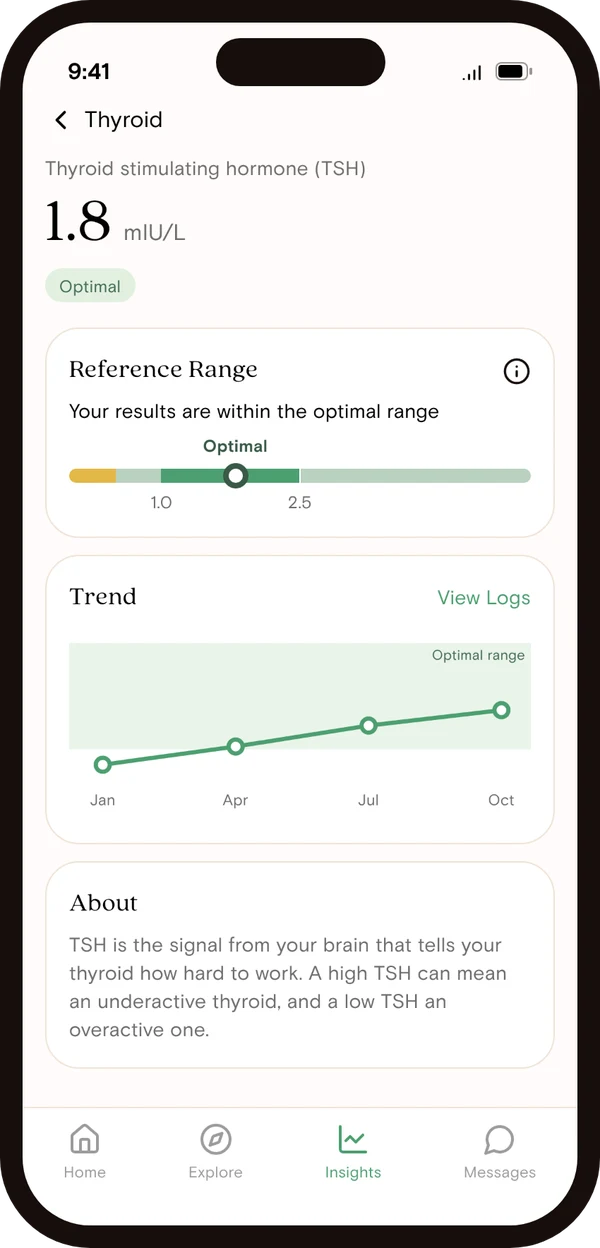
Most Australian labs use about 0.4 or 0.5 to 4.0 mIU/L for adults, and the range used in the Vively app is 0.5 to 4.0. Among 2,101 Vively women, median TSH was 1.4 to 1.6 mIU/L up to 59 and 1.9 mIU/L at 60 and over. Pregnancy has its own ranges.
The same adult range applies, about 0.5 to 4.0 mIU/L. Among 1,209 Vively men, the median was 1.5 to 1.6 mIU/L at every age, and 2% to 4% had a TSH above 4.
The range used in the Vively app is 10 to 25 pmol/L for adults. Among 1,094 Vively women, median free T4 was 15 to 16 pmol/L at every age, and the middle half sat between about 14 and 18 pmol/L.
Yes, a little. In Vively members, median TSH was steady until 60 and then rose in women, with 8% of women 60 and over above 4 mIU/L. Large US studies show the upper end of TSH rising into the 80s, so a mild rise is more common in older people.
The Vively optimal range is 1.0 to 2.5 mIU/L. It is a long-term health target, not a diagnosis. A TSH between 2.5 and 4.0 mIU/L with a normal free T4 is within lab ranges and doesn't need thyroid medicine on its own.
No. Fasting doesn't change TSH or free T4 much. Test in the morning so results are comparable over time, and stop high-dose biotin for at least two days before, if your doctor agrees.
Vively supports preventative health and health optimisation. It does not replace your GP, emergency care or specialist medical advice.
.avif)


.svg)


Vively is a general wellness platform and does not provide medical advice, diagnosis, or treatment. Any information, insights or guidance offered through our app, website, programs, or coaches is for educational and informational purposes only and should not be considered a substitute for professional medical advice or care. Always consult a qualified healthcare provider before making any health-related decisions.
We acknowledge the Traditional Custodians of the lands where we live and work, the Gadigal of the Eora Nation. We pay our respects to their Elders past and present.