



Among 1,163 Vively women, median FSH was about 6 IU/L in the 20s and 30s and 8 IU/L in the 40s, then jumped to 58 IU/L at 50 to 59 and 70 IU/L at 60 and over. Median oestradiol fell from about 250 pmol/L in the 40s to 70 pmol/L at 60 and over. In 604 men, median oestradiol stayed at 110 to 129 pmol/L.
Oestradiol (also spelt estradiol) is the main form of oestrogen. FSH (follicle stimulating hormone) is the signal from the pituitary gland that tells the ovaries, or the testes, to work. In women, both move through the menstrual cycle and change sharply around menopause, so a single number only makes sense with your age, cycle day and menopause stage.
This guide shows oestradiol and FSH by age and by menopause stage from the first blood test of Vively members, in the units Australian labs use (pmol/L and IU/L).
Oestradiol and FSH are in the Female Hormone Health, Perimenopause and Menopause Hormone tests, which you add to your Baseline Health Check.
Median and middle 50% (in brackets). 1,163 women with FSH, 1,124 with oestradiol.
| Age | Women (FSH) | FSH (IU/L) | Women (oestradiol) | Oestradiol (pmol/L) |
|---|---|---|---|---|
| 18 to 29 | 68 | 6 (5 to 8) | 66 | 182 (140 to 312) |
| 30 to 39 | 302 | 6 (5 to 8) | 298 | 234 (146 to 441) |
| 40 to 49 | 394 | 8 (5 to 13) | 380 | 254 (133 to 471) |
| 50 to 59 | 279 | 58 (31 to 85) | 268 | 103 (70 to 270) |
| 60 and over | 120 | 70 (51 to 85) | 112 | 70 (60 to 88) |
Cycle day isn’t recorded with these results, so the younger groups mix early-cycle, mid-cycle and late-cycle results, and some women take the pill or HRT. Use this to see the pattern, not to read your own result.
FSH stayed low into the 40s, then jumped in women aged 50 to 59, the decade most women reach menopause. The line is the median at each age. The darker band is the middle 50%, the lighter band the middle 80% of women. 1,163 women.
| Group (IU/L) | Members | 10th | 25th | Median | 75th | 90th |
|---|---|---|---|---|---|---|
| Women 18 to 29 | 68 | 3 | 5 | 6 | 8 | 9 |
| Women 30 to 39 | 302 | 3 | 5 | 6 | 8 | 12 |
| Women 40 to 49 | 394 | 3 | 5 | 8 | 13 | 30 |
| Women 50 to 59 | 279 | 11 | 31 | 58 | 85 | 110 |
| Women 60+ | 120 | 37 | 51 | 70 | 85 | 109 |
Median FSH was 6.2 IU/L in women still having periods and 65.4 IU/L after menopause.
| Value | Members | |
|---|---|---|
| Median FSH (IU/L): Still having periods | 6.2 | 237 |
| Median FSH (IU/L): Perimenopausal | 11.0 | 243 |
| Median FSH (IU/L): Post-menopausal | 65.4 | 304 |
Women grouped by the menopause status they told us. Median and middle 50% (in brackets). 784 women with FSH.
| Stage | Age | Women (FSH) | FSH (IU/L) | Women (oestradiol) | Oestradiol (pmol/L) |
|---|---|---|---|---|---|
| Still having periods | 33 (29 to 37) | 237 | 6.2 (5.0 to 8.0) | 231 | 221 (144 to 424) |
| Perimenopausal | 47 (44 to 50) | 243 | 11.0 (6.6 to 28.0) | 237 | 260 (121 to 490) |
| Post-menopausal | 57 (54 to 62) | 304 | 65.4 (44.0 to 87.6) | 292 | 80 (60 to 137) |
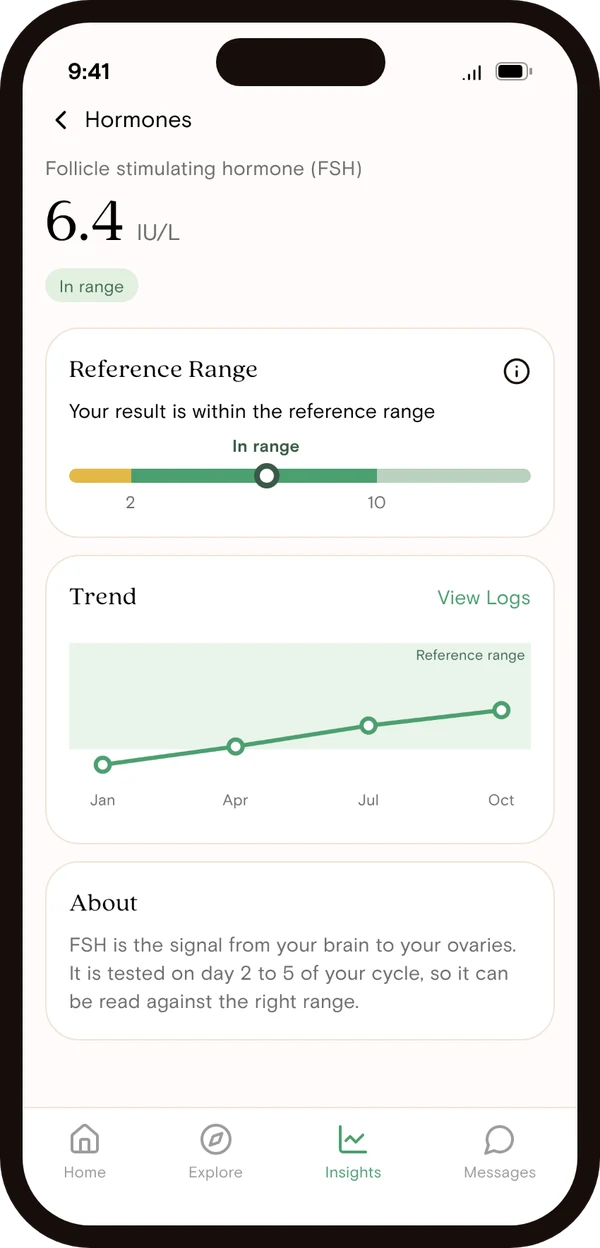
Women who weren’t sure of their stage are left out. Cycle day isn’t recorded, so the first two groups mix cycle phases, and some post-menopausal women take HRT. Ranges used in the Vively app: FSH 2 to 10 IU/L on day 2 to 5 of the cycle, 20 to 135 IU/L after menopause.
Median oestradiol was highest in the 40s and fell after 50. The wide band before 50 shows how much it swings through the cycle. The line is the median at each age. The band is the middle 50% of women. 1,124 women.
| Group (pmol/L) | Members | 25th | Median | 75th |
|---|---|---|---|---|
| Women 18 to 29 | 66 | 140 | 182 | 312 |
| Women 30 to 39 | 298 | 146 | 234 | 441 |
| Women 40 to 49 | 380 | 133 | 254 | 471 |
| Women 50 to 59 | 268 | 70 | 103 | 270 |
| Women 60+ | 112 | 60 | 70 | 88 |
Median and middle 50% (in brackets). 604 men with oestradiol.
| Age | Men | Oestradiol (pmol/L) | FSH (IU/L) |
|---|---|---|---|
| 18 to 29 | 69 | 129 (98 to 153) | 4 (2 to 5) |
| 30 to 39 | 166 | 112 (92 to 135) | 4 (3 to 6) |
| 40 to 49 | 203 | 110 (94 to 134) | 5 (3 to 7) |
| 50 to 59 | 112 | 122 (98 to 140) | 5 (4 to 8) |
| 60 and over | 54 | 112 (98 to 130) | 6 (4 to 9) |
Range used in the Vively app: oestradiol 36 to 150 pmol/L, FSH 1.5 to 12.5 IU/L. Ranges vary between labs and assays.
Type your oestradiol to see where it sits among Vively men your age.
| Group (pmol/L) | Members | 25th | Median | 75th |
|---|---|---|---|---|
| Men 18 to 29 | 69 | 98 | 129 | 153 |
| Men 30 to 39 | 166 | 92 | 112 | 135 |
| Men 40 to 49 | 203 | 94 | 110 | 134 |
| Men 50 to 59 | 112 | 98 | 122 | 140 |
| Men 60+ | 54 | 98 | 112 | 130 |
These are Vively members who chose to add a hormone test, so they may not represent all Australians. Cycle day isn't recorded with these results, and we can't exclude people taking the pill, HRT or testosterone. Some labs report low oestradiol as "under 70 pmol/L", so the lowest results are less precise. A member median is not a target or a normal range.
In Vively women, FSH changed little until the 40s. The median was about 6 IU/L in women in their 20s and 30s and 8 IU/L in their 40s, though the top quarter of women in their 40s were above 13 IU/L as some approached menopause. At 50 to 59 the median jumped to 58 IU/L, and at 60 and over it was 70 IU/L.
Oestradiol moved the other way. The median was 182 to 254 pmol/L from the 20s to the 40s, with a very wide spread because oestradiol rises and falls through every cycle. It fell to 103 pmol/L at 50 to 59 and 70 pmol/L at 60 and over.
Age is only a rough guide to where a woman is in the menopause transition, so we also grouped women by the stage they told us.
The perimenopause results show why one hormone test rarely settles whether you are in perimenopause. Some cycles still ovulate and some don't, so oestradiol can spike higher than in your 30s one month and drop the next, and FSH can be high one week and normal the next.
Hormone ranges depend on the phase of your cycle, so labs print separate ranges for the early cycle, mid-cycle, the second half of the cycle and after menopause. Read your result against the range for the day you tested. The ranges used in the Vively app are:
| Range used in the Vively app | |
|---|---|
| FSH, women, day 2 to 5 of the cycle | 2 to 10 IU/L |
| FSH, women after menopause | 20 to 135 IU/L |
| FSH, men | 1.5 to 12.5 IU/L |
| Oestradiol, women after menopause | 40 to 200 pmol/L |
| Oestradiol, men | 36 to 150 pmol/L |
Labs measure oestradiol in pmol/L in Australia. To compare with US figures in pg/mL, divide pmol/L by 3.67: 200 pmol/L is about 54 pg/mL.
Menopause is the last period, confirmed after 12 months without one. The average age in Australia is 51. After menopause FSH is usually well above 30 IU/L: in post-menopausal Vively women the median was 65.4 IU/L and three quarters were above 44 IU/L.
The Australasian Menopause Society advises against using FSH to diagnose menopause or perimenopause in women over 45 with typical symptoms, because results swing so much. Hormone tests are more useful under 45, after a hysterectomy or with an IUD that stops periods, when there is no period pattern to go by. In women under 40, an FSH above 25 IU/L on two tests at least 4 weeks apart, with periods stopped for 4 months or more, is how doctors diagnose premature ovarian insufficiency. In your 40s, the more useful blood tests are often the ones that rule out look-alikes, such as iron and thyroid.
Men make oestradiol mainly from testosterone, through an enzyme called aromatase that is most active in fat tissue. Men need it for bone strength, sex drive and erections. In Vively men, median oestradiol was 110 to 129 pmol/L at every age, and FSH rose slowly from a median of 4 IU/L in the 20s to 6 IU/L at 60 and over.
High oestradiol in men is most often linked to extra body fat or testosterone treatment, and can cause breast tissue to grow (gynaecomastia). Low oestradiol in men usually goes with low testosterone. In a US study of men whose hormones were lowered and then partly replaced, low oestradiol was linked to more body fat and lower sexual function. Read men's results with total and free testosterone: see our guide to testosterone levels in men.
See your GP if your periods stop for 3 months or more before 45, if you have bleeding after menopause, or if symptoms such as hot flushes, poor sleep or low mood are affecting your life, whatever your hormone results. Men should see a GP for breast swelling or tenderness, or an oestradiol or FSH outside the range on their report. Don't stop contraception because of one high FSH: you can still get pregnant during perimenopause.
Oestradiol and FSH are in the Female Hormone Health Test, the Perimenopause Hormone Test and the Menopause Hormone Test, which you add to your Baseline Health Check. You don't need a referral from your own GP: a doctor in our network reviews and signs your request. You have one blood draw at one of our 3,700+ partner collection centres, on the cycle day your test asks for, and your results arrive in the Vively app, usually within a few days. A Vively practitioner reads your hormones with your cycle, contraception and symptoms. Men who want oestradiol checked can ask their Vively practitioner about adding it.
It depends on cycle day more than age until menopause. Among Vively women, median oestradiol was 182 to 254 pmol/L from the 20s to the 40s, with a wide spread, then 103 pmol/L at 50 to 59 and 70 pmol/L at 60 and over. Your lab prints a range for each cycle phase.
There isn't one normal level, because oestradiol swings widely in perimenopause. In perimenopausal Vively women the median was 260 pmol/L, and the middle half sat between 121 and 490 pmol/L. That is why a single result can't confirm perimenopause.
The range used in the Vively app is 40 to 200 pmol/L after menopause. In post-menopausal Vively women, median oestradiol was 80 pmol/L, and the middle half sat between 60 and 137 pmol/L. Women on HRT have higher levels.
After menopause FSH is usually well above 30 IU/L. Post-menopausal Vively women had a median FSH of 65.4 IU/L. In women over 45, doctors diagnose menopause from 12 months without a period rather than from FSH, because FSH swings during perimenopause.
The range used in the Vively app for men is 36 to 150 pmol/L. Among 604 Vively men, median oestradiol was 110 to 129 pmol/L at every age, and the middle half sat between about 92 and 153 pmol/L.
On day 2 to 5 of your cycle, counting the first day of bleeding as day 1, unless your practitioner asks for another day. Progesterone is the exception: it is checked about 7 days before your next period to see whether you ovulated.
Vively supports preventative health and health optimisation. It does not replace your GP, emergency care or specialist medical advice.
.avif)


.svg)


Vively is a general wellness platform and does not provide medical advice, diagnosis, or treatment. Any information, insights or guidance offered through our app, website, programs, or coaches is for educational and informational purposes only and should not be considered a substitute for professional medical advice or care. Always consult a qualified healthcare provider before making any health-related decisions.
We acknowledge the Traditional Custodians of the lands where we live and work, the Gadigal of the Eora Nation. We pay our respects to their Elders past and present.