



Among 717 Vively men tested between 2024 and 2026, median total testosterone sat between 16 and 19 nmol/L in every age group from the 20s to the 60s. Free testosterone fell instead, by about a quarter, from a median of about 400 pmol/L in men in their 20s to about 290 pmol/L at 60 and over.
Most testosterone-by-age charts online come from overseas surveys. This guide uses the first blood test of 717 Vively men aged 18 and over, shown next to the Australian lab ranges your report is read against.
In these men, total testosterone held steady across the age groups, but SHBG (the protein that carries testosterone in the blood) rose, so free testosterone fell. That is why we look at all three together.
Total testosterone, free testosterone and SHBG are in the Male Hormone Health Test, an add-on to your Baseline Health Check.
Median and middle 50% (in brackets) for total testosterone, free testosterone and SHBG. 717 men.
| Age | Men | Total testosterone (nmol/L) | Below the range on their lab report | Free testosterone (pmol/L) | SHBG (nmol/L) |
|---|---|---|---|---|---|
| 18 to 29 | 75 | 19 (14 to 25) | 7% | 400 (320 to 470) | 31 (24 to 44) |
| 30 to 39 | 208 | 18 (13 to 23) | 6% | 370 (290 to 440) | 32 (25 to 42) |
| 40 to 49 | 245 | 16 (13 to 22) | 7% | 340 (280 to 410) | 31 (24 to 43) |
| 50 to 59 | 127 | 19 (14 to 23) | 9% | 340 (280 to 380) | 39 (29 to 53) |
| 60 and over | 62 | 17 (12 to 21) | 7% | 290 (220 to 350) | 40 (31 to 56) |
Range used in the Vively app for total testosterone: 11 to 40 nmol/L (optimal 12 to 40). SHBG: 11 to 71 nmol/L. Free testosterone ranges vary between labs. Free testosterone rounded to the nearest 10. Men with free testosterone: 711; with SHBG: 712.
The line is the median at each age. The darker band is the middle 50% of men, the lighter band the middle 80%. 711 men.
| Group (pmol/L) | Members | 10th | 25th | Median | 75th | 90th |
|---|---|---|---|---|---|---|
| Men 18 to 29 | 75 | 233 | 323 | 396 | 473 | 612 |
| Men 30 to 39 | 205 | 234 | 292 | 369 | 436 | 514 |
| Men 40 to 49 | 244 | 230 | 275 | 340 | 407 | 491 |
| Men 50 to 59 | 125 | 183 | 276 | 336 | 384 | 456 |
| Men 60+ | 62 | 183 | 223 | 292 | 352 | 402 |
Type your total testosterone to see where it sits among Vively men your age.
| Group (nmol/L) | Members | 5th | 10th | 25th | Median | 75th | 90th | 95th |
|---|---|---|---|---|---|---|---|---|
| Men 18 to 29 | 75 | 8.7 | 9.7 | 13.5 | 18.8 | 25.0 | 30.1 | 38.0 |
| Men 30 to 39 | 208 | 8.0 | 10.4 | 13.0 | 17.9 | 22.7 | 27.7 | 31.4 |
| Men 40 to 49 | 245 | 8.2 | 10.0 | 12.5 | 16.4 | 22.0 | 28.0 | 31.4 |
| Men 50 to 59 | 127 | 7.1 | 9.0 | 13.5 | 18.8 | 23.2 | 27.0 | 31.0 |
| Men 60+ | 62 | 7.0 | 9.6 | 12.3 | 16.6 | 20.9 | 23.2 | 26.4 |
Type your free testosterone (pmol/L) to see where it sits among Vively men your age. Labs calculate free testosterone in slightly different ways, so compare with the range on your own report.
| Group (pmol/L) | Members | 10th | 25th | Median | 75th | 90th |
|---|---|---|---|---|---|---|
| Men 18 to 29 | 75 | 233 | 323 | 396 | 473 | 612 |
| Men 30 to 39 | 205 | 234 | 292 | 369 | 436 | 514 |
| Men 40 to 49 | 244 | 230 | 275 | 340 | 407 | 491 |
| Men 50 to 59 | 125 | 183 | 276 | 336 | 384 | 456 |
| Men 60+ | 62 | 183 | 223 | 292 | 352 | 402 |
These are Vively members who chose to add a hormone test, so they may not represent all Australian men. Some may have had symptoms, and we can't exclude men taking testosterone. A member median is not a target or a normal range.
In Vively members, total testosterone barely changed with age: the median was 16 to 19 nmol/L in every group from 18 to 29 through to 60 and over. The middle half of men sat between about 12 and 25 nmol/L at every age.
Free testosterone tells a different story. The median fell from about 400 pmol/L in men aged 18 to 29 to about 340 pmol/L in their 40s and 50s, and about 290 pmol/L at 60 and over. Over the same ages, median SHBG rose from 31 to 40 nmol/L. More SHBG binds more testosterone, so less is free to act on the body even when the total looks the same.
Larger studies show the same pattern. In the Massachusetts Male Aging Study, total testosterone fell by about 0.8% for each year of age, while free testosterone fell by about 2% a year and SHBG rose by about 1.6% a year. Australia's Healthy Man Study found no drop in total testosterone with age in men who rated their health as very good or excellent, which suggests weight gain and illness explain much of the fall seen in older men.
Most Australian labs report an adult male range for total testosterone of roughly 10 to 35 nmol/L. Ranges differ between labs and assays, so always read your result against the range printed on your report.
| Total testosterone | |
|---|---|
| Healthy Male reference interval, men 21 to 35 | 9.7 to 34.3 nmol/L |
| Healthy Male reference interval, healthy men 71 to 87 | 6.6 to 26.7 nmol/L |
| Range used in the Vively app | 11 to 40 nmol/L |
| Vively optimal range | 12 to 40 nmol/L |
In every age group, 6% to 9% of Vively men had a total testosterone below the range on their own lab report. A low number on its own does not mean low testosterone as a medical condition (androgen deficiency). Healthy Male, Australia's men's health body, says diagnosis needs symptoms plus low results on at least two fasting, morning samples taken on different days, along with LH and FSH.
The Vively optimal range is what we aim for to support long-term health. It is not a diagnostic cut-off.
Total testosterone is all the testosterone in your blood. Most of it is bound to SHBG (sex hormone binding globulin) or albumin, and only about 2% is free.
Free testosterone is the unbound part that can act on muscle, bone, brain and sexual function. Most Australian labs calculate it from total testosterone, SHBG and albumin rather than measuring it directly, which is why free testosterone ranges vary more between labs than total testosterone does.
SHBG explains a lot of confusing results:
That is why we report total testosterone, free testosterone and SHBG side by side.
Testosterone moves through the day and with your health, so the conditions on test day matter.
Do you need to fast? Yes, for the most reliable result. Fast overnight and have your blood taken before 10am. The Baseline Health Check is a fasting test too, so the two fit in the same early collection.
One low result is a reason to repeat the test, not a diagnosis. Testosterone varies from day to day, so doctors confirm a low result on a second fasting morning sample before drawing any conclusions.
Common reasons for a low result in men who otherwise feel well:
Less common causes include conditions of the testes or the pituitary gland, and haemochromatosis (iron overload). Symptoms that can go with low testosterone include low sex drive, fewer morning erections, erection problems, low energy and loss of muscle. Many of these have other causes, which is why the blood test and the symptoms are read together.
On the PBS, testosterone treatment for men is only subsidised for confirmed androgen deficiency, for example a testosterone below 6 nmol/L, or 6 to 15 nmol/L with a raised LH, alongside a diagnosed cause.
High testosterone in a man who isn't taking testosterone or anabolic steroids is uncommon. The usual explanations are a sample taken soon after a testosterone dose, high SHBG lifting the total while free testosterone is normal, or, rarely, a hormone-producing condition. If your result is above the range and you aren't using testosterone, see your GP.
Testosterone makes most sense next to SHBG, LH and your metabolic markers.
| Pattern | What it can mean |
|---|---|
| Low total testosterone, low SHBG, free testosterone in range | Often linked to extra weight or insulin resistance. Check HOMA-IR |
| Normal total testosterone, high SHBG, low free testosterone | Common with age, a lean build, liver or thyroid conditions. Check TSH and liver enzymes |
| Low testosterone with low or normal LH | The signal from the pituitary may be low. Needs GP review |
| Low testosterone with high LH and FSH | The testes may not be responding. Needs GP review |
| Low testosterone with high ferritin and transferrin saturation | Iron overload can affect hormone production. Needs GP review |
Most of what lowers testosterone in otherwise healthy men is in your hands.
Retest about three months after a change, on a fasting morning sample, so you're comparing like with like.
See your GP if your testosterone is below the range on your report and you have symptoms, if it is low on two separate morning tests, or if it is below about 6 nmol/L. Also see your GP for breast swelling or tenderness, loss of body hair, shrinking or soft testes, concerns about fertility, or new headaches with changes in your vision. Talk to your GP before starting any testosterone treatment, because it can stop sperm production.
Total testosterone, free testosterone and SHBG are in the Male Hormone Health Test, an add-on to the Baseline Health Check. You don't need to see your own GP first: a doctor in our network reviews and signs your request. You have one blood draw at one of our 3,700+ partner collection centres (book an early morning slot and fast overnight), and your results arrive in the Vively app, usually within a few days. A Vively practitioner then reads your hormones with your metabolic and liver markers. Order the Male Hormone Health Test.
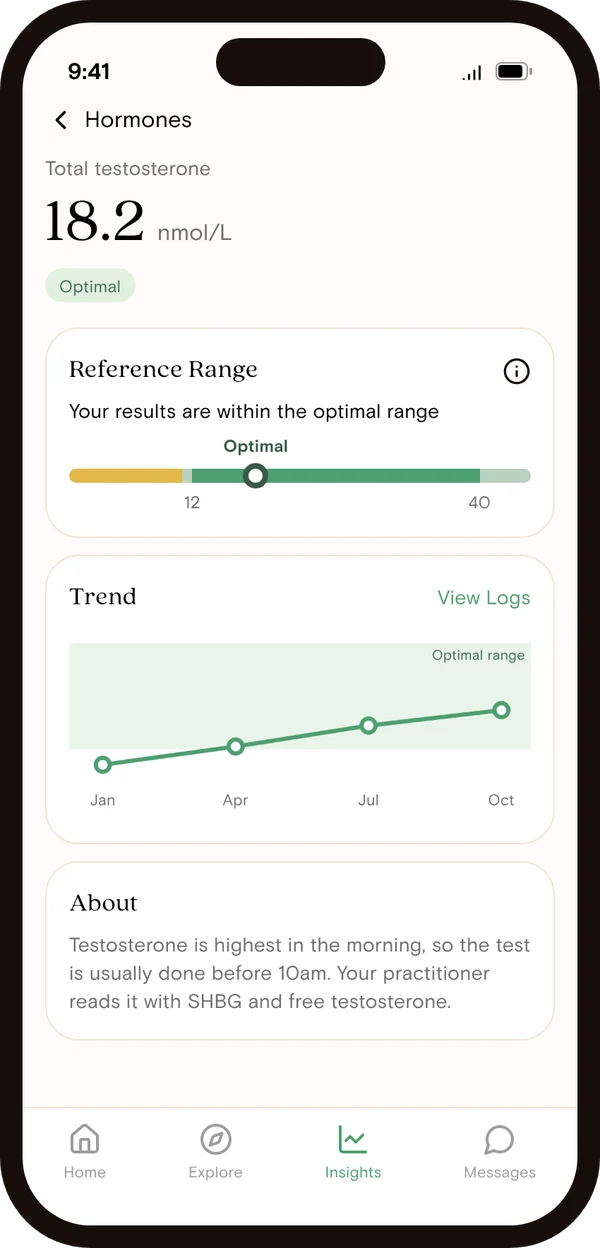
Most Australian labs report a total testosterone range for adult men of roughly 10 to 35 nmol/L, and Healthy Male gives 9.7 to 34.3 nmol/L for men aged 21 to 35. Among 717 Vively men, the median was 16 to 19 nmol/L at every age. Your report shows your own lab's range.
Total testosterone drops only slightly in healthy men. In Vively members the median was 16 to 19 nmol/L in every age group, while free testosterone fell by about a quarter from the 20s to 60 and over as SHBG rose. Weight gain and illness explain much of the larger drops seen in older men.
A total testosterone of 10 nmol/L is near the bottom of most Australian lab ranges, and about 1 in 10 Vively men had a result this low or lower. On its own it isn't a diagnosis. Repeat it on a fasting morning sample and read it with SHBG, free testosterone, LH and how you feel.
Free testosterone is the small share of testosterone, about 2%, that isn't bound to SHBG or albumin and can act on the body. Labs usually calculate it from total testosterone, SHBG and albumin. It can be low when total testosterone looks normal, which is more common with age.
Have it before 10am, after an overnight fast. Testosterone is highest in the morning and a meal can lower it for a few hours, so an afternoon or after-lunch test can read low. If you're on testosterone treatment, test just before your next dose.
Yes, you can get one without a referral from your own GP. With Vively, a doctor in our network still reviews and signs the request, as for all standard blood tests in Australia. Testosterone is in the Male Hormone Health Test, which you add to your Baseline Health Check.
Vively supports preventative health and health optimisation. It does not replace your GP, emergency care or specialist medical advice.
.avif)


.svg)


Vively is a general wellness platform and does not provide medical advice, diagnosis, or treatment. Any information, insights or guidance offered through our app, website, programs, or coaches is for educational and informational purposes only and should not be considered a substitute for professional medical advice or care. Always consult a qualified healthcare provider before making any health-related decisions.
We acknowledge the Traditional Custodians of the lands where we live and work, the Gadigal of the Eora Nation. We pay our respects to their Elders past and present.