Choose how you’d like to begin
CGM program
Optimise metabolism in real time with sensors

Advanced Blood Test
Get your baseline health report and personalised plan













This article will explore the key distinctions and similarities between the Vively app and Veri
Vively and Veri take a similar starting point: using continuous glucose monitoring and lifestyle data to help people understand their metabolic health. Both are aimed at people who are not managing diabetes with insulin, but still want clearer insight into how food choices, exercise, sleep, and stress affect their glucose patterns. This can be useful if you are trying to lose weight, reduce glucose spikes, manage insulin resistance, or take a more proactive approach because of family history or personal risk factors.
Vively is Australian-based and Australian-owned. Veri is based in the US and ships to the UK and selected European countries. Both platforms pair a CGM with an app experience that helps users translate glucose trends into day-to-day decisions, rather than focusing purely on medical glucose management.
Vively helps members turn glucose data into practical lifestyle changes that support metabolic health, weight goals, and overall wellbeing. The program pairs a CGM sensor with the Vively app, where you can see real-time glucose trends alongside the habits that shape them most, such as meals, movement, sleep, and stress.
Vively now uses the SIBIONICS GS3 CGM sensor, which syncs more frequently and offers a smaller, more comfortable on-body experience for many users. The goal is a smoother day-to-day flow: less fuss, clearer trends, and faster feedback you can actually use.
In terms of how the program runs, each CGM is worn for a set period to give you a meaningful snapshot of your patterns. You track your glucose, review your trends and insights in the app, and use that feedback to make changes that fit your routine. Members also get access to the Vively community, and you can choose to add expert coaching if you want more personalised support and accountability.
Like Vively, Veri offers a CGM-led experience that syncs glucose data to an app, helping users evaluate meal responses and build a clearer picture of what works for their body. Veri is not currently available in Australia, but it is widely used in the US and also ships to parts of the UK and Europe.
Veri’s model is centred around membership access to the app and program features, with options to purchase CGM sensor packs as needed. Veri also describes different approaches to monitoring, including intermittent monitoring for people who prefer periodic check-ins, and a continuous monitoring plan that provides two sensors per month (covering around 28 days of tracking).
Some users appreciate the independence and clean interface, while others report confusion about how membership and add-ons work, particularly when plans are presented in multiple payment formats.
Vively is designed to feel approachable whether you want a detailed experience or something lighter-touch. You can keep logging minimal and focus on trends, or you can track more inputs for richer insights. If you want extra guidance, optional dietitian-led coaching is available to help you turn patterns into next steps and stay consistent when life gets busy.
Veri offers an intuitive, app-led experience with strong emphasis on self-guided progress. It includes in-app support and community features, and it highlights streamlined food tracking within the app. Feedback varies by user, but the most common themes tend to be around clarity of membership structure and mixed experiences with food logging accuracy.
Vively is structured around membership options that support ongoing learning, not just a one-off sensor experience. You complete a CGM period to understand patterns, then continue applying those insights in the app. Members can also purchase additional sensors if they want more check-ins throughout the year, and coaching is available as an add-on for those who want more guided support.
Veri positions its offering as a membership that provides access to the app and program features, with flexibility to buy sensor packs. It also outlines a choice between intermittent monitoring and continuous monitoring styles, depending on how frequently you want to wear a sensor and how you want to pace your learning.
Vively bundles the CGM sensor with interpretation and context as part of a structured program.
Veri’s pricing varies by region and by plan type, but current published ranges typically run from an app-only option at around $39 per month, through intermittent monitoring plans starting around $139 per month, up to continuous monitoring plans around $299 per month.
Both Vively and Veri offer data-driven tools that help people understand glucose patterns and make more informed lifestyle decisions. If you want a flexible program designed for Australians, with real-time glucose insights inside an app built around habit change and optional dietitian-led coaching, Vively is designed to support that end-to-end experience. If you prefer a more self-directed approach with membership-based access and flexible sensor purchasing, Veri offers a comparable CGM-led model for users in supported regions.
Ultimately, the best choice is the one that matches your goals, your preferred level of support, and how you want to use CGM data over time. We also encourage you to check in with your healthcare practitioner before making decisions, especially if you are managing a medical condition, are pregnant, or take medication that affects glucose.
Ready to see what your glucose can really tell you? Explore the Vively CGM sensor and start turning insights into everyday wins.
Subscribe to our newsletter & join a community of 20,000+ Aussies
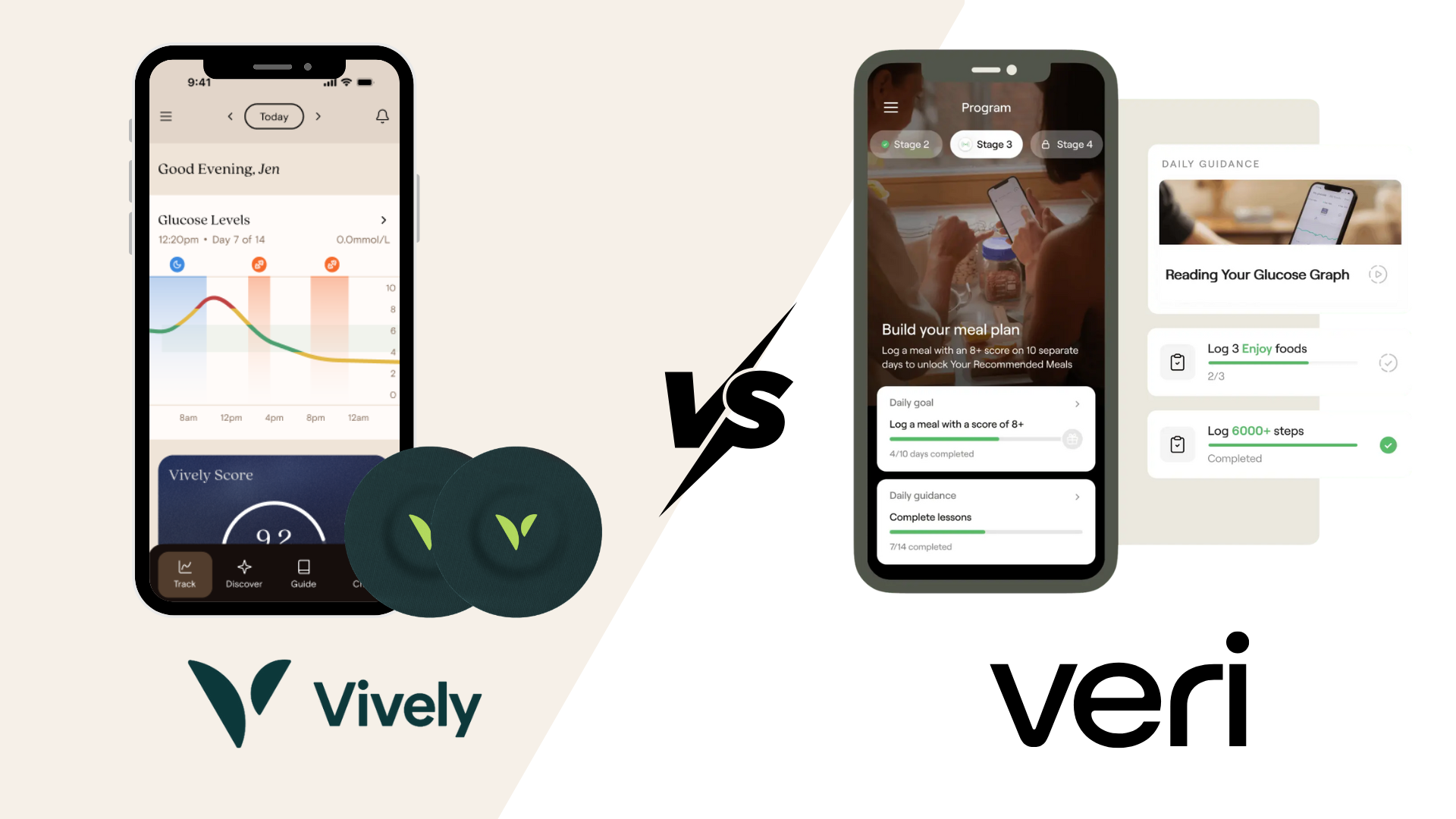
This article will explore the key distinctions and similarities between the Vively app and Veri
Vively and Veri take a similar starting point: using continuous glucose monitoring and lifestyle data to help people understand their metabolic health. Both are aimed at people who are not managing diabetes with insulin, but still want clearer insight into how food choices, exercise, sleep, and stress affect their glucose patterns. This can be useful if you are trying to lose weight, reduce glucose spikes, manage insulin resistance, or take a more proactive approach because of family history or personal risk factors.
Vively is Australian-based and Australian-owned. Veri is based in the US and ships to the UK and selected European countries. Both platforms pair a CGM with an app experience that helps users translate glucose trends into day-to-day decisions, rather than focusing purely on medical glucose management.
Vively helps members turn glucose data into practical lifestyle changes that support metabolic health, weight goals, and overall wellbeing. The program pairs a CGM sensor with the Vively app, where you can see real-time glucose trends alongside the habits that shape them most, such as meals, movement, sleep, and stress.
Vively now uses the SIBIONICS GS3 CGM sensor, which syncs more frequently and offers a smaller, more comfortable on-body experience for many users. The goal is a smoother day-to-day flow: less fuss, clearer trends, and faster feedback you can actually use.
In terms of how the program runs, each CGM is worn for a set period to give you a meaningful snapshot of your patterns. You track your glucose, review your trends and insights in the app, and use that feedback to make changes that fit your routine. Members also get access to the Vively community, and you can choose to add expert coaching if you want more personalised support and accountability.
Like Vively, Veri offers a CGM-led experience that syncs glucose data to an app, helping users evaluate meal responses and build a clearer picture of what works for their body. Veri is not currently available in Australia, but it is widely used in the US and also ships to parts of the UK and Europe.
Veri’s model is centred around membership access to the app and program features, with options to purchase CGM sensor packs as needed. Veri also describes different approaches to monitoring, including intermittent monitoring for people who prefer periodic check-ins, and a continuous monitoring plan that provides two sensors per month (covering around 28 days of tracking).
Some users appreciate the independence and clean interface, while others report confusion about how membership and add-ons work, particularly when plans are presented in multiple payment formats.
Vively is designed to feel approachable whether you want a detailed experience or something lighter-touch. You can keep logging minimal and focus on trends, or you can track more inputs for richer insights. If you want extra guidance, optional dietitian-led coaching is available to help you turn patterns into next steps and stay consistent when life gets busy.
Veri offers an intuitive, app-led experience with strong emphasis on self-guided progress. It includes in-app support and community features, and it highlights streamlined food tracking within the app. Feedback varies by user, but the most common themes tend to be around clarity of membership structure and mixed experiences with food logging accuracy.
Vively is structured around membership options that support ongoing learning, not just a one-off sensor experience. You complete a CGM period to understand patterns, then continue applying those insights in the app. Members can also purchase additional sensors if they want more check-ins throughout the year, and coaching is available as an add-on for those who want more guided support.
Veri positions its offering as a membership that provides access to the app and program features, with flexibility to buy sensor packs. It also outlines a choice between intermittent monitoring and continuous monitoring styles, depending on how frequently you want to wear a sensor and how you want to pace your learning.
Vively bundles the CGM sensor with interpretation and context as part of a structured program.
Veri’s pricing varies by region and by plan type, but current published ranges typically run from an app-only option at around $39 per month, through intermittent monitoring plans starting around $139 per month, up to continuous monitoring plans around $299 per month.
Both Vively and Veri offer data-driven tools that help people understand glucose patterns and make more informed lifestyle decisions. If you want a flexible program designed for Australians, with real-time glucose insights inside an app built around habit change and optional dietitian-led coaching, Vively is designed to support that end-to-end experience. If you prefer a more self-directed approach with membership-based access and flexible sensor purchasing, Veri offers a comparable CGM-led model for users in supported regions.
Ultimately, the best choice is the one that matches your goals, your preferred level of support, and how you want to use CGM data over time. We also encourage you to check in with your healthcare practitioner before making decisions, especially if you are managing a medical condition, are pregnant, or take medication that affects glucose.
Ready to see what your glucose can really tell you? Explore the Vively CGM sensor and start turning insights into everyday wins.
Get irrefutable data about your diet and lifestyle by using your own glucose data with Vively’s CGM Program. We’re currently offering a 20% discount for our annual plan. Sign up here.

Co-Founder & CEO
Vively is reimagining how healthcare is delivered with the world's first online holistic healthcare clinic.


Discover how controlling your glucose levels can aid in ageing gracefully. Learn about the latest research that links glucose levels and ageing, and how Vively, a metabolic health app, can help you manage your glucose and age well.


Delve into the concept of mindful eating and discover its benefits, including improved glucose control and healthier food choices. Learn about practical strategies to implement mindful eating in your daily life.


Understand the nuances of polycystic ovary syndrome (PCOS) testing in Australia, the importance of early diagnosis, and the tests used to effectively diagnose the condition. Also, find out when these diagnostic procedures should be considered.
.png)

Vively is a general wellness platform and does not provide medical advice, diagnosis, or treatment. Any information, insights or guidance offered through our app, website, programs, or coaches is for educational and informational purposes only and should not be considered a substitute for professional medical advice or care. Always consult a qualified healthcare provider before making any health-related decisions.
We acknowledge the Traditional Custodians of the lands where we live and work, the Gadigal of the Eora Nation. We pay our respects to their Elders past and present.
 Share
Share Tweet
Tweet Share
Share