
What a CGM adds for clients without diabetes
Blood tests give you snapshots. Fasting glucose is one moment, and HbA1c is an average over the last two to three months. Neither shows what happens after your client's breakfast, how long a rise takes to come down, or what glucose does overnight.
A 14-day continuous glucose monitor (CGM) records glucose every few minutes, day and night. Your client logs meals, activity and sleep in the Vively app, so each reading sits next to what they were doing. That turns general advice ("add protein to breakfast", "walk after dinner") into something your client can test on their own body and see for themselves.
It works best alongside blood tests. Early insulin resistance usually shows first in fasting insulin and HOMA-IR, years before glucose or HbA1c leave the lab range (Tabák et al., 2009). And people with normal standard tests can still have frequent glucose rises into the prediabetes range after meals (Hall et al., 2018). See how to read insulin resistance in blood tests for the markers and ranges.
Which clients it suits
A CGM is most useful when you and your client have a clear question the data can answer. It often suits clients who:
- have early signs in their bloods, such as fasting insulin above 5 mIU/L, HOMA-IR above 1.0, or an HbA1c creeping up inside the lab range
- have PCOS, a family history of type 2 diabetes, or had gestational diabetes in a past pregnancy
- report energy dips, hunger or cravings a few hours after meals and want to see whether glucose follows the same pattern
- want to test specific foods, meal timing or meal order rather than follow a general plan
- respond well to numbers and feedback
Think twice, or check with the client's doctor first, if your client:
- has a history of disordered eating, or tends to become anxious about numbers. A curve after every meal can feed restriction.
- has diabetes or takes insulin or glucose-lowering medicine. Their GP or diabetes team manages glucose monitoring, and Vively's CGM program is designed for people without diabetes.
- is pregnant or has a medical condition that affects glucose
- has reacted to medical adhesives before
A CGM shows patterns. It doesn't diagnose or treat diabetes, insulin resistance or any other condition. Always follow the directions for use.
A 14-day plan you can run with a client
Before the sensor. Agree on one or two questions, for example "Which of my usual breakfasts keeps me steadiest?" or "Does a walk after dinner change my evening rise?" If you don't have recent bloods, add the Baseline Health Check to the same referral. It includes HbA1c and fasting glucose, plus fasting insulin and HOMA-IR when the GP includes fasting insulin.
Days 1 to 3: eat as usual. Your client applies the sensor, pairs it with the Vively app and logs every meal with a photo. Ask them not to change anything yet. These days show their normal pattern. Readings can be less steady in the first day while the sensor settles.
Days 4 to 10: test one change at a time. Run each test on at least two days, because one day can mislead. Useful tests include:
- the same breakfast with and without extra protein or fibre
- vegetables and protein first, carbohydrate last
- a 10 to 15 minute walk after the evening meal
- an earlier dinner against a later one
- a usual snack against a swap you've suggested
The glucose spikes guide shows how 38 everyday foods affected Vively members' glucose, which can help you pick what to test.
Days 11 to 14: repeat what worked. Your client keeps the changes that helped and notes days with poor sleep, illness, alcohol, hard training or stress, since all of these move glucose.
Review consult. Open the client's Glucose page together. Agree on one or two changes to keep, not a long list. A second sensor after about 10 to 12 weeks shows whether the changes held.
How to order a CGM for a client through Vively
- Get access. Request practitioner access. It's free for verified practitioners, with no subscription.
- Refer one to four sensors. Each Sibionics GS3 sensor lasts 14 days, so four sensors give up to eight weeks. Refer the CGM on its own or with pathology such as the Baseline Health Check. CGM prices show in your account once you're verified, and your client or your practice can pay.
- Vively handles the device. We dispatch the sensor and a protective patch by Australia Post within 1 to 2 business days of payment, guide your client through setup and pairing, and arrange a replacement if a sensor fails.
- Your client shares their data with you. At checkout your client agrees to share their results with you. Their glucose, meals and activity then appear in their client record under Glucose.
Your client stays your client. They get no Vively marketing emails or texts, and no Vively dietitian offers or upgrade prompts in the app. A CGM bought through Vively doesn't need a prescription or a doctor's referral. Pathology is different: a GP in Vively's network signs off each pathology request you refer.
What the CGM report shows
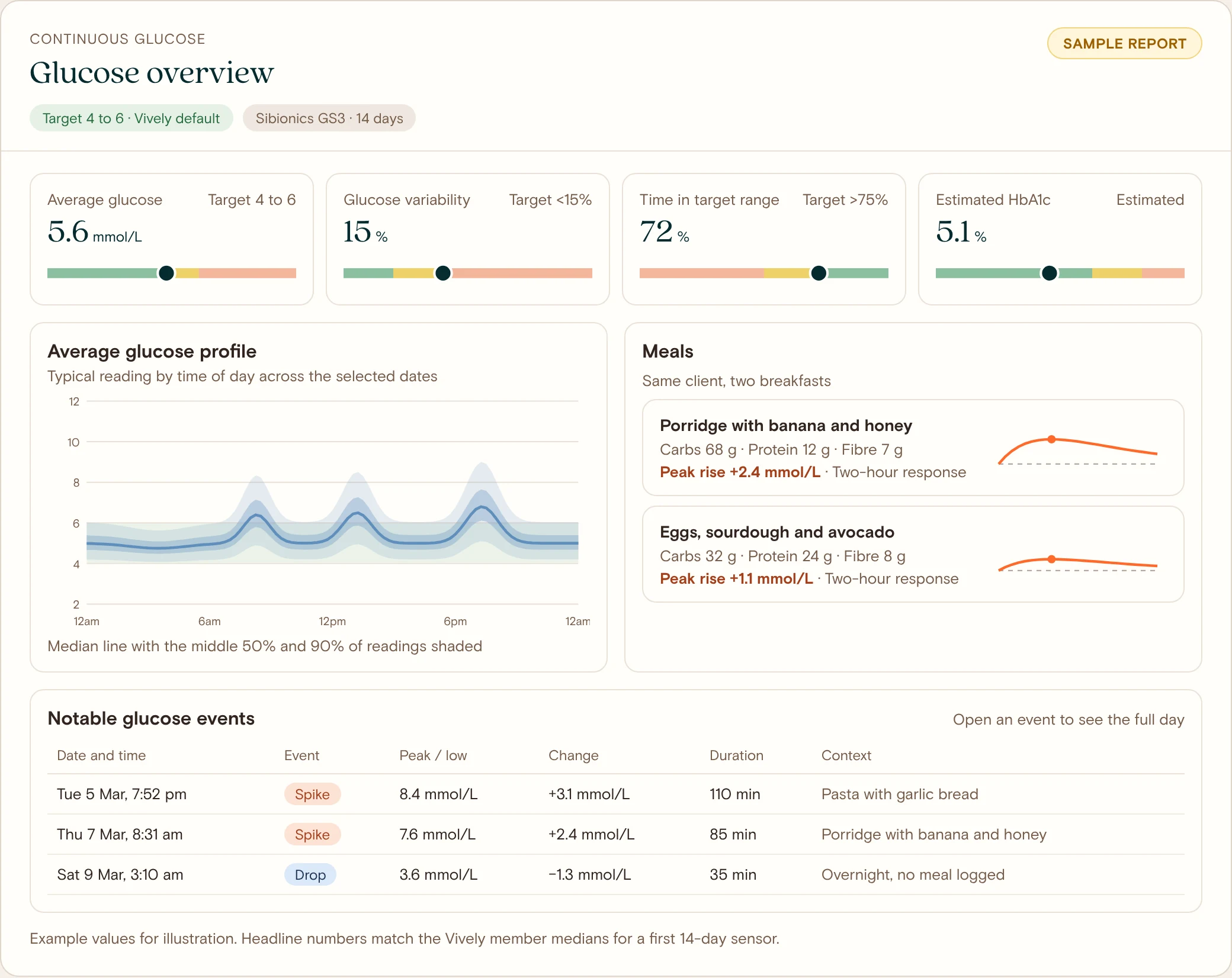
Each client's Glucose page in the Vively platform starts with four numbers, each on a range bar:
- Average glucose in mmol/L across the selected dates
- Time in target range: the share of readings inside the target. Vively's default target is 4 to 6 mmol/L, with a goal of 75% or more of readings. You can set a different target for any client, and it updates in their app too.
- Glucose variability: the coefficient of variation (standard deviation divided by the average). Lower means steadier glucose. The platform target is below 15%.
- Estimated HbA1c, calculated from average glucose. It's an estimate, not a lab result.
Below those you'll find the average glucose profile (a typical day by time of day), notable glucose events (the biggest spikes and drops, each with its peak, change from baseline, duration and what your client logged), and a Meals list. For each logged meal, the platform shows the two-hour glucose response and the peak rise above the client's average over the four hours before eating.
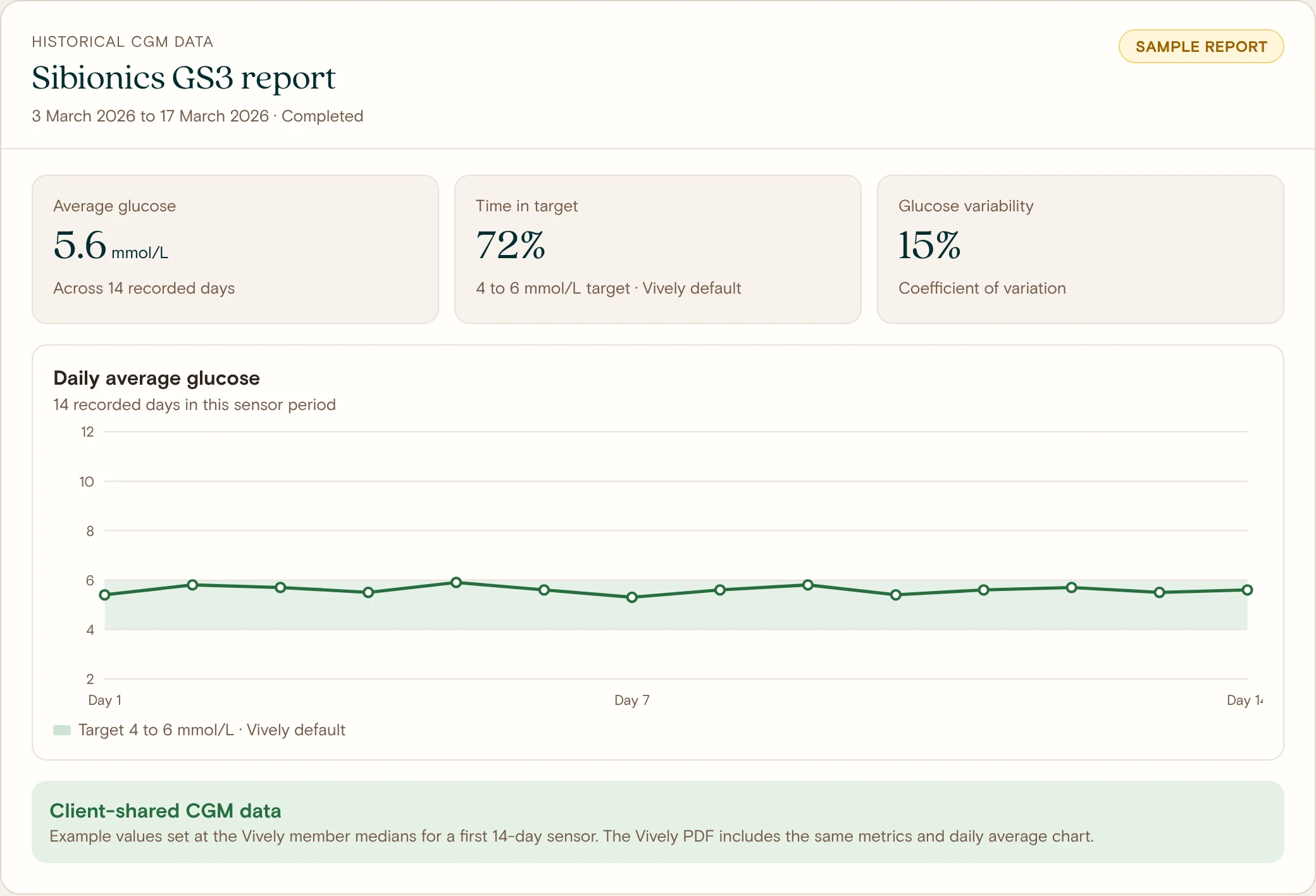
When a sensor period is complete, you can export a practitioner report as a PDF and compare two to four sensor periods lined up by sensor day. For a step-by-step walkthrough of each screen, see how to read a 14-day CGM report.
A note on targets: published CGM targets are written for people with diabetes. The international consensus uses 3.9 to 10 mmol/L and aims for more than 70% of readings in that range (Battelino et al., 2019). Vively's 4 to 6 mmol/L default is a narrower educational target, so its time in range figure isn't comparable with those numbers.
What a first sensor looks like: Vively member data
To give you a reference point, we looked at the first 14-day sensor of 8,409 Vively members who have not told us they have type 2 diabetes. You can compare a new client's first report against these numbers.
| Measure (first 14-day sensor) | Median | Middle 50% of members |
|---|---|---|
| Average glucose | 5.6 mmol/L | 5.3 to 5.9 mmol/L |
| Time in 4 to 6 mmol/L | 72% | 61% to 81% |
| Glucose variability (CV) | 15% | 13% to 18% |
| Readings above 7.8 mmol/L | 2% | 1% to 4% |
| Readings below 3.9 mmol/L | 1% | 0% to 2% |
What this means for your clients:
- 44% of members reached the 75% time in range goal on their first sensor, and 87% had at least half their readings between 4 and 6 mmol/L. A first result of 60% is in the bottom quarter, not unusual.
- 90% had variability of 20% or less. A client well above 20% is worth a closer look at meals, sleep and training days.
- About 1 in 4 members (24%) spent 5% or more of their readings above 7.8 mmol/L, which is about 70 minutes a day on average.
- 16% had 4% or more of readings below 3.9 mmol/L. In people without diabetes, low readings often come from lying on the sensor overnight, so check the time and context before treating a low as real. For comparison, healthy adults in a US study spent about 96% of the day between 3.9 and 7.8 mmol/L (Shah et al., 2019).
How we calculated this: each member's first completed 14-day sensor from January 2024 to September 2026, with at least 10 days of readings (FreeStyle Libre 2 Plus and Sibionics GS3). Members who told us they have type 2 diabetes, and staff and test accounts, are left out. We report medians and the middle 50%, never single results. Members chose to use a CGM with Vively, so they aren't a cross-section of Australia. More on our methods at how we use member data.
Three common first-sensor patterns
These profiles are built from the member figures above (the 25th, 50th and 75th percentiles), not from individual clients. They show how you might talk through a first report.
| Pattern | Average glucose | Time in 4 to 6 | Variability | Where to start |
|---|---|---|---|---|
| Steady | 5.3 mmol/L | 81% | 13% | Confirm what's working and look at the few largest rises. Is there one meal or one late night behind most of them? |
| Typical | 5.6 mmol/L | 72% | 15% | Pick the two meals with the biggest peak rise and test one swap each, such as more protein or fibre, or a walk afterwards. |
| Worth a closer look | 5.9 mmol/L | 61% | 18% | Check sleep, training and stress days first, then evening meals. If fasting insulin or HOMA-IR is also high, plan a retest of bloods. |
Talking to clients about their numbers
- A rise after a carbohydrate meal is expected. How high it goes and how quickly it comes back matter more than whether it rises at all.
- Look for patterns across days. One high reading after one meal tells you little. A rise that repeats with the same food or the same time of day is worth acting on.
- Keep food whole. Use the data to change portions, pairings and timing, not to cut out whole food groups.
- Readings run a little behind blood. A CGM measures glucose in the fluid around cells, so it lags blood glucose by several minutes and can differ from a finger prick.
- Know when to refer. A CGM can't diagnose diabetes. If readings sit high (for example, waking glucose of 7 mmol/L or more on several mornings, or frequent readings above 11 mmol/L), refer your client to their GP for blood tests. See blood results to refer back to the GP.
Keep learning: Masterclass, course and videos
The Vively Practitioner Masterclass, Part 1 works through early insulin resistance in "normal" bloods with an example client, and Part 2 covers thyroid, hormones and perimenopause. Verified practitioners also get the metabolic health essentials course in the platform's Guides, with a module on CGM use cases.
The featured video on this page is a Vively fireside chat on metabolic health for practitioners. These two go further into glucose:
Metabolic health and glucose responses
Personalised interpretation of sensor data
CPD: some professional associations accept extra education towards CPD. Masterclass sessions can count if you give your association evidence of completion. They are not formally accredited CPD.
Can dietitians and nutritionists order a CGM for clients without diabetes?
Yes. Through Vively, verified dietitians, nutritionists and naturopaths can refer one to four Sibionics GS3 sensors for a client, on their own or with blood tests. Vively posts the sensor within 1 to 2 business days, supports setup and shares the data with you once your client agrees.
Does my client need a prescription or GP referral for a CGM?
No. A CGM bought through Vively doesn't need a prescription or a doctor's referral. Pathology is different: a GP in Vively's network signs off each pathology request you refer.
What glucose range should I use for clients without diabetes?
Vively's default target is 4 to 6 mmol/L, with a goal of 75% or more of readings in range. The international consensus range of 3.9 to 10 mmol/L was written for people with diabetes. You can set a different target for any client in the platform, and it updates in their app.
What is a normal time in range for someone without diabetes?
On their first 14-day sensor, the median Vively member without type 2 diabetes had 72% of readings between 4 and 6 mmol/L, and the middle half ranged from 61% to 81%. 44% reached 75% or more.
How long should a client wear a CGM?
One sensor lasts 14 days, which is enough to see a usual pattern and test a few changes. You can refer up to four sensors for up to eight weeks of data. A second sensor after 10 to 12 weeks shows whether changes held.
Is a CGM accurate enough for people without diabetes?
It's accurate enough to show patterns. A CGM measures glucose in the fluid around cells, so it runs several minutes behind blood glucose, can be less steady on the first day, and can read falsely low when someone lies on the sensor overnight. Read trends across days rather than single readings.
Can a CGM diagnose insulin resistance or prediabetes?
No. A CGM shows day-to-day glucose patterns but doesn't diagnose any condition. Insulin resistance shows in fasting insulin and HOMA-IR, and prediabetes and diabetes are diagnosed with blood tests ordered by a doctor.
How much does a CGM cost through Vively?
CGM prices show in your practitioner account once you're verified. Your client sees the price before paying, or your practice can pay.
- Battelino T, Danne T, Bergenstal RM, et al. Clinical targets for continuous glucose monitoring data interpretation: recommendations from the International Consensus on Time in Range. Diabetes Care. 2019;42(8):1593-1603.
- Shah VN, DuBose SN, Li Z, et al. Continuous glucose monitoring profiles in healthy nondiabetic participants: a multicenter prospective study. Journal of Clinical Endocrinology and Metabolism. 2019;104(10):4356-4364.
- Hall H, Perelman D, Breschi A, et al. Glucotypes reveal new patterns of glucose dysregulation. PLOS Biology. 2018;16(7):e2005143.
- Tabák AG, Jokela M, Akbaraly TN, et al. Trajectories of glycaemia, insulin sensitivity, and insulin secretion before diagnosis of type 2 diabetes: an analysis from the Whitehall II study. Lancet. 2009.
- Vively member data: first 14-day sensor of 8,409 members without self-reported type 2 diabetes, January 2024 to September 2026. Method at vively.com.au/our-data.