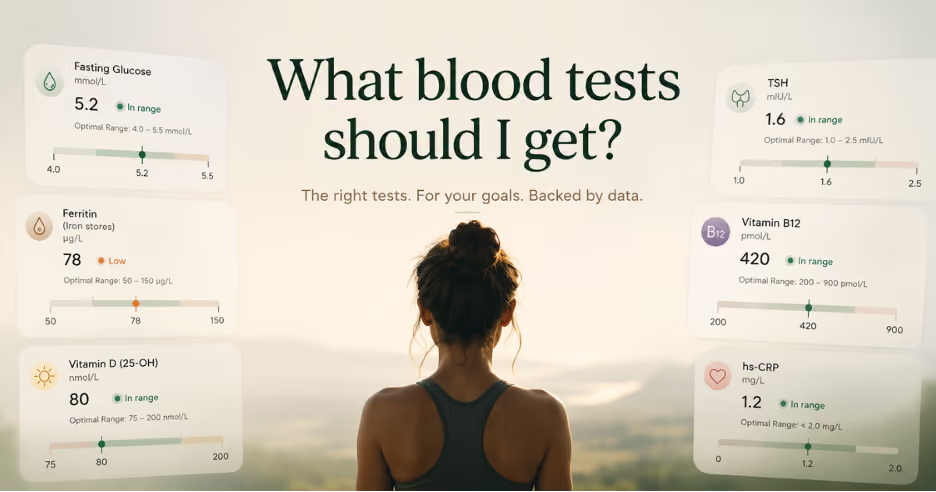










Most people read blood test results in a simple way.
A result is marked either high or low. If nothing is flagged, it is assumed that everything is fine.
That is understandable, but more insights can be extracted.
Blood test results are not just a list of numbers. They are signals. The real value comes from understanding what the markers mean together, how they relate to your health risk, and whether they are changing over time.
A single result can be useful. A pattern is better. A trajectory is better again.
That is how Vively thinks about blood testing.
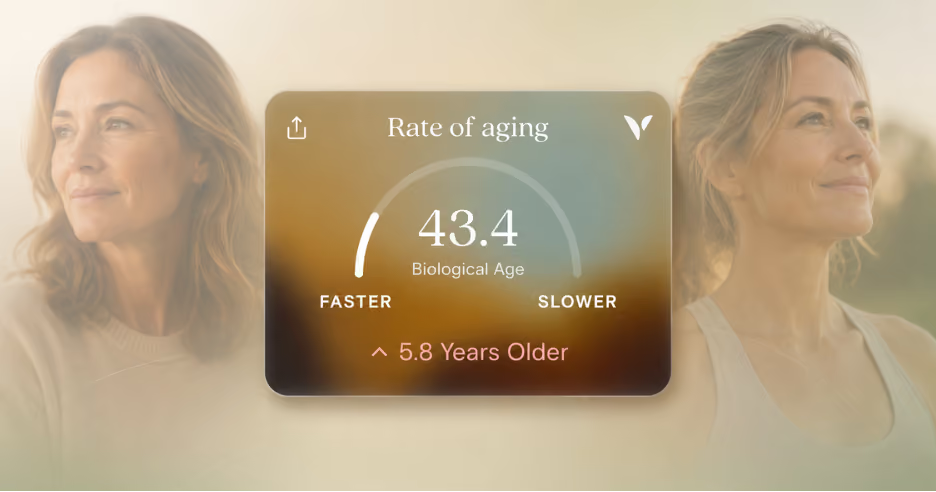
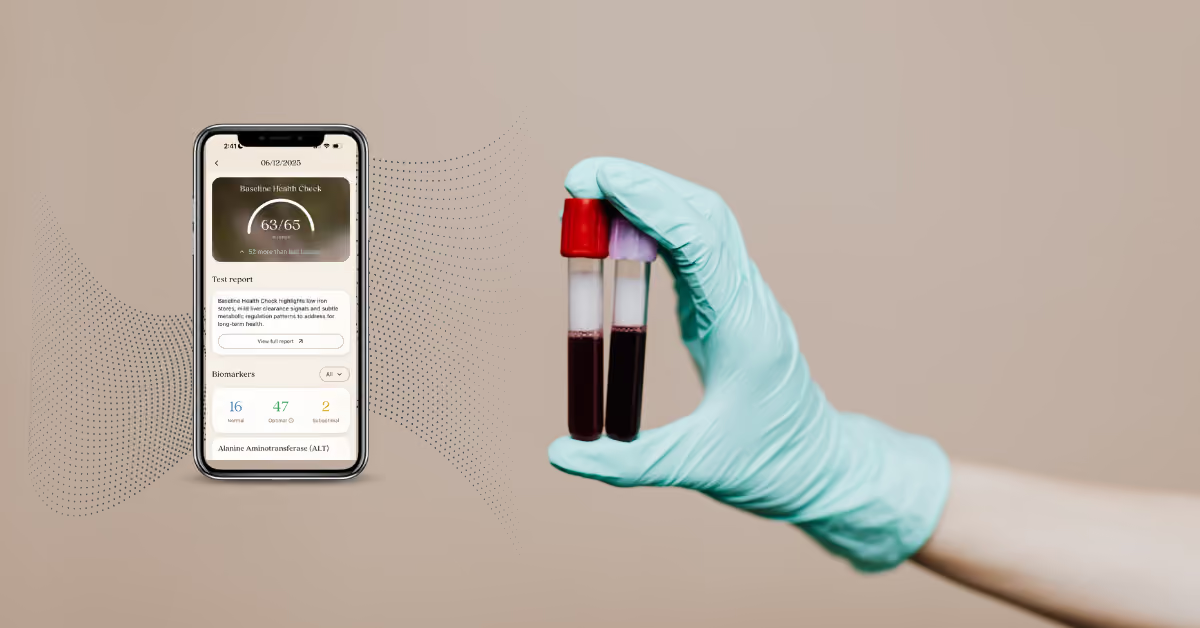
Vively’s Baseline Health Check checks 70+ key markers across 10 key health areas, including metabolic health, inflammation, heart health, liver health, kidney health, blood health, thyroid, nutrients and biological age. Your results are reviewed using optimal ranges, not just standard reference ranges, and turned into a personalised plan with support from your Vively health team.
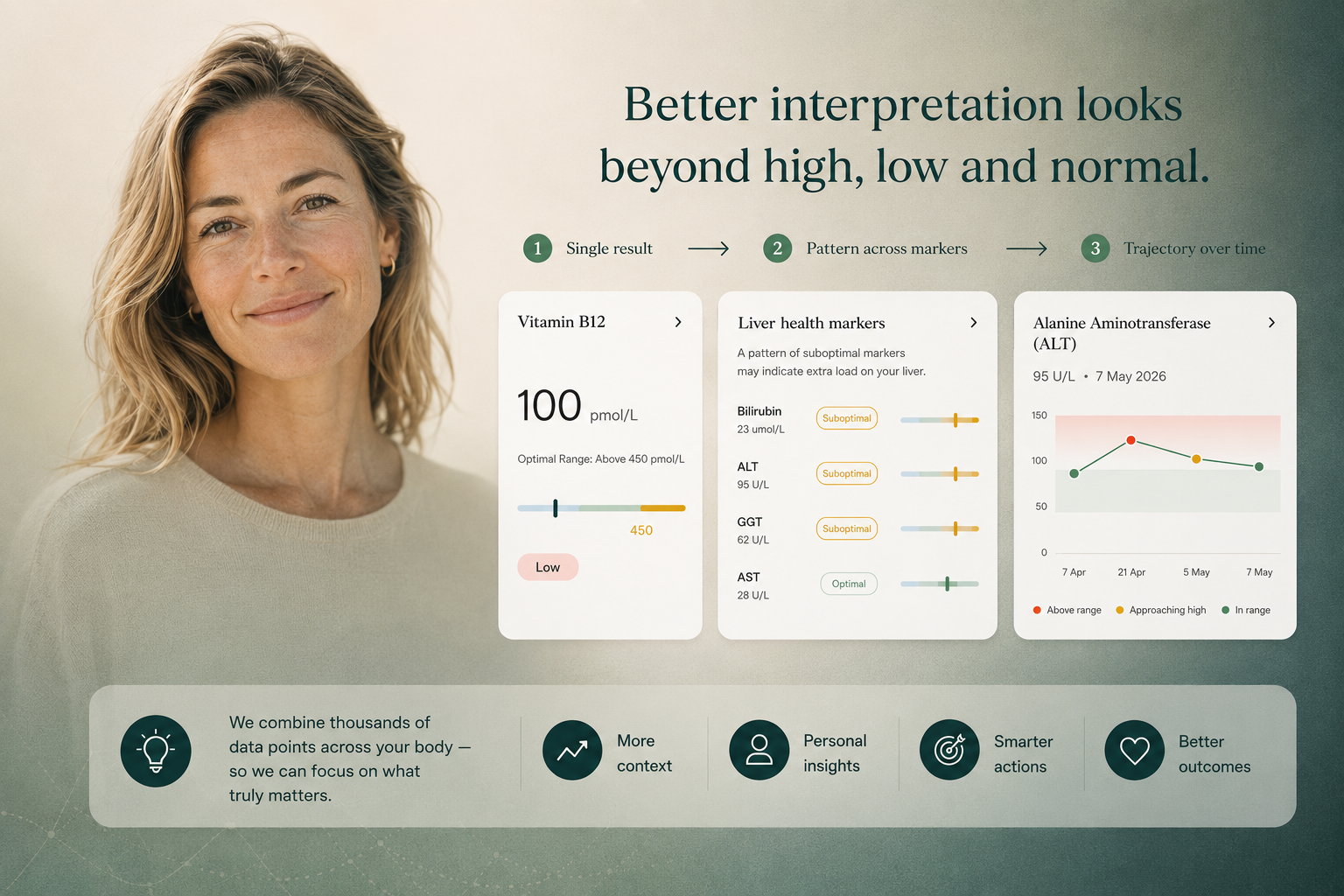
A blood test result does not mean much without context.
The same number can mean different things depending on your:
Healthdirect Australia says blood test results only have meaning in the context of the reason for the test, your age and sex, overall health, lifestyle, and any treatments or medicines you are taking.
That is why blood tests should not be read in isolation.
For example, ferritin can be low because of low iron intake, blood loss, heavy periods or poor absorption. It can also be high because of inflammation, infection, liver stress, metabolic dysfunction or iron overload.
ALT can rise because of fatty liver, alcohol, medication, supplements, viral illness, intense exercise or other liver stress.
CRP can rise after infection, injury, dental issues, autoimmune activity, poor sleep or metabolic inflammation.
The better question is not, “Is this marker normal?”
The better question is, “What does this result mean in my context?”
Most blood test reports compare your result to a laboratory reference range.
A reference range helps show whether your result is unusually high or low compared with a reference population. Pathology Tests Explained describes reference intervals as a way of comparing test results with what is considered normal for the general population, and notes that being outside the range does not automatically mean you are unwell.
Reference ranges are useful. They help doctors identify results that may need medical review, repeat testing or treatment.
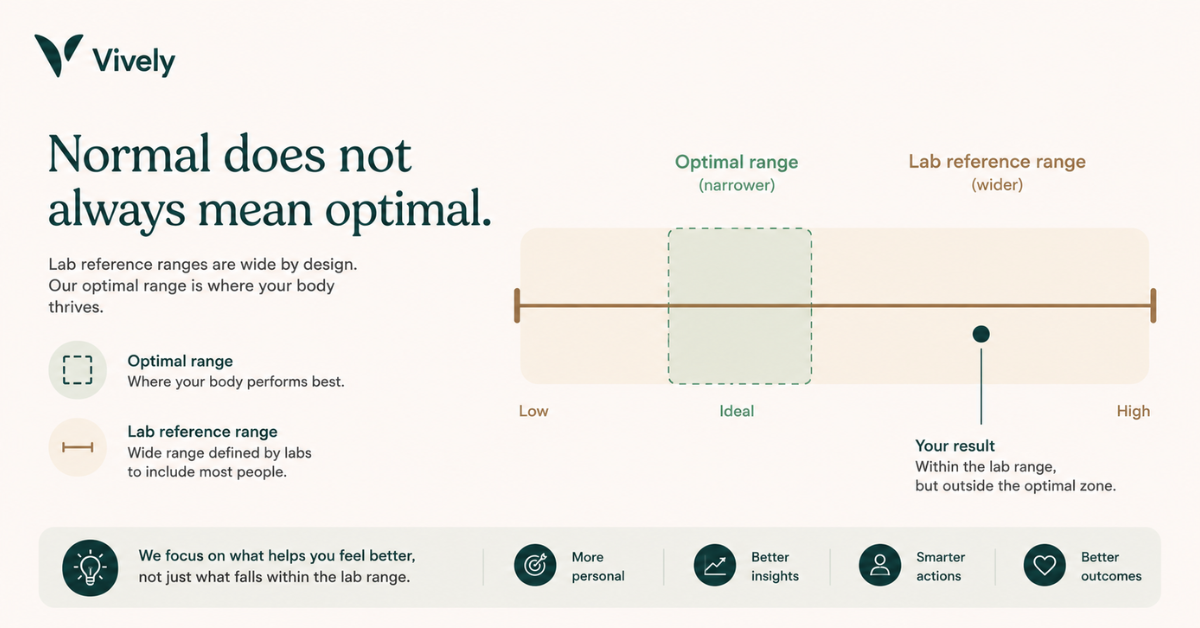
But reference ranges are not the same as optimal health.
Reference intervals are often based on the central 95% of values from a reference population. That means some healthy people will naturally fall outside the range, and some people inside the range may still have markers that are not ideal for their goals or health trajectory.
A standard blood test report is usually designed to identify clear abnormality.
That is important for medical care.
But many people are not only trying to rule out disease. They want to understand why they feel tired, why they are gaining weight, why their recovery is poor, why they feel “inflamed”, why their hormones feel different, are they doing all they can to prevent chronic disease or whether they are ageing well.
For that, “normal” may not be enough.
.png)
This is why Vively uses optimal ranges.
Optimal ranges are not diagnostic thresholds. They help identify what may be worth improving, how lifestyle change can help, what should be monitored and what may need medical review.
The goal is not to panic over every result. The goal is to understand what healthy looks like for you now and over the long term.
The biggest shift is to not only read blood results marker by marker, but to understand how they work as a system.
Your body does not work in separate columns.
Markers cluster into systems.
Look at these markers together:
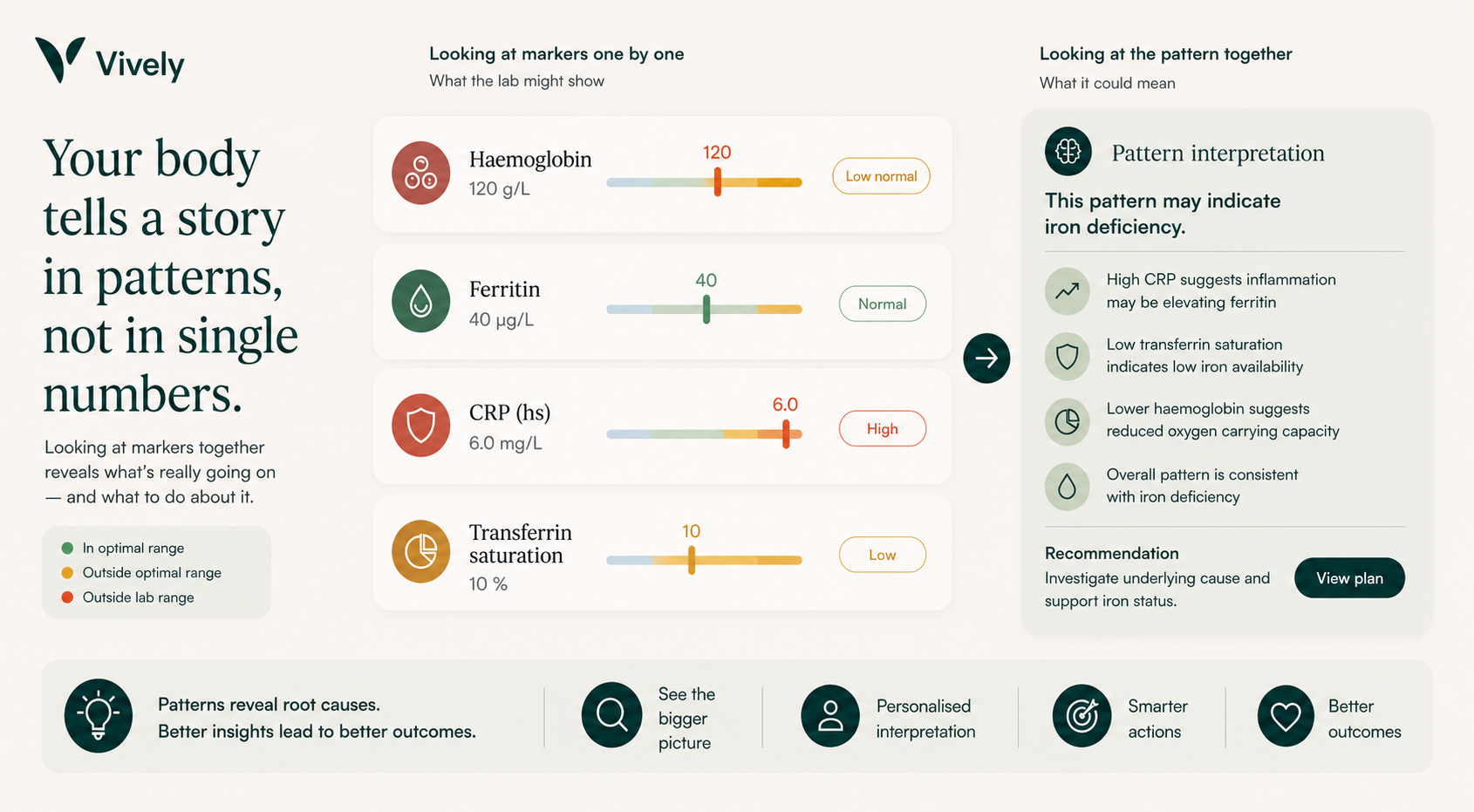
Ferritin alone is not enough. Low ferritin can suggest low iron stores. High ferritin can suggest inflammation, infection, liver stress or possible iron overload. Haemoglobin helps show whether iron status is affecting oxygen transport. CRP helps show whether inflammation may be affecting ferritin interpretation.

Look at these markers together:
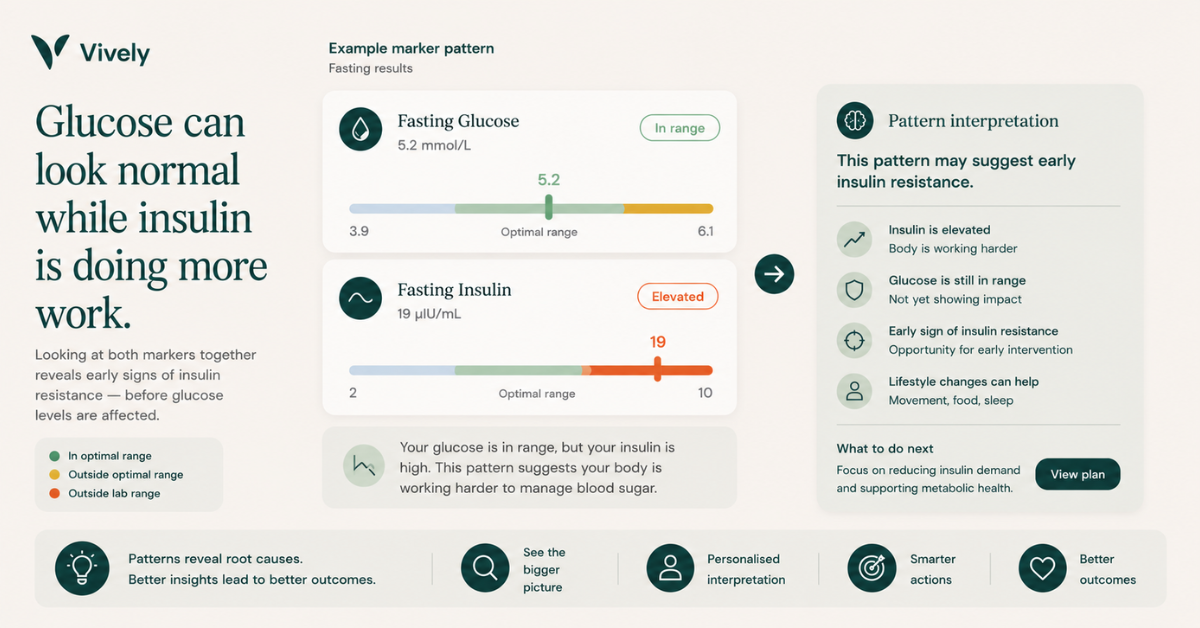
Fasting glucose and HbA1c are useful. But they may not show early insulin resistance. Fasting insulin can rise before glucose becomes abnormal because the body is producing more insulin to keep glucose controlled.
That is why someone can be told their glucose is fine while still having metabolic strain.
.png)
Relevant Vively links:
Look at these markers together:
Cholesterol is not one number. The pattern matters.
LDL may matter differently depending on ApoB, triglycerides, HDL, inflammation, blood pressure, insulin resistance, smoking status and family history.

Look at these markers together:
Liver markers can shift with fatty liver, alcohol, medications, supplements, intense exercise and metabolic dysfunction.
One mildly elevated result may not tell the full story. A rising pattern is often more useful.

This content is for educational purposes only and is not medical advice. The descriptors and examples are simplified and are not intended to represent a complete or exhaustive list.
Look at these markers together:
TSH is a useful starting point. It is not always the full thyroid picture.
Thyroid function should be interpreted with symptoms, nutrient status, medications, pregnancy status, cycle changes, stress and broader health context.

Look at these markers together:
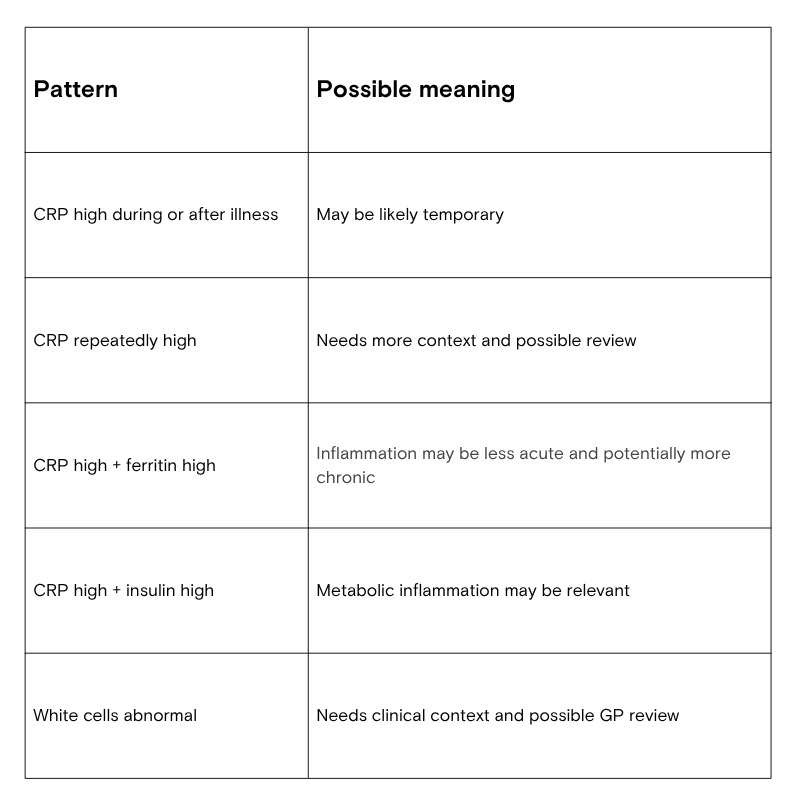
CRP is non-specific. It can rise for many reasons. The point is not to diagnose the cause from CRP alone. The point is to decide whether inflammation is temporary, persistent or part of a broader pattern.
One result is a snapshot.
Several results over time show your trajectory.
This is where the most useful insight often appears, especially when you are trying to prevent chronic disease. A marker can be technically normal but moving in the wrong direction.

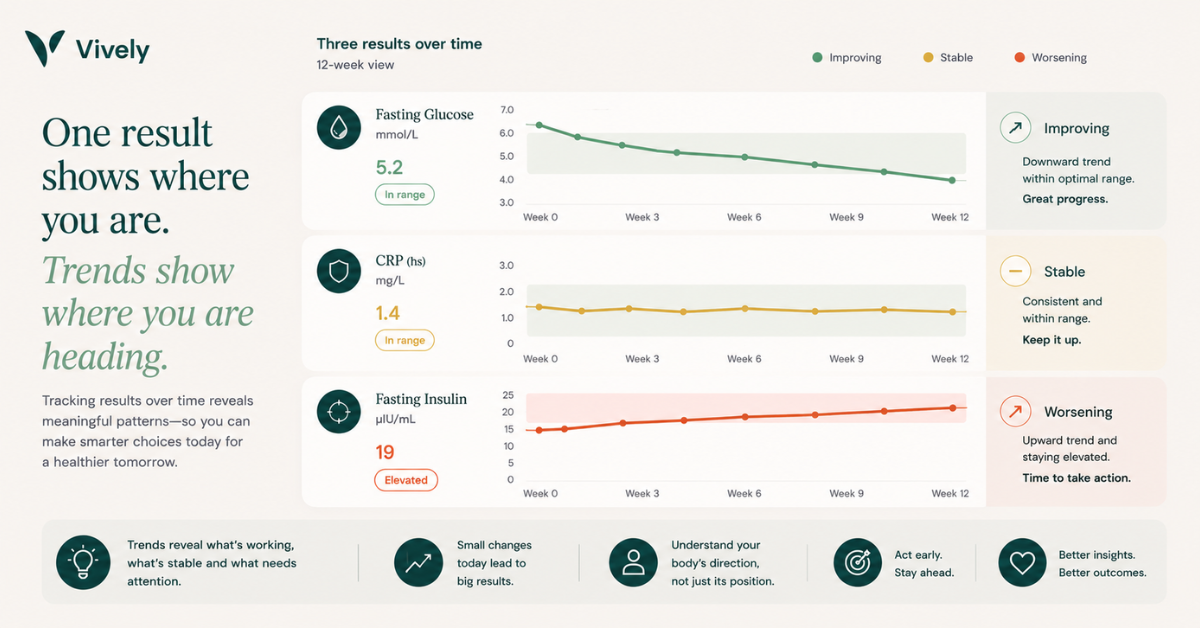
This is why Vively is built around ongoing tracking, not just one-off testing. Your Baseline Health Check gives you a starting point. The Vively platform tracks meals, workouts, sleep, stress and wearable data. Your dietitian can see shared context and help you understand what is changing.
A good blood test report should not just give you a long list of markers.
It should group them into health areas.
Vively’s Baseline Health Check reviews 70+ markers across 10 key health areas. A practical way to read your results is to group them like this:

The RCPA notes that individual pathology results should be assessed using the reference intervals quoted by the pathology laboratory performing the test, because differences can occur between laboratories.
That is one reason Vively interpretation uses the lab result, the optimal range, the broader pattern and your clinical context.
An abnormal result does not always mean something serious.
It means the result needs context.
Pathology Tests Explained notes that results outside a reference interval do not automatically mean you are unwell and may not mean anything in your personal situation.
There are many reasons a result may be temporarily out of range:
The right response is interpretation, not panic.
Ask:
The reverse is also true.
A normal result does not automatically mean everything is optimal.
A marker can be normal but still worth improving if it is:
Examples:

This is the difference between reactive testing and preventative testing.
Reactive testing asks, “Is it bad enough to flag?”
Preventative testing asks, “Is this the direction we want?”
Blood results become more useful when they are connected to your daily life. Education leads to motivation and accountability – this is the hallmark of prevention.
Your meals, workouts, sleep, stress, cycle, alcohol, supplements and symptoms can all help explain your markers.

This is why Vively tracks the behaviours that shape your results, including meals, workouts, sleep, stress and wearable data. Your health team can review shared context instead of looking at your blood test in isolation.

Vively does not just show you a PDF.
It helps you understand what matters.
With Vively’s Baseline Health Check, your results are reviewed across 70+ markers and 10 key health areas. You see where results sit against optimal ranges, how they connect to biological age and what patterns are worth acting on.
Your dietitian review helps explain the results in context. Your dietitian support helps turn the results into practical nutrition and lifestyle recommendations.
Your personalised plan can include:
You can also add specialty tests when deeper insight is needed, including hormone, nutrient, stress and CGM programs.
The point is not to collect more data.
The point is to turn data into action.
Blood test results can help you understand your health, but they do not replace medical care.
Speak with a GP or qualified healthcare professional if you have:
Vively supports preventative health and health optimisation. It does not replace your GP, emergency care or specialist medical advice.
Do not stop at high, low or normal.
Read your results in five steps.

The goal is not to chase perfect numbers.
The goal is to understand what healthy looks like for you, what is changing and what to do next.
That is what Vively is built to help you do.
It means your result is higher or lower than the laboratory reference interval. It does not automatically mean you are seriously unwell. The result needs clinical context, including symptoms, medical history, medications, recent illness, exercise, diet and previous results.
Yes. A blood test can be normal while you still have symptoms or early patterns that are worth reviewing. Some markers are only useful when viewed with other markers, symptoms and trends over time.
A reference range helps identify results that are unusually high or low compared with a reference population. An optimal range helps identify where a marker may sit for better energy, metabolism, recovery and long-term prevention. Optimal ranges are not diagnostic thresholds and should be interpreted in context.
Vively uses optimal ranges to help members understand which markers may be worth improving before they become clearly abnormal. This helps support prevention, personalisation and trend tracking.
Trends show whether your markers are improving, worsening or staying stable. A single result is a snapshot. A trajectory gives more useful information, especially for markers like fasting insulin, HbA1c, ferritin, ALT, GGT, CRP, vitamin D and cholesterol.
Not always. One abnormal result may be temporary or explainable. It should be reviewed in context. Very abnormal results, persistent abnormalities or results linked to serious symptoms should be reviewed by a doctor.
Vively reviews your results across 70+ markers, optimal ranges, biological age and key health areas. Your dietitian can use shared clinical context, app data and your goals to help build a personalised plan.
No. Vively does not replace your GP. Vively supports preventative health, personalised insights and behaviour change. You should still see your GP for diagnosis, treatment, prescriptions, urgent symptoms and medical conditions.
Disclaimer: This information is for educational purposes only and does not constitute medical advice. It should not be relied upon as a substitute for professional medical advice, diagnosis, or treatment. The descriptors and examples provided are simplified for educational purposes and are not intended to be exhaustive or comprehensive.
START YOUR BASELINE
Most of what we write about here shows up in your blood work. A Vively Baseline Health Check covers 70+ biomarkers, with every result explained in plain English. $99 to start your membership.
Get my baseline · $99Subscribe to our newsletter & join a community of 30,000+ Aussies
Most people read blood test results in a simple way.
A result is marked either high or low. If nothing is flagged, it is assumed that everything is fine.
That is understandable, but more insights can be extracted.
Blood test results are not just a list of numbers. They are signals. The real value comes from understanding what the markers mean together, how they relate to your health risk, and whether they are changing over time.
A single result can be useful. A pattern is better. A trajectory is better again.
That is how Vively thinks about blood testing.
Vively’s Baseline Health Check checks 70+ key markers across 10 key health areas, including metabolic health, inflammation, heart health, liver health, kidney health, blood health, thyroid, nutrients and biological age. Your results are reviewed using optimal ranges, not just standard reference ranges, and turned into a personalised plan with support from your Vively health team.
A blood test result does not mean much without context.
The same number can mean different things depending on your:
Healthdirect Australia says blood test results only have meaning in the context of the reason for the test, your age and sex, overall health, lifestyle, and any treatments or medicines you are taking.
That is why blood tests should not be read in isolation.
For example, ferritin can be low because of low iron intake, blood loss, heavy periods or poor absorption. It can also be high because of inflammation, infection, liver stress, metabolic dysfunction or iron overload.
ALT can rise because of fatty liver, alcohol, medication, supplements, viral illness, intense exercise or other liver stress.
CRP can rise after infection, injury, dental issues, autoimmune activity, poor sleep or metabolic inflammation.
The better question is not, “Is this marker normal?”
The better question is, “What does this result mean in my context?”
Most blood test reports compare your result to a laboratory reference range.
A reference range helps show whether your result is unusually high or low compared with a reference population. Pathology Tests Explained describes reference intervals as a way of comparing test results with what is considered normal for the general population, and notes that being outside the range does not automatically mean you are unwell.
Reference ranges are useful. They help doctors identify results that may need medical review, repeat testing or treatment.
But reference ranges are not the same as optimal health.
Reference intervals are often based on the central 95% of values from a reference population. That means some healthy people will naturally fall outside the range, and some people inside the range may still have markers that are not ideal for their goals or health trajectory.
A standard blood test report is usually designed to identify clear abnormality.
That is important for medical care.
But many people are not only trying to rule out disease. They want to understand why they feel tired, why they are gaining weight, why their recovery is poor, why they feel “inflamed”, why their hormones feel different, are they doing all they can to prevent chronic disease or whether they are ageing well.
For that, “normal” may not be enough.
This is why Vively uses optimal ranges.
Optimal ranges are not diagnostic thresholds. They help identify what may be worth improving, how lifestyle change can help, what should be monitored and what may need medical review.
The goal is not to panic over every result. The goal is to understand what healthy looks like for you now and over the long term.
The biggest shift is to not only read blood results marker by marker, but to understand how they work as a system.
Your body does not work in separate columns.
Markers cluster into systems.
Look at these markers together:
Ferritin alone is not enough. Low ferritin can suggest low iron stores. High ferritin can suggest inflammation, infection, liver stress or possible iron overload. Haemoglobin helps show whether iron status is affecting oxygen transport. CRP helps show whether inflammation may be affecting ferritin interpretation.
Look at these markers together:
Fasting glucose and HbA1c are useful. But they may not show early insulin resistance. Fasting insulin can rise before glucose becomes abnormal because the body is producing more insulin to keep glucose controlled.
That is why someone can be told their glucose is fine while still having metabolic strain.
Relevant Vively links:
Look at these markers together:
Cholesterol is not one number. The pattern matters.
LDL may matter differently depending on ApoB, triglycerides, HDL, inflammation, blood pressure, insulin resistance, smoking status and family history.
Look at these markers together:
Liver markers can shift with fatty liver, alcohol, medications, supplements, intense exercise and metabolic dysfunction.
One mildly elevated result may not tell the full story. A rising pattern is often more useful.
This content is for educational purposes only and is not medical advice. The descriptors and examples are simplified and are not intended to represent a complete or exhaustive list.
Look at these markers together:
TSH is a useful starting point. It is not always the full thyroid picture.
Thyroid function should be interpreted with symptoms, nutrient status, medications, pregnancy status, cycle changes, stress and broader health context.
Look at these markers together:
CRP is non-specific. It can rise for many reasons. The point is not to diagnose the cause from CRP alone. The point is to decide whether inflammation is temporary, persistent or part of a broader pattern.
One result is a snapshot.
Several results over time show your trajectory.
This is where the most useful insight often appears, especially when you are trying to prevent chronic disease. A marker can be technically normal but moving in the wrong direction.
This is why Vively is built around ongoing tracking, not just one-off testing. Your Baseline Health Check gives you a starting point. The Vively platform tracks meals, workouts, sleep, stress and wearable data. Your dietitian can see shared context and help you understand what is changing.
A good blood test report should not just give you a long list of markers.
It should group them into health areas.
Vively’s Baseline Health Check reviews 70+ markers across 10 key health areas. A practical way to read your results is to group them like this:
The RCPA notes that individual pathology results should be assessed using the reference intervals quoted by the pathology laboratory performing the test, because differences can occur between laboratories.
That is one reason Vively interpretation uses the lab result, the optimal range, the broader pattern and your clinical context.
An abnormal result does not always mean something serious.
It means the result needs context.
Pathology Tests Explained notes that results outside a reference interval do not automatically mean you are unwell and may not mean anything in your personal situation.
There are many reasons a result may be temporarily out of range:
The right response is interpretation, not panic.
Ask:
The reverse is also true.
A normal result does not automatically mean everything is optimal.
A marker can be normal but still worth improving if it is:
Examples:
This is the difference between reactive testing and preventative testing.
Reactive testing asks, “Is it bad enough to flag?”
Preventative testing asks, “Is this the direction we want?”
Blood results become more useful when they are connected to your daily life. Education leads to motivation and accountability – this is the hallmark of prevention.
Your meals, workouts, sleep, stress, cycle, alcohol, supplements and symptoms can all help explain your markers.
This is why Vively tracks the behaviours that shape your results, including meals, workouts, sleep, stress and wearable data. Your health team can review shared context instead of looking at your blood test in isolation.
Vively does not just show you a PDF.
It helps you understand what matters.
With Vively’s Baseline Health Check, your results are reviewed across 70+ markers and 10 key health areas. You see where results sit against optimal ranges, how they connect to biological age and what patterns are worth acting on.
Your dietitian review helps explain the results in context. Your dietitian support helps turn the results into practical nutrition and lifestyle recommendations.
Your personalised plan can include:
You can also add specialty tests when deeper insight is needed, including hormone, nutrient, stress and CGM programs.
The point is not to collect more data.
The point is to turn data into action.
Blood test results can help you understand your health, but they do not replace medical care.
Speak with a GP or qualified healthcare professional if you have:
Vively supports preventative health and health optimisation. It does not replace your GP, emergency care or specialist medical advice.
Do not stop at high, low or normal.
Read your results in five steps.
The goal is not to chase perfect numbers.
The goal is to understand what healthy looks like for you, what is changing and what to do next.
That is what Vively is built to help you do.
It means your result is higher or lower than the laboratory reference interval. It does not automatically mean you are seriously unwell. The result needs clinical context, including symptoms, medical history, medications, recent illness, exercise, diet and previous results.
Yes. A blood test can be normal while you still have symptoms or early patterns that are worth reviewing. Some markers are only useful when viewed with other markers, symptoms and trends over time.
A reference range helps identify results that are unusually high or low compared with a reference population. An optimal range helps identify where a marker may sit for better energy, metabolism, recovery and long-term prevention. Optimal ranges are not diagnostic thresholds and should be interpreted in context.
Vively uses optimal ranges to help members understand which markers may be worth improving before they become clearly abnormal. This helps support prevention, personalisation and trend tracking.
Trends show whether your markers are improving, worsening or staying stable. A single result is a snapshot. A trajectory gives more useful information, especially for markers like fasting insulin, HbA1c, ferritin, ALT, GGT, CRP, vitamin D and cholesterol.
Not always. One abnormal result may be temporary or explainable. It should be reviewed in context. Very abnormal results, persistent abnormalities or results linked to serious symptoms should be reviewed by a doctor.
Vively reviews your results across 70+ markers, optimal ranges, biological age and key health areas. Your dietitian can use shared clinical context, app data and your goals to help build a personalised plan.
No. Vively does not replace your GP. Vively supports preventative health, personalised insights and behaviour change. You should still see your GP for diagnosis, treatment, prescriptions, urgent symptoms and medical conditions.
Disclaimer: This information is for educational purposes only and does not constitute medical advice. It should not be relied upon as a substitute for professional medical advice, diagnosis, or treatment. The descriptors and examples provided are simplified for educational purposes and are not intended to be exhaustive or comprehensive.
Get irrefutable data about your diet and lifestyle by using your own glucose data with Vively’s CGM Program. We’re currently offering a 20% discount for our annual plan. Sign up here.

Integrative GP and Vively Medical Director
Dr Michelle Woolhouse is an integrative GP, with over 20 years experience treating chronic conditions through lifestyle medicine



Discover how controlling your glucose levels can aid in ageing gracefully. Learn about the latest research that links glucose levels and ageing, and how Vively, a metabolic health app, can help you manage your glucose and age well.

Delve into the concept of mindful eating and discover its benefits, including improved glucose control and healthier food choices. Learn about practical strategies to implement mindful eating in your daily life.


Understand the nuances of polycystic ovary syndrome (PCOS) testing in Australia, the importance of early diagnosis, and the tests used to effectively diagnose the condition. Also, find out when these diagnostic procedures should be considered.
.avif)


.svg)


Vively is a general wellness platform and does not provide medical advice, diagnosis, or treatment. Any information, insights or guidance offered through our app, website, programs, or coaches is for educational and informational purposes only and should not be considered a substitute for professional medical advice or care. Always consult a qualified healthcare provider before making any health-related decisions.
We acknowledge the Traditional Custodians of the lands where we live and work, the Gadigal of the Eora Nation. We pay our respects to their Elders past and present.
 Share
Share Tweet
Tweet Share
Share Share
Share Tweet
Tweet Share
Share