



Among 6,045 Vively members, median ALT was 17 to 20 U/L in women and 24 to 30 U/L in men at every age. About 1 in 5 men aged 18 to 59 had an ALT above 40 U/L, against 3% to 8% of women. Median GGT rose with age in women, from 13 to 18 U/L.
ALT and GGT are two enzymes on a standard liver function test. A raised result is one of the most common surprises on a routine blood test, and most of the time the cause is fat in the liver, alcohol or a medicine rather than serious liver disease.
This guide shows ALT and GGT by age and sex from the first blood test of 6,045 Vively members, next to the ranges Australian labs use, so you can see how common a raised result is and what usually explains it.
ALT and GGT are two of 70+ markers in the Baseline Health Check, with AST, ALP, bilirubin, triglycerides and HOMA-IR alongside them, so a raised liver enzyme is read with your metabolic markers.
Median and middle 50% (in brackets), and the share above two common cut-offs. 3,759 women.
| Age | Women | ALT (U/L) | ALT above 40 | GGT (U/L) | GGT above 50 |
|---|---|---|---|---|---|
| 18 to 29 | 263 | 18 (13 to 22) | 3% | 13 (12 to 18) | 2% |
| 30 to 39 | 984 | 17 (13 to 22) | 4% | 14 (11 to 18) | 1% |
| 40 to 49 | 1,152 | 18 (14 to 23) | 5% | 15 (12 to 20) | 3% |
| 50 to 59 | 865 | 20 (16 to 27) | 8% | 16 (13 to 22) | 5% |
| 60 and over | 495 | 20 (16 to 25) | 5% | 18 (13 to 25) | 6% |
Range used in the Vively app: ALT 5 to 35 U/L (Vively optimal 10 to 20), GGT 5 to 35 U/L. Upper limits vary between labs, so check the range on your own report.
Median and middle 50% (in brackets), and the share above two common cut-offs. 2,286 men.
| Age | Men | ALT (U/L) | ALT above 40 | GGT (U/L) | GGT above 50 |
|---|---|---|---|---|---|
| 18 to 29 | 265 | 29 (21 to 38) | 20% | 19 (15 to 25) | 4% |
| 30 to 39 | 648 | 29 (22 to 40) | 24% | 20 (15 to 28) | 8% |
| 40 to 49 | 699 | 30 (23 to 39) | 24% | 22 (17 to 30) | 9% |
| 50 to 59 | 410 | 29 (22 to 39) | 22% | 22 (17 to 31) | 10% |
| 60 and over | 264 | 24 (19 to 32) | 12% | 22 (16 to 31) | 10% |
Range used in the Vively app: ALT 5 to 40 U/L (Vively optimal 10 to 30), GGT 5 to 50 U/L. Upper limits vary between labs, so check the range on your own report.
ALT above 40 U/L was 3 to 6 times as common in men as in women under 60.
% with ALT above 40 U/L
| Women | Men | |
|---|---|---|
| 18 to 29 | 3% (n=265) | 20% (n=265) |
| 30 to 39 | 4% (n=991) | 24% (n=652) |
| 40 to 49 | 5% (n=1,159) | 24% (n=703) |
| 50 to 59 | 8% (n=870) | 22% (n=412) |
| 60+ | 5% (n=497) | 12% (n=265) |
% with GGT above 50 U/L
| Women | Men | |
|---|---|---|
| 18 to 29 | 2% (n=265) | 4% (n=265) |
| 30 to 39 | 1% (n=990) | 8% (n=651) |
| 40 to 49 | 3% (n=1,159) | 9% (n=704) |
| 50 to 59 | 5% (n=870) | 10% (n=412) |
| 60+ | 6% (n=497) | 10% (n=265) |
Median ALT sat close to 20 U/L in women and 30 U/L in men until 60, then fell slightly in men. The line is the median at each age. The darker band is the middle 50%, the lighter band the middle 90% of members. The dotted line is the median for the other sex. 6,045 members.
| Group (U/L) | Members | 5th | 10th | 25th | Median | 75th | 90th | 95th |
|---|---|---|---|---|---|---|---|---|
| Women 18 to 29 | 263 | 9 | 11 | 13 | 18 | 22 | 29 | 35 |
| Women 30 to 39 | 984 | 10 | 11 | 13 | 17 | 22 | 31 | 38 |
| Women 40 to 49 | 1,152 | 10 | 11 | 14 | 18 | 23 | 32 | 41 |
| Women 50 to 59 | 865 | 11 | 13 | 16 | 20 | 27 | 37 | 48 |
| Women 60+ | 495 | 12 | 14 | 16 | 20 | 25 | 33 | 40 |
| Men 18 to 29 | 265 | 15 | 18 | 21 | 29 | 38 | 53 | 73 |
| Men 30 to 39 | 648 | 16 | 18 | 22 | 29 | 40 | 59 | 71 |
| Men 40 to 49 | 699 | 16 | 18 | 23 | 30 | 39 | 53 | 66 |
| Men 50 to 59 | 410 | 15 | 17 | 22 | 29 | 39 | 50 | 59 |
| Men 60+ | 264 | 14 | 15 | 19 | 24 | 32 | 44 | 53 |
Type your ALT to see where it sits among Vively members of your sex and age.
| Group (U/L) | Members | 5th | 10th | 25th | Median | 75th | 90th | 95th |
|---|---|---|---|---|---|---|---|---|
| Women 18 to 29 | 263 | 9 | 11 | 13 | 18 | 22 | 29 | 35 |
| Women 30 to 39 | 984 | 10 | 11 | 13 | 17 | 22 | 31 | 38 |
| Women 40 to 49 | 1,152 | 10 | 11 | 14 | 18 | 23 | 32 | 41 |
| Women 50 to 59 | 865 | 11 | 13 | 16 | 20 | 27 | 37 | 48 |
| Women 60+ | 495 | 12 | 14 | 16 | 20 | 25 | 33 | 40 |
| Men 18 to 29 | 265 | 15 | 18 | 21 | 29 | 38 | 53 | 73 |
| Men 30 to 39 | 648 | 16 | 18 | 22 | 29 | 40 | 59 | 71 |
| Men 40 to 49 | 699 | 16 | 18 | 23 | 30 | 39 | 53 | 66 |
| Men 50 to 59 | 410 | 15 | 17 | 22 | 29 | 39 | 50 | 59 |
| Men 60+ | 264 | 14 | 15 | 19 | 24 | 32 | 44 | 53 |
Type your GGT to see where it sits among Vively members of your sex and age.
| Group (U/L) | Members | 5th | 10th | 25th | Median | 75th | 90th | 95th |
|---|---|---|---|---|---|---|---|---|
| Women 18 to 29 | 263 | 8 | 10 | 12 | 13 | 18 | 24 | 29 |
| Women 30 to 39 | 983 | 9 | 10 | 11 | 14 | 18 | 26 | 34 |
| Women 40 to 49 | 1,152 | 9 | 10 | 12 | 15 | 20 | 31 | 41 |
| Women 50 to 59 | 865 | 10 | 11 | 13 | 16 | 22 | 35 | 49 |
| Women 60+ | 495 | 10 | 11 | 13 | 18 | 25 | 37 | 53 |
| Men 18 to 29 | 265 | 12 | 13 | 15 | 19 | 25 | 35 | 48 |
| Men 30 to 39 | 647 | 12 | 13 | 15 | 20 | 28 | 44 | 65 |
| Men 40 to 49 | 700 | 12 | 14 | 17 | 22 | 30 | 47 | 69 |
| Men 50 to 59 | 410 | 12 | 13 | 17 | 22 | 31 | 50 | 75 |
| Men 60+ | 264 | 12 | 14 | 16 | 22 | 31 | 48 | 79 |
These are Vively members who chose to have a blood test, so they may not represent all Australians. Results weren't checked for recent alcohol, exercise or medicines. A member median is not a target or a normal range.
In Vively members, ALT changed little with age. The median was 17 to 20 U/L in women in every age group and 29 to 30 U/L in men until their 60s, when it fell to 24 U/L. The gap between the sexes was the clearest pattern: 20% to 24% of men aged 18 to 59 had an ALT above 40 U/L, against 3% to 8% of women.
GGT rose with age, more so in women. Median GGT in women went from 13 U/L at 18 to 29 to 18 U/L at 60 and over, and the share above 50 U/L rose from 1% to 2% under 40 to 6% at 60 and over. In men the median was 19 to 22 U/L, and 8% to 10% of men aged 30 and over had a GGT above 50 U/L.
Against the tighter Vively optimal range for ALT (10 to 20 U/L for women, 10 to 30 U/L for men), 34% to 48% of women and 29% to 48% of men sat outside it, mostly above.
Each lab sets its own reference range, so read your result against the range printed on your report. The ranges used in the Vively app are:
| Women | Men | |
|---|---|---|
| ALT, range used in the Vively app | 5 to 35 U/L | 5 to 40 U/L |
| ALT, Vively optimal range | 10 to 20 U/L | 10 to 30 U/L |
| GGT, range used in the Vively app | 5 to 35 U/L | 5 to 50 U/L |
The Vively optimal range for ALT is lower than most lab limits. The American College of Gastroenterology's 2017 guideline puts the true healthy upper limit of ALT at 29 to 33 U/L for men and 19 to 25 U/L for women, because lab ranges were built from groups that included people with undiagnosed fatty liver. The optimal range is what we aim for to support long-term health. It is not a diagnostic cut-off.
In every age group, 6% to 12% of Vively women and 12% to 20% of men had an ALT above the range on their own lab report.
ALT (alanine aminotransferase) is an enzyme found mainly in liver cells. When liver cells are stressed or damaged, ALT leaks into the blood, so a raised ALT is the most specific sign on a standard panel that the liver itself is under strain.
GGT (gamma-glutamyl transferase) sits in the liver and bile ducts. It rises with alcohol, some medicines, fatty liver and blocked bile flow. GGT on its own doesn't say which, which is why it is read with ALT, AST, ALP and bilirubin. Large studies have also linked higher GGT within the normal range to heart disease. In 163,944 Austrian adults followed for 17 years, higher GGT went with higher cardiovascular death rates.
Do you need to fast? Not for ALT or GGT alone. The Baseline Health Check is a fasting test because of glucose, insulin and triglycerides, so fast overnight. Skip alcohol and hard exercise for two to three days before the test so they don't confuse the result.
An ALT of 40 U/L is at or just above the upper limit for women on most Australian lab reports, and about at the limit for men. An ALT of 70 U/L is about double the upper limit. On its own, that is a mild rise. The Gastroenterological Society of Australia (GESA) describes mild rises as under 5 times the upper limit, and these are most often from fatty liver, alcohol or medicines.
One raised result is a reason to look for the cause and repeat the test, not a diagnosis. A GP will usually ask about alcohol, medicines and supplements, check for hepatitis B and C, look at your weight, blood sugar and triglycerides, and repeat the liver tests. An ultrasound may follow if the rise persists.
A GGT of 50 U/L is above the range used in the Vively app for women (5 to 35 U/L) and at the top of the range for men (5 to 50 U/L). The usual causes are alcohol, fatty liver and medicines. A high GGT with a normal ALT often points to alcohol or a medicine. A high GGT with a high ALP points to the bile ducts and needs a GP to look at it.
| Pattern | What it can mean |
|---|---|
| Raised ALT, raised triglycerides and HOMA-IR | Often fat in the liver linked to insulin resistance |
| ALT higher than AST | Typical of fatty liver. See the AST/ALT ratio |
| AST higher than ALT, raised GGT | Can point to alcohol, or to muscle after hard exercise |
| Raised GGT, normal ALT | Often alcohol or a medicine |
| Raised GGT and ALP, with or without raised bilirubin | Can point to the bile ducts. Needs GP review |
| Raised ALT with high ferritin and transferrin saturation | Iron overload is possible. Needs GP review |
Most mildly raised liver enzymes come down when the cause is dealt with.
Retest about three months after a change, without hard exercise or alcohol in the days before, so you're comparing like with like.
See your GP if your ALT or GGT is above the range on your report on two tests, or if your ALT is more than about 3 times the upper limit. See a doctor promptly if a raised result comes with yellow skin or eyes, dark urine, pale stools, itching, pain under the right ribs or unexplained weight loss.
ALT and GGT are in the Baseline Health Check, with AST, ALP, bilirubin, albumin, triglycerides, fasting glucose, insulin and HOMA-IR. You don't need a referral from your own GP: a doctor in our network reviews and signs your request. You have one blood draw at one of our 3,700+ partner collection centres, and your results arrive in the Vively app, usually within a few days. A Vively practitioner reads your liver enzymes with your metabolic markers, and members have a targeted re-test after 3 months. Get your Baseline Health Check.
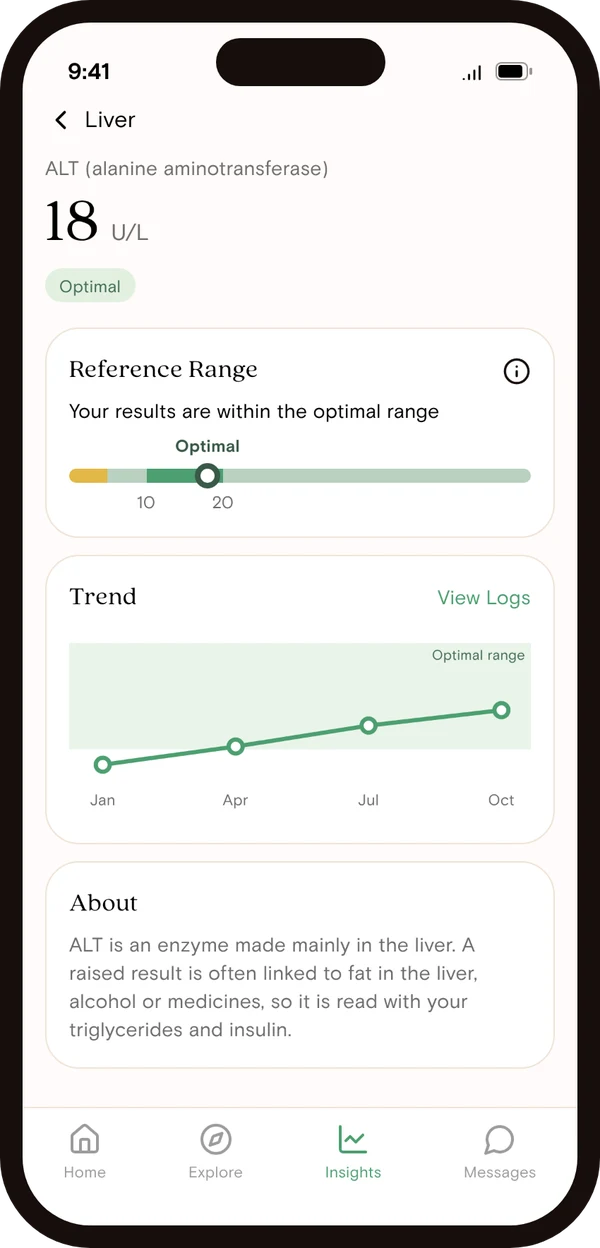
Most Australian labs give women an upper limit for ALT of about 30 to 35 U/L, and the range used in the Vively app is 5 to 35 U/L. Among 3,759 Vively women, the median ALT was 17 to 20 U/L at every age. Your report shows your own lab's range.
The range used in the Vively app for men is 5 to 40 U/L, and most Australian lab limits for men sit around 40 to 45 U/L. Among 2,286 Vively men, the median ALT was 29 to 30 U/L until 60 and 24 U/L after, and about 1 in 5 men under 60 were above 40 U/L.
The range used in the Vively app is 5 to 35 U/L for women and 5 to 50 U/L for men. Among Vively members, median GGT was 13 to 18 U/L in women, rising with age, and 19 to 22 U/L in men.
ALT changes little with age in adults. In Vively members it was steady in women and fell slightly in men after 60. GGT rises with age, especially in women: the median went from 13 U/L in women aged 18 to 29 to 18 U/L at 60 and over.
An ALT of 70 U/L is about double the upper limit on most Australian reports, which counts as a mild rise. The usual causes are fat in the liver, alcohol, medicines or recent hard exercise. Repeat it and talk to your GP, who can look for the cause.
Yes. Weight training and long or hard sessions can raise ALT and AST for several days, because muscle contains these enzymes too. Skip hard exercise for two to three days before a liver test so it doesn't confuse the result.
Vively supports preventative health and health optimisation. It does not replace your GP, emergency care or specialist medical advice.
.avif)


.svg)


Vively is a general wellness platform and does not provide medical advice, diagnosis, or treatment. Any information, insights or guidance offered through our app, website, programs, or coaches is for educational and informational purposes only and should not be considered a substitute for professional medical advice or care. Always consult a qualified healthcare provider before making any health-related decisions.
We acknowledge the Traditional Custodians of the lands where we live and work, the Gadigal of the Eora Nation. We pay our respects to their Elders past and present.