


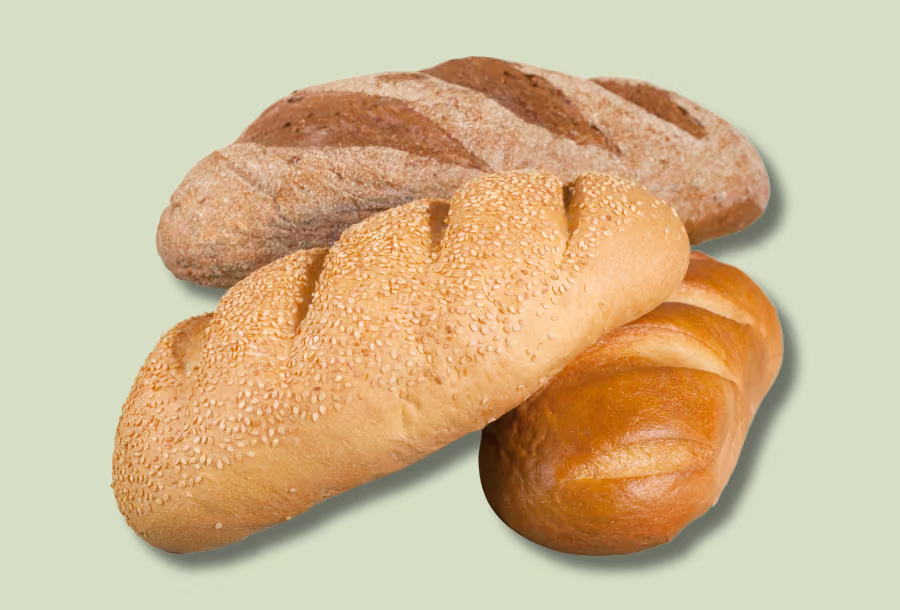
Low GI bread has a glycaemic index of 55 or less, so it raises blood sugar more slowly than white bread, which tests at 70 to 74. In Australian testing, the lowest GI loaves are dense and grainy: Burgen Wholemeal & Seeds (39), sourdough rye (48) and pumpernickel (41 to 56). Wholemeal bread is usually medium to high.
Typical rise in blood sugar (mmol/L) when Vively members wearing a continuous glucose monitor ate each food on its own. Each food has at least 30 members behind it.
GI tables come from lab tests on small groups. Real responses vary a lot from person to person. See the curves on our glucose spikes page, or try a CGM to see your own.
Not every brown, seeded or sourdough loaf is low GI. We pulled every bread with a published GI from the University of Sydney's tables and GI News, Australian brands first. Pick the bread you buy now to see lower GI swaps.
Low GI bread is bread that has been tested in people and scored 55 or less on the glycaemic index. The GI ranks carbohydrate foods by how quickly they raise blood glucose against pure glucose, which scores 100.
To test a loaf, 10 or more healthy people eat a portion containing 50 g of available carbohydrate, and their blood glucose is tracked for two hours. So a GI belongs to a specific bread, not a whole category. Two "multigrain" loaves can land in different bands.
Three things push a bread's GI down:
You will also see low GI bread called low glycemic bread, using the US spelling. It means the same thing.
The Australian supermarket breads with a published low GI are mostly grainy loaves from Burgen and Tip Top, plus Helga's Lower Carb range and two fibre-enriched white breads.
GI News round-ups from 2010 and 2013 listed Burgen Soy-Lin, Burgen Wholemeal & Seeds and Tip Top 9 Grain as carrying the GI Foundation's GI symbol, and Burgen Rye and Tip Top Up in 2010. Symbol status can change when a recipe or licence changes, so check the current pack. The retailer listing for Helga's Lower Carb range says "certified Low GI", but we could not confirm the GI symbol itself.
We found no published GI for Turkish bread or for any Abbott's Village Bakery loaf, so they are not in the explorer.
White bread has a GI of 70 to 74 in Australian testing, which is high. Plain Australian white tested at 74, and WonderWhite and Sunblest at 70.
Refined flour is milled very fine and baked into a light, airy crumb, so digestive enzymes reach the starch almost at once. One 37 g slice carries about 16 g of carbohydrate.
Low GI white bread does exist. Bakers Delight Hi Fibre Lo GI tested at 52 and Tip Top Up EnerGI at 54 to 58, both thanks to added fibre. If your household will only eat white, these are a fair swap.
Sourdough can be low GI, but it depends on the loaf: Australian tests run from 54 to 77.
A generic Australian sourdough scored 54. A Vienna-style sourdough scored 66, and a commercial sourdough cob scored 77, as high as white bread. Traditional sourdough rises slowly with a starter culture, and the acids it makes slow stomach emptying. Some breads sold as sourdough are made more quickly and behave more like ordinary white bread.
Sourdough rye combines both effects and tested at 48. If you buy from a bakery, ask whether the loaf is made with a starter and fermented slowly. A dense crumb and a clearly sour taste are good signs.

Wholegrain rye bread and pumpernickel are usually low GI, at about 41 to 56.
Burgen Rye tested at 51 to 53, sourdough rye at 48 and pumpernickel at 41 to 56, with a Dutch pumpernickel at 49. Pumpernickel is made from whole rye kernels, so much of the starch stays locked inside the grain.
Light rye loaves made mostly from wheat flour were not tested in the sources we used, so treat them as unknown rather than low GI.
Wholemeal bread is usually medium to high GI (64 to 75), because the flour is milled as finely as white flour.
Fibre does little to slow digestion once the grain is ground to powder. Multigrain bread spans 39 to 68: a loaf packed with whole kernels can be low, while a soft loaf with a few grains mixed through can be medium.
A seeded look is not proof of a low GI. Helga's Classic Seed Loaf tested at 68, in the medium band. Spelt multigrain sits at 54 to 62, wraps and tortillas at 50 to 62, and Lebanese pita at 65.
Gluten-free bread is the widest spread of all. Country Life gluten-free white tested at 40, while gluten-free loaves made with wheat starch run 71 to 80, so check the brand.
Wholemeal still gives you more fibre than white, which is good for your gut. For blood sugar, though, a dense grainy or rye loaf is the better swap. Baker Heart and Diabetes Institute advice is the same: choose multigrain or seeded, traditional sourdough or pumpernickel instead of white or wholemeal.

For people with diabetes or prediabetes, the best bread is a dense grainy, rye or traditional sourdough loaf with a tested low GI, eaten in a modest serve with protein or fat.
Glycaemic load (GL) combines GI with how much carbohydrate you actually eat: GI x grams of carbohydrate, divided by 100. A 40 g slice of sourdough rye has a GL of about 8. Two slices of dense whole grain bread come to about 12, the same as a single slice of white.
So two slices of a good loaf is a sensible serve. Four slices of any bread is a lot of carbohydrate, so treat bread like other starchy serves such as pasta or rice: one portion, not two.
The GI Foundation says protein and fat slow digestion when eaten with carbohydrate, and acid such as vinegar or lemon slows stomach emptying. Eggs, tinned fish, cheese, hummus, avocado or nut butter all help. Jam or honey on white toast does the opposite.
If you have diabetes, Diabetes Australia's general targets are 4.0 to 7.0 mmol/L before meals and 5.0 to 10.0 mmol/L two hours after starting a meal. Your GP or specialist sets your own targets. Our guide to blood sugar after eating explains the numbers, and our 7-day prediabetes meal plan shows low GI bread in real meals.
GI is an average, and individual responses to the same bread vary a lot.
In a study of 800 people (Zeevi and colleagues, Cell, 2015), the glucose rise after a standard bread meal with 50 g of carbohydrate differed widely between people. The top 10% had more than five times the rise of the bottom 10%, yet each person's own response was fairly repeatable. Sleep, activity, stress and what you ate earlier all shift the result too.
A finger-prick test before your toast and again two hours after shows your own pattern. A continuous glucose monitor (CGM) shows the whole curve, including how high it went and how fast it came back.
Vively's CGM program pairs a 14-day sensor with the Vively app, so you can eat your usual bread one morning and a lower GI swap the next, then compare the curves. You get guidance on what to change, based on your own data. If you would rather start with a blood test, the Baseline Health Check measures fasting glucose, HbA1c, fasting insulin and HOMA-IR, which can show insulin resistance before glucose rises.
Wear a CGM sensor for 14 days and see how your breakfast toast, sandwiches and swaps change your glucose, with clear guidance on what to change.
Of the Australian breads with published tests, Burgen Wholemeal & Seeds (39), Burgen Soy-Lin (36 to 52) and Tip Top 9 Grain Original (43 to 53) sit lowest, along with sourdough rye (48) and pumpernickel (41 to 56). Dense loaves with whole kernels and seeds, or rye with a sourdough ferment, tend to test lower than soft white or wholemeal bread, though a seeded look alone is no guarantee.
Sometimes. Australian tests range from 54 for a generic sourdough to 77 for a commercial sourdough cob, so it depends on how the loaf is made. Slow fermentation with a starter culture produces acids that slow digestion. Sourdough rye is the most reliable choice, testing at 48, which is comfortably in the low GI band.
Yes, wholegrain rye usually is. Burgen Rye tested at 51 to 53, sourdough rye at 48 and pumpernickel at 41 to 56. The lower results come from whole rye kernels and sourdough acids. Light rye made mostly from wheat flour has not been tested in the sources we used, so do not assume it is low GI.
No, it is usually medium to high, at 64 to 75. Wholemeal flour is milled as finely as white flour, so it digests almost as quickly even though it has more fibre. For a lower GI, choose a dense grainy loaf, rye or traditional sourdough. Keep wholemeal for the fibre if you enjoy it, in a modest serve.
Yes. Bakers Delight Hi Fibre Lo GI white tested at 52 and Tip Top Up EnerGI white at 54 to 58, both because of added fibre. Regular white bread is 70 to 74. These are a practical option for children or anyone who will not eat grainy bread, especially with protein on top.
A low GI, dense grainy, rye or traditional sourdough loaf, such as Burgen Wholemeal & Seeds, Burgen Soy-Lin, Tip Top 9 Grain or sourdough rye, eaten one or two slices at a time with protein or fat. If you have diabetes or notice signs of prediabetes, ask your GP or a dietitian to tailor your carbohydrate serves.
START YOUR BASELINE
Vively includes a Baseline Health Check with 70+ biomarkers, a results report and practitioner support in the $99 a month membership. No minimum term.
Explore Baseline Health CheckSubscribe to our newsletter & join a community of 30,000+ Aussies

Start a PCOS assessment with your GP. Learn which blood tests matter, when ultrasound or AMH is useful, and how contraception affects results.


Know what to do about an unexpected high blood sugar reading, when to seek urgent help, and which everyday habits support longer-term glucose care.





Vively is a general wellness platform and does not provide medical advice, diagnosis, or treatment. Any information, insights or guidance offered through our app, website, programs, or coaches is for educational and informational purposes only and should not be considered a substitute for professional medical advice or care. Always consult a qualified healthcare provider before making any health-related decisions.
We acknowledge the Traditional Custodians of the lands where we live and work, the Gadigal of the Eora Nation. We pay our respects to their Elders past and present.
 Share
 Tweet
 Share