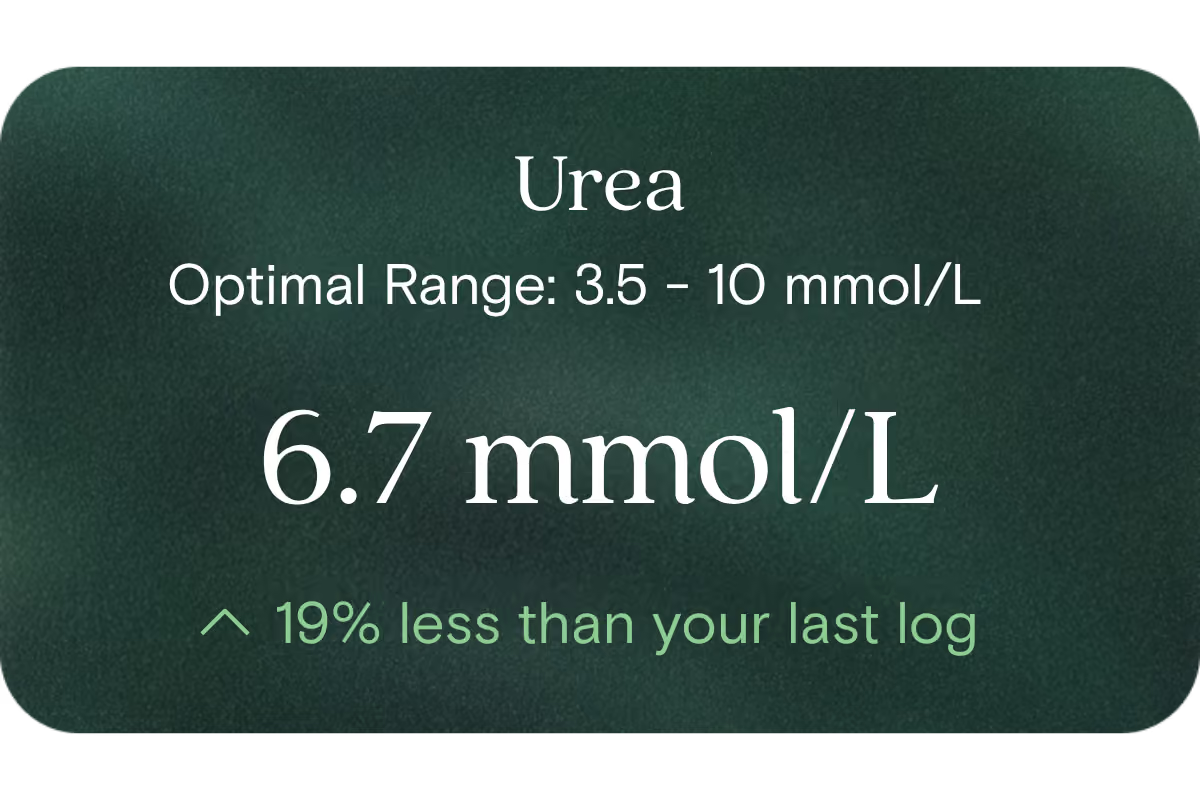
What is urea?
Urea is a waste product your liver makes from protein. When your body breaks down amino acids, the building blocks of protein, it strips off their nitrogen as ammonia. Ammonia is toxic, so the liver converts it into urea, which travels in your blood to the kidneys and leaves your body in urine.
Your kidneys filter urea out of the blood, then reabsorb some of it. How much they reabsorb depends on how hard they are working to hold onto water. That is why urea is so sensitive to hydration.
In Australia, urea is reported in millimoles per litre (mmol/L). US labs report the same waste product as blood urea nitrogen (BUN), in milligrams per decilitre (mg/dL).
What does a urea blood test show?
A urea test shows the balance between how much urea your liver makes and how much your kidneys clear. Three things drive that balance:
- Protein load. More protein eaten, or more muscle broken down, means more urea.
- Hydration. Being short on fluid pushes the level up.
- Kidney function. If the kidneys filter less blood, urea builds up.
Because everyday habits shift it so easily, urea is a weak kidney test by itself. Creatinine and eGFR measure kidney filtering far more directly.
Kidney disease rarely causes early symptoms. The Australian Institute of Health and Welfare estimates about 1 in 10 Australian adults have signs of chronic kidney disease, most without knowing. Tracking urea with creatinine and eGFR is an easy way to watch your kidney health.
Urea normal range
For most adults, urea sits between about 2.5 and 7.8 mmol/L, with a higher upper limit in older adults.
| Range |
|---|
| Typical lab reference range (adults) | About 2.5 to 7.8 mmol/L |
| Older adults | Often a higher upper limit, up to about 10 mmol/L at some labs |
| Vively optimal range | None set. We read urea against your creatinine, eGFR and previous results |
Urea tends to creep up with age as kidney filtering slows a little. Use the range on your own report, and compare the number with your previous results.
What does high urea mean?
A high urea most often means you were a little dehydrated or have been eating a lot of protein. If your creatinine and eGFR are normal, a mildly high urea is usually not a kidney problem. If creatinine is also high or eGFR is low, see your GP.
Common, everyday reasons:
- Dehydration. A hot day, a big training session, a night of drinking, gastro, or not drinking much before your test.
- High protein intake. Large serves of meat, protein shakes and high-protein diets all increase urea production.
- Heavy training, long fasts or crash dieting. These break down your own protein, adding to the load.
- Some medicines, such as corticosteroids and diuretics (fluid tablets), which can leave you dehydrated.
Medical causes a doctor will look for:
- Reduced kidney function, usually with a high creatinine and a lower eGFR.
- Heart failure or low blood pressure, which reduce blood flow to the kidneys.
- Bleeding in the stomach or upper bowel. Digested blood is a large protein load.
- A blockage to urine flow, such as an enlarged prostate.
- Serious illness, including severe infection, major burns or a heart attack.
What does low urea mean?
A low urea usually reflects a low protein intake or a lot of fluid. In a healthy person, it is rarely a concern.
- Eating little protein, including some vegetarian and vegan diets, or eating very little in general.
- Pregnancy. Blood volume expands and the kidneys filter faster, so urea normally falls.
- Drinking large amounts of fluid.
- Less often, severe liver disease (the liver can't make urea properly) or malnutrition.
A low urea is worth a closer look when albumin or total protein are low too, or your liver function tests are abnormal.
What can affect your urea result
Urea shifts easily, so preparation matters.
- Do you need to fast? Not for urea itself, but your Baseline includes fasting glucose and insulin, so you'll have only water overnight. That suits urea too, because a big high-protein meal in the hours before a test can nudge it up.
- Hydration. Drink water normally the day before and the morning of your test. Turning up dehydrated is the most common reason for a mildly high urea.
- Exercise. Skip a long or very hard session the day before your test.
- High-protein eating. Let us know, so we read your urea with it in mind.
- Recent illness, especially gastro or a fever.
- Medicines. Corticosteroids and diuretics can raise urea, so mention them if you take either.
How urea fits with your other results
The urea:creatinine ratio compares these two waste products directly. A BUN:creatinine ratio on an overseas report is the US version, in different units.
| Pattern | What it can mean |
|---|
| High urea, normal creatinine and eGFR | Most often dehydration, high protein intake or hard training. Rehydrate and retest if it persists. |
| High urea with a high urea:creatinine ratio | Urea is outpacing creatinine, usually from fluid or protein, less often from bleeding in the upper gut. |
| High urea, high creatinine and low eGFR | Both waste products are building up together, which suggests reduced kidney filtering. Needs GP review. |
| Low urea with low albumin or total protein | May point to low protein intake or, less often, a liver problem. Worth reviewing. |
| High urea with abnormal sodium or potassium | Fluid or electrolyte balance may be off. Needs GP review if it doesn't settle. |
How to support healthy urea levels
Most changes in urea come down to fluid and protein, and you can adjust both. If your kidneys are the reason, the focus shifts to protecting kidney function with your GP.
- Spread your fluids across the day, and add more in hot weather and on training days. Urine the colour of pale straw usually means you're drinking enough.
- Match protein to your needs. Australian Nutrient Reference Values set adult protein needs at around 0.75 to 0.84 g per kilogram of body weight a day, a little more from age 70. Active people often need more, but several shakes a day on top of big meals adds urea without adding benefit.
- Look after your blood pressure and blood glucose. Diabetes and high blood pressure are two of the commonest causes of kidney disease in Australia.
- Go easy on anti-inflammatory painkillers such as ibuprofen. Regular use can affect the kidneys, especially when you're dehydrated.
When to see your GP
See your GP if your urea is above your lab's range together with a high creatinine or low eGFR, if it stays high on a repeat test after you've been well hydrated, or if it keeps rising over time. A very high urea, around 20 mmol/L or more, needs prompt medical attention.
Also see your GP for swollen ankles or legs, passing much less urine than usual, ongoing nausea, unusual tiredness, itchy skin or breathlessness. Black, tarry stools or vomiting blood need same-day care.
Testing urea with Vively
Urea sits in the kidney section of Vively's Baseline Health Check, next to creatinine, eGFR and your electrolytes. Your final marker list is confirmed when the referring doctor reviews your request.
Sign up online and our GP network arranges your referral. One blood draw at any of 3,700+ accredited partner collection centres, and results reach the app usually within a few days, set against optimal ranges in plain English. A Vively practitioner talks you through them and builds your personalised plan, and a retest shows whether changes to fluid or protein have moved the number. If your urea is a bit high because you were short on water, we'll tell you that.
Check your urea and kidney markers with the Baseline Health Check.
Frequently asked questions
Do I need to fast before a urea test?
No. Urea can be tested after eating, though a large protein-heavy meal shortly before can nudge it up. Your Vively Baseline needs an overnight fast for glucose and insulin anyway, which takes care of that. Keep drinking water while you fast, because dehydration is the most common reason for a mildly high urea.
Is a urea of 8.5 mmol/L high?
Yes, slightly. It is above many labs' upper limit of about 7.8 mmol/L, though some labs, especially for older adults, accept up to about 10 mmol/L. If your creatinine and eGFR are normal, dehydration or a high protein intake is the likely cause. Rehydrate and retest, and see your GP if it stays high.
Can dehydration cause high urea?
Yes. When you're low on fluid, your kidneys hold onto water and reabsorb more urea along with it, so the blood level rises. Urea usually rises proportionally more than creatinine, which pushes the urea:creatinine ratio up. A repeat test after a normal, well-hydrated day usually brings it back down.
Can a high protein diet raise my urea?
Yes. The more protein you eat, the more urea your liver makes, so high-protein diets and regular protein shakes can push urea towards or above the top of the range. With normal creatinine and eGFR this isn't kidney damage, but it's worth matching your intake to what your body needs.
What is the difference between urea and BUN?
They measure the same waste product in different ways. Australian labs report urea in mmol/L. US labs report blood urea nitrogen (BUN) in mg/dL, which counts only the nitrogen in urea. Multiply BUN by 0.357 to get urea in mmol/L, so a BUN of 14 mg/dL is about 5 mmol/L.
Can I get a urea test through Medicare?
Yes, it can be. Many blood tests, urea included, can be Medicare-funded when a doctor orders them for a clinical reason. With Vively, we arrange the referral through our GP network, and urea is requested with your other kidney markers as part of the Baseline Health Check.
References
- Royal College of Pathologists of Australasia (RCPA). RCPA Manual: Urea. https://www.rcpa.edu.au/Manuals/RCPA-Manual/Pathology-Tests/U/Urea
- Pathology Tests Explained. Urea (blood and urine). https://pathologytestsexplained.org.au/ptests.php?q=Urea+%28blood+and+urine%29
- Higgins C. Urea and creatinine concentration, the urea:creatinine ratio. Acute Care Testing. https://acutecaretesting.org/en/articles/urea-and-creatinine-concentration-the-urea-creatinine-ratio
- Hosten AO. BUN and Creatinine. In: Walker HK, Hall WD, Hurst JW, editors. Clinical Methods: The History, Physical, and Laboratory Examinations. 3rd edition. Butterworths; 1990. NCBI Bookshelf.
- Australian Institute of Health and Welfare. Chronic kidney disease: Australian facts.
- National Health and Medical Research Council. Nutrient Reference Values for Australia and New Zealand: Protein.