



Cholesterol often rises after menopause, and our members' blood tests show it clearly. Among 820 Vively members aged 45 to 55, 40% of women past menopause had LDL cholesterol above the lab range of 3.5 mmol/L, against 24% of women the same age in perimenopause. Total cholesterol above 5.6 mmol/L followed the same pattern: 43% against 29%.
Women aged 45 to 55: LDL cholesterol was above 3.5 mmol/L in 40% of women after menopause, against 24% of women in perimenopause.
| Value | Members | |
|---|---|---|
| LDL above 3.5: Perimenopause | 24% | 506 |
| LDL above 3.5: After menopause | 40% | 314 |
| Total above 5.6: Perimenopause | 29% | 509 |
| Total above 5.6: After menopause | 43% | 315 |
Cholesterol rises with age in everyone. So if you compare a 40 year old woman with a 60 year old, you can't tell how much of the difference comes from menopause and how much from 20 extra years.
To get around that, we looked only at women aged 45 to 55 at their first Vively blood test, from January 2024 to October 2026. In that age range, some women are still in perimenopause and some have been through menopause. We grouped them by the stage they told us in the Vively app: 506 in perimenopause and 314 who had reached menopause or were past it. Women who weren't sure of their stage are left out.
Comparing women of similar age shows a gap that age alone doesn't explain.
Against women the same age in perimenopause, women past menopause had:
Some markers barely moved. HDL cholesterol, triglycerides and HbA1c were much the same in both groups. That fits what longer studies have found: the change around menopause shows up mostly in LDL.
| Peri | After | |
|---|---|---|
| LDL above 3.5 | 24% | 40% |
| Total cholesterol above 5.6 | 29% | 43% |
| HOMA-IR above 2.9 | 10% | 15% |
| Triglycerides above 2.1 | 4% | 4% |
| HbA1c above 5.9% | 3% | 2% |
| Median ferritin (µg/L) | 53 | 80 |
Across all ages, the picture flips around 50. Under 50, fewer women than men had cholesterol above the lab range in every age group. From 50 the gap closes, and at 60 and over, 52% of women had total cholesterol above 5.6 mmol/L, against 34% of men. For LDL above 3.5 mmol/L, women 60 and over were at 42% and men at 37%. Our cholesterol levels by age guide has total cholesterol, LDL and HDL for every age group.
Aged 60 and over, 52% of women had total cholesterol above 5.6 mmol/L, against 34% of men. Under 50, women were lower at every age.
% with total cholesterol above 5.6 mmol/L
| Women | Men | |
|---|---|---|
| 18 to 29 | 10% (n=270) | 11% (n=267) |
| 30 to 39 | 14% (n=1,005) | 22% (n=659) |
| 40 to 49 | 24% (n=1,180) | 33% (n=711) |
| 50 to 59 | 42% (n=879) | 39% (n=417) |
| 60+ | 52% (n=506) | 34% (n=267) |
% with LDL above 3.5 mmol/L
| Women | Men | |
|---|---|---|
| 18 to 29 | 10% (n=268) | 17% (n=264) |
| 30 to 39 | 14% (n=996) | 26% (n=651) |
| 40 to 49 | 22% (n=1,172) | 37% (n=699) |
| 50 to 59 | 38% (n=871) | 40% (n=413) |
| 60+ | 42% (n=499) | 37% (n=260) |
Oestrogen helps your liver clear LDL cholesterol from your blood. As oestrogen falls through the menopause transition, LDL tends to rise. Jean Hailes for Women's Health describes the same change.
A large US study of midlife women, the Study of Women's Health Across the Nation, followed women through menopause. It found LDL and apolipoprotein B (ApoB) rose sharply in the year around the final period, faster than at any other time. Age alone didn't explain the jump.
Higher LDL over many years adds to the risk of heart disease, one of the leading causes of death for Australian women. Cholesterol is one risk factor among many, alongside blood pressure, smoking, diabetes, weight and family history.
A lipid panel (total cholesterol, LDL, HDL and triglycerides) is the starting point. ApoB counts the particles that carry LDL and is worth asking about if your LDL is borderline or heart disease runs in your family. Our post on ApoB and lipoprotein(a) explains both.
If you had your cholesterol checked in your early 40s, it is worth checking again once your periods become irregular or stop. A result that was fine at 42 may not be at 52. Read your result against the range on your own report: labs set their own ranges, and typical ones are LDL up to 3.5 mmol/L and total cholesterol up to 5.6 mmol/L.
Hormone tests can help describe where you are in the transition, though during perimenopause they swing from week to week. Our perimenopause blood test guide and women's hormone blood tests guide cover which tests help and when to have them.
See your GP to talk about your heart risk if your LDL is well above the lab range, if heart disease or stroke happened early in your family, or if you have high blood pressure or diabetes. Your GP can work out your overall risk with the Australian cardiovascular risk calculator and talk through options, including whether medicine makes sense.
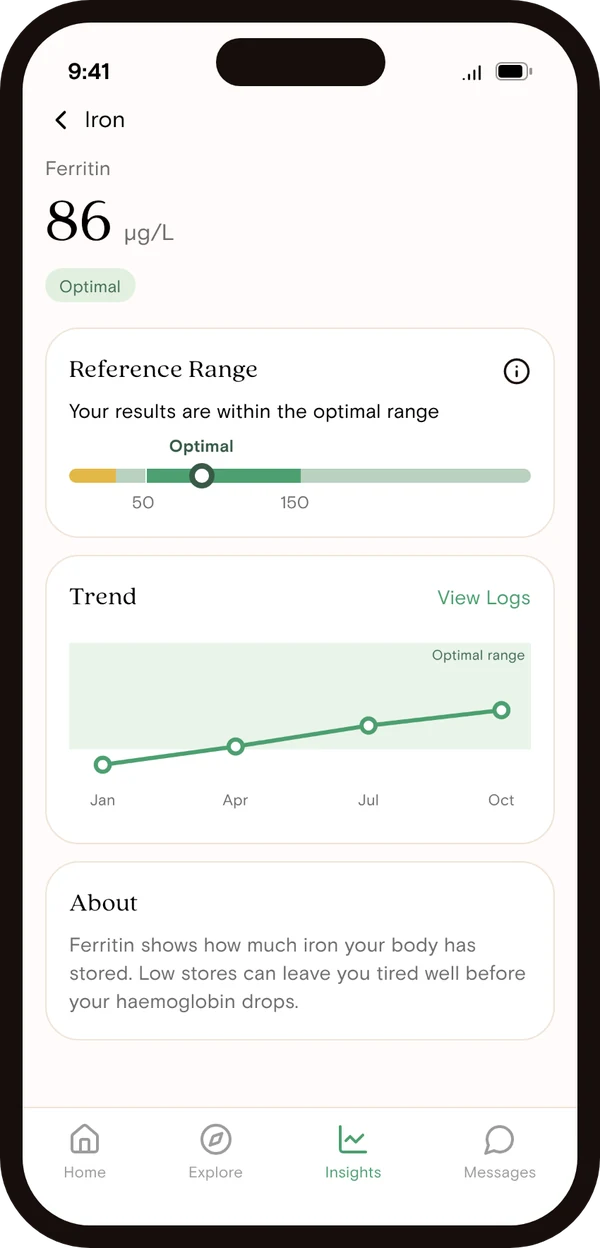
The Vively Baseline Health Check includes a full lipid panel, HbA1c, fasting insulin, HOMA-IR and ferritin, so you can see the markers in this story in one test. ApoB and hormone tests can be added. Re-testing every 3 months shows how your numbers move through the transition, and a practitioner helps you read them. See the LDL cholesterol test and total cholesterol test pages for more on each result.
Vively is an Australian health membership for $99 a month, with no minimum term. It starts with the Baseline Health Check: a blood test covering 70+ markers, including LDL, HDL, total cholesterol, triglycerides and ferritin, at one of 3,700+ collection centres. A practitioner goes through your results with you.
For many women, yes. LDL cholesterol tends to rise as oestrogen falls. Among Vively members aged 45 to 55, 40% of women past menopause had LDL above 3.5 mmol/L, against 24% of women the same age still in perimenopause.
It can start to. A large US study found the sharpest rise in LDL came in the year around the final period, which falls at the end of perimenopause.
The lab ranges are the same at any age. Typical ranges are LDL up to 3.5 mmol/L and total cholesterol up to 5.6 mmol/L, but use the range on your own report. Among Vively members aged 50 to 59, the typical (median) total cholesterol for women was 5.5 mmol/L and LDL was 3.2 mmol/L.
It usually doesn't fall back on its own. Diet, activity, weight and, where your GP advises it, medicine can all lower LDL. Some women also discuss menopausal hormone therapy with their GP, mainly for symptoms rather than for cholesterol.
Ask your GP, as it depends on your results and overall risk. A check once periods become irregular or stop, and again within a year or two, will show whether your numbers have moved.
START YOUR BASELINE
Vively includes a Baseline Health Check with 70+ biomarkers, a results report and practitioner support in the $99 a month membership. No minimum term.
Explore Baseline Health CheckSubscribe to our newsletter & join a community of 30,000+ Aussies

Start a PCOS assessment with your GP. Learn which blood tests matter, when ultrasound or AMH is useful, and how contraception affects results.


Know what to do about an unexpected high blood sugar reading, when to seek urgent help, and which everyday habits support longer-term glucose care.





Vively is a general wellness platform and does not provide medical advice, diagnosis, or treatment. Any information, insights or guidance offered through our app, website, programs, or coaches is for educational and informational purposes only and should not be considered a substitute for professional medical advice or care. Always consult a qualified healthcare provider before making any health-related decisions.
We acknowledge the Traditional Custodians of the lands where we live and work, the Gadigal of the Eora Nation. We pay our respects to their Elders past and present.

 Share
 Tweet
 Share