



Coffee can temporarily raise blood sugar in some people, even when it contains no added sugar. Caffeine can affect insulin sensitivity, while milk, sugar and syrups change the drink's carbohydrate content. Your response also depends on the meal, sleep and activity around it; coffee is not a treatment for diabetes or insulin resistance.
Start by describing the coffee you actually drink. A small black coffee and a large sweetened iced latte are different drinks, so comparing them tells you little about caffeine alone.
Black coffee can affect glucose despite containing very little carbohydrate. Caffeine influences signalling involved in glucose regulation and can temporarily make the body less sensitive to insulin. The effect differs between people, and a small experimental result does not predict what every person will see after an ordinary cup.
A randomised crossover study published in Applied Physiology, Nutrition, and Metabolism in 2013 tested caffeine in healthy adults and found reduced insulin sensitivity. Participants received controlled caffeine doses and a glucose test. That is useful evidence about caffeine's short-term effects, but it is different from drinking coffee with breakfast in daily life.
Morning readings can also change because your liver releases glucose while you are fasting, or because of poor sleep and stress. A rise after coffee does not prove coffee caused the whole change. Our normal blood glucose guide explains why timing and the type of measurement matter.
Short-term caffeine experiments and long-term coffee studies answer different questions. An experiment can test what happens over a few hours after a controlled dose. An observational study can compare people who usually drink different amounts of coffee, but those groups may differ in other ways too.
Research following coffee drinkers has often found an association with lower type 2 diabetes risk. That association does not establish that coffee prevents diabetes, and it is not a reason to begin drinking it or increase your intake. The drink also contains compounds beyond caffeine, so results for caffeine alone cannot explain every finding.
Possible biological explanations for a research finding need separate testing before they can be described as proven benefits. If you already enjoy coffee and tolerate it, consider it within your usual diet. If it disrupts sleep, causes palpitations or makes you feel unwell, those effects deserve attention regardless of a long-term statistical association.

Milk and added sweeteners change the carbohydrate content of your coffee. Dairy milk contains lactose, while plant-based drinks differ in ingredients and carbohydrate amounts. A label comparison is more useful than assuming that all oat, almond or soy drinks behave in the same way.
Compare products per the same volume, then consider how much goes into your cup. An unsweetened label means no sweetener was added in the way defined for that product; it does not necessarily mean there is no carbohydrate. Barista versions can also differ from the standard product from the same brand.
Protein and fat can affect digestion and fullness, but they do not cancel carbohydrate. A milk coffee may suit your appetite and nutrition needs even if its glucose response differs from black coffee. Do not remove a food you enjoy solely because it produces a larger rise than a drink with almost no carbohydrate.
Sugar, honey and syrups add to the drink's carbohydrate. If you want to reduce them, make a change you can sustain, such as using less syrup or choosing a smaller sweetened drink. There is no need to describe a coffee as good or bad based on one ingredient.
Decaffeinated coffee contains much less caffeine, but it is not necessarily caffeine-free and it does not guarantee no glucose response. Milk, sweeteners and the accompanying food remain relevant. It can be a useful option when caffeine affects your sleep, anxiety or comfort, with advice from your clinician where needed.
A small randomised crossover trial in young men compared decaffeinated coffee, caffeinated coffee, caffeine and a placebo around an oral glucose tolerance test. The results showed that decaf and caffeine did not have identical effects. They do not establish decaf as a diabetes treatment or predict an exact benefit for your morning routine.
If you compare regular and decaf coffee, keep the cup size, milk and meal similar. Note how you feel as well as any readings. Changing your coffee and breakfast at the same time makes it harder to know which change mattered, and repeated observations are more useful than one comparison.
For a fasting blood test, follow the collection centre's instructions rather than assuming black coffee is allowed. Water is generally the safest drink during a prescribed fast. Coffee can affect the conditions under which the result is interpreted, even when it has no sugar or milk.
Our guide to fasting for a blood sugar test explains how to prepare. If you accidentally drink coffee, tell the collector before the sample is taken. They can advise whether to proceed or arrange another time; do not hide the change or extend the fast to compensate.
Outside a test, there is no single coffee schedule that suits everyone. Consider sleep, appetite and any symptoms. If breakfast helps you feel better, build a satisfying meal rather than using coffee to replace food. If you manage diabetes, keep your usual medicine and meal instructions unless your treating clinician changes them.
A glucose rise after coffee is a clue to examine in context, not a diagnosis. Record the whole drink and meal, the timing and whether you were unwell or unusually tired. The glucose spikes hub explains why isolated peaks can be misleading.
A CGM measures glucose in fluid under the skin, so its readings can lag behind blood glucose. If a reading does not match symptoms, follow the device instructions and your diabetes plan, including a finger-prick check when advised. Do not take extra medicine to correct a coffee-related reading without a prescribed plan.
Repeated concerning results warrant clinical assessment. A fasting glucose test and other appropriate laboratory tests can help your GP assess the pattern. The fasting insulin page explains a different marker; a CGM cannot directly measure insulin or tell you how much your pancreas released.

Seek advice if coffee repeatedly causes troublesome palpitations, tremor, anxiety or poor sleep. These symptoms do not prove low glucose, and their cause may need assessment. Persistent thirst, frequent urination or unexplained weight loss also deserve a GP review rather than a series of self-directed food experiments.
Pregnancy, breastfeeding, medicines and particular medical conditions can change the advice about caffeine. Ask your clinician what applies to you. We have not set a universal number of cups because caffeine content varies considerably between drinks, and a cup count can conceal a large difference in dose.
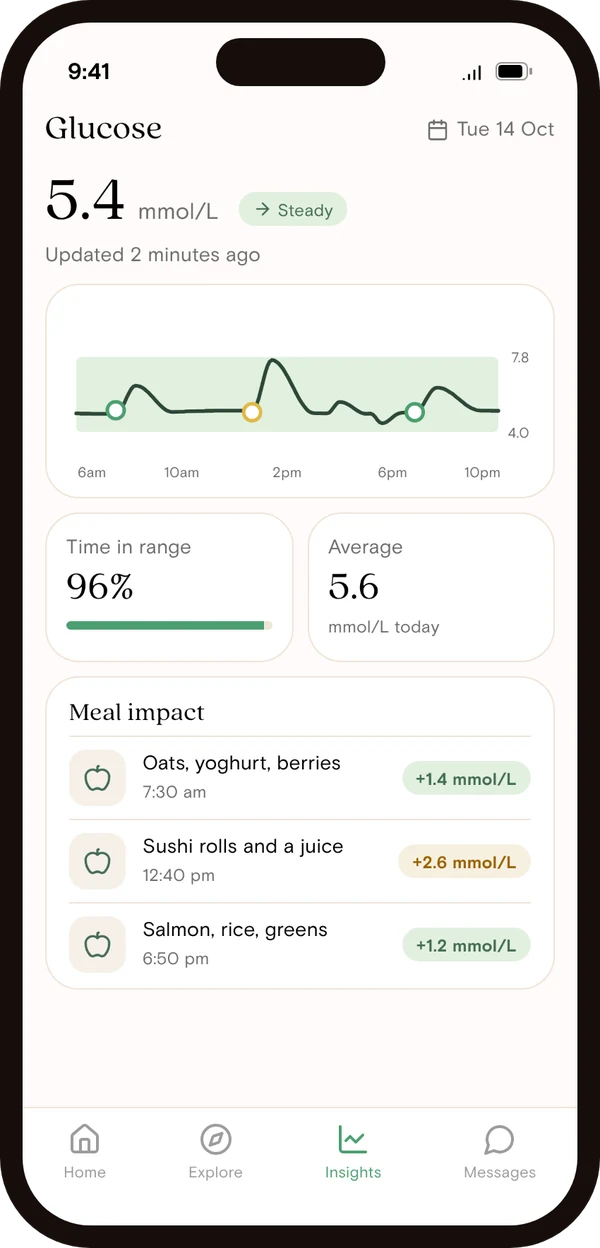
We can help you examine patterns around your usual coffee without treating every glucose rise as a problem. The Vively CGM program records trends alongside meals and activity. The Baseline Health Check adds broader laboratory context and a practitioner consult to explain the results.
Review your blood results with a practitioner and choose useful next steps for your health.
Milk contains nutrients that can stimulate insulin release as part of normal digestion. A glucose monitor does not measure insulin, so its curve cannot tell you the size of an insulin response. Consider the drink's portion and your broader nutritional needs, and use clinical testing if there is a reason to assess insulin resistance.
Black coffee usually contains much less carbohydrate than a latte, but caffeine can still affect glucose. The better choice depends on your preferences, nutrition needs and treatment plan. Compare the actual drink sizes and ingredients, and avoid making a long-term decision from a single sensor reading after a different breakfast.
One coffee or one temporary rise after caffeine does not establish a cause of diabetes. Type 2 diabetes develops through several interacting factors. Long-term observational research on coffee cannot prove protection either. If you have symptoms or repeated concerning readings, ask your GP about appropriate testing instead of trying to diagnose yourself from coffee responses.
There is no fixed duration that applies to everyone. Caffeine exposure, the drink's ingredients, the accompanying meal and individual metabolism all matter. If you monitor glucose, record the full context and discuss repeated concerns with your clinician. Do not assume a later reading is still caused by coffee when other factors have changed.
START YOUR BASELINE
Vively includes a Baseline Health Check with 70+ biomarkers, a results report and practitioner support in the $99 a month membership. No minimum term.
Explore Baseline Health CheckSubscribe to our newsletter & join a community of 30,000+ Aussies

Start a PCOS assessment with your GP. Learn which blood tests matter, when ultrasound or AMH is useful, and how contraception affects results.


Know what to do about an unexpected high blood sugar reading, when to seek urgent help, and which everyday habits support longer-term glucose care.

Learn how sleep apnoea and high blood glucose are linked, what CPAP research can tell us, and which symptoms deserve a GP or sleep specialist review.





Vively is a general wellness platform and does not provide medical advice, diagnosis, or treatment. Any information, insights or guidance offered through our app, website, programs, or coaches is for educational and informational purposes only and should not be considered a substitute for professional medical advice or care. Always consult a qualified healthcare provider before making any health-related decisions.
We acknowledge the Traditional Custodians of the lands where we live and work, the Gadigal of the Eora Nation. We pay our respects to their Elders past and present.

 Share
 Tweet
 Share