


Honey has a glycaemic index (GI) of 35 to 72 in Australian testing, depending on the flowers bees fed on. In the University of Sydney GI database, pure eucalypt honeys such as yellow box (35), stringybark (44), red gum (46) and ironbark (48) are low GI. Two commercial blends tested at 62 and 72. Table sugar sits at about 60.
Honey is not one food. Its GI depends on its mix of fructose and glucose, which depends on the flowers. Use the explorer to compare tested honeys with other sweeteners, then pick what you usually buy to see lower GI options.
Australian honeys have tested anywhere from 35 to 72, so honey can be low, medium or high GI. GI ranks carbohydrate foods by how quickly they raise blood glucose compared with pure glucose, which scores 100. Low GI is 55 or less, medium is 56 to 69 and high is 70 or more.
The test uses a portion of food that gives 25 or 50 grams of carbohydrate, eaten on its own by 10 or so healthy people, with blood glucose measured over two hours. That is a lot of honey, and it says nothing about what you eat it with.
The University of Sydney's GI Research Service tested pure honeys from bees that visited only eucalypt flowers, and found yellow box, stringybark, red gum and ironbark all low GI (35 to 48). Commercial blends were higher: 62 for a Western Australian blend and 72 for a New South Wales blend. A second yellow box honey from a different producer tested at 60 in 2006, which shows how much one floral label can vary.
Worldwide, honeys have tested anywhere from 32 to 87, according to the University of Sydney's GI News.
We found no good evidence that raw honey has a lower GI than processed honey. In a 2010 German study (Deibert and colleagues, European Journal of Clinical Nutrition), heated linden honey tested lower (49) than the same honey unheated (60).
Five New Zealand manuka honeys tested at 54 to 59, so manuka is low to medium GI like many other honeys. Acacia honey is often quoted at GI 32. That number comes from a 1982 test of Romanian locust (acacia) honey in people with type 2 diabetes. A German acacia honey tested in healthy adults in 2010 gave 53.
Honey is mostly two sugars, fructose and glucose, plus water. FSANZ's Australian Food Composition Database lists an average honey at 40 g fructose and 31 g glucose per 100 g. Fructose has a GI of about 23, because the liver handles most of it before it reaches the bloodstream as glucose. Glucose scores close to 100.
So the more fructose a honey has, the lower its GI tends to be. In the Sydney data, the 52% fructose stringybark scored 44 and the 28% fructose NSW blend scored 72. The match is not perfect: red gum had only 35% fructose but tested at 46, lower than the WA blend with 38%. Floral source, the other sugars present and how the honey is handled all play a part.
“In the days prior to processed foods, sweet food meant the food was both safe and full of energy. There is no known poison that tastes sweet.”
Dr Michelle Woolhouse, Vively Medical Director
That instinct served us well when honey was rare. It is easy to overdo now that a squeeze bottle sits in the pantry.
A level teaspoon of honey weighs about 7 g and carries about 5 g of sugar and 83 kJ (20 Calories). FSANZ lists honey at 72.3 g of sugars and 1,162 kJ per 100 g, with a density of 1.43, which is why a 5 mL teaspoon of honey weighs more than a teaspoon of sugar.
All of that counts as free sugar. The World Health Organization recommends keeping free sugars under 10% of daily energy, and ideally under 5%, and it names honey alongside table sugar. The Australian Dietary Guidelines say to limit foods and drinks with added sugars. A low GI honey still counts toward that limit.
Two safety notes. Babies under 12 months should never have honey, because it can carry the bacteria that cause infant botulism (Healthdirect). And if you have diabetes, count honey as carbohydrate exactly as you would sugar.
When members wearing a continuous glucose monitor (CGM) logged honey on its own, their glucose typically rose 1.6 mmol/L. That is a modest rise, in the same range as a banana, and smaller than porridge or Weet-Bix eaten alone.
The rise is modest mostly because of portion size. A GI test feeds people 25 or 50 g of carbohydrate in one go. Most people drizzle a teaspoon or two, which is 5 to 10 g of sugar. The rise from a small amount of a medium GI food is small. Pile it on, or stir it into a large bowl of cereal, and it adds up.
| Food | Typical rise (mmol/L) | Members |
|---|---|---|
| Apple | 1.2 | 2,285 |
| Ice cream | 1.4 | 1,842 |
| Dates | 1.5 | 435 |
| Honey | 1.6 | 162 |
| Banana | 1.6 | 2,394 |
| White bread | 1.8 | 151 |
| Porridge | 2.1 | 458 |
| Weet-Bix | 2.5 | 138 |
An average can still hide a lot. After honey, 37% of members typically rose less than 1 mmol/L, while 33% rose 2 mmol/L or more.
“But in those who average blood glucose levels remain in the normal range, some of those people are in fact experiencing highs and lows and this in itself can be an issue.”
Dr Michelle Woolhouse, Vively Medical Director
Keep the amount small and eat it with protein, fat or fibre. Those slow how fast the sugar reaches your blood.
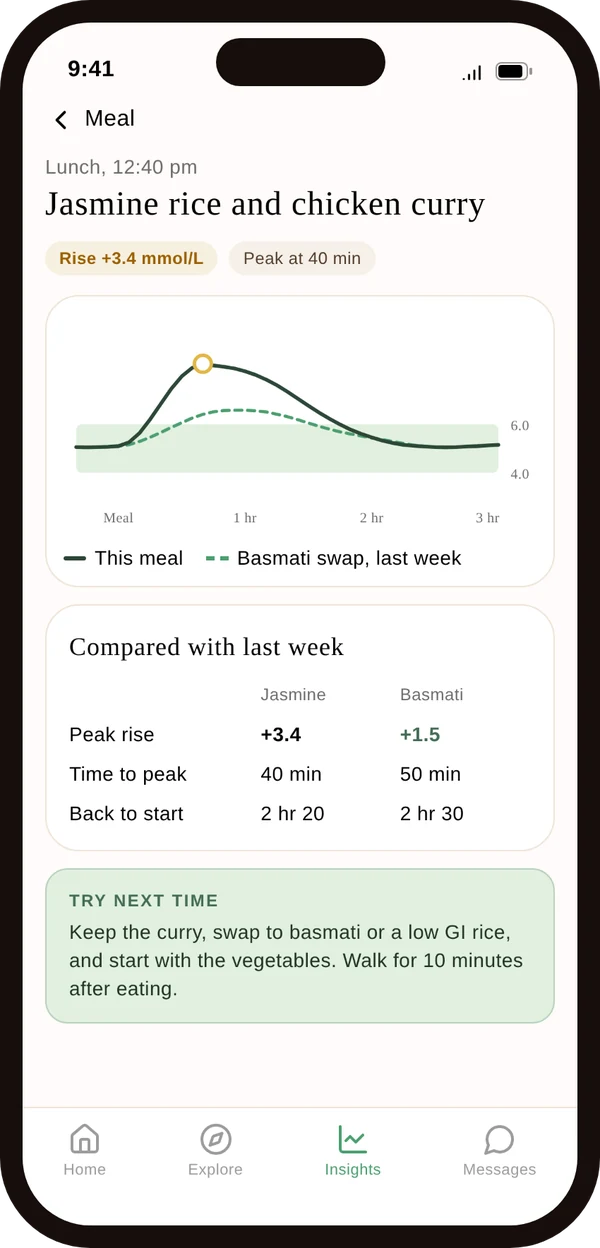
GI tables tell you about honey in general. A CGM shows what happens in your body, with your portion and your breakfast. In the Vively app, you log what you eat and see your readings against a 4 to 6 mmol/L range for people without diabetes. Diabetes Australia gives 4.0 to 7.8 mmol/L as the usual range across the day, including after meals. You can read more about how continuous glucose monitors work.
The Vively CGM program pairs a 14-day sensor with the app, so you can see how honey, your breakfast, a walk or a bad night's sleep shift your glucose, and our dietitians can help you act on it through the membership. If you want to know what is happening underneath, the Baseline Health Check measures 70+ markers, including fasting glucose, HbA1c and fasting insulin, read against optimal ranges. Our guide to carbohydrates and GI is a good next read.
Wear a CGM sensor for 14 days and see how your meals, sleep, stress and movement shift your glucose, with dietitian support to help you decide what to change.
It depends on the honey. Pure Australian eucalypt honeys such as yellow box (35), stringybark (44), red gum (46) and ironbark (48) tested low GI at the University of Sydney. Commercial blends tested medium to high, at 62 and 72. Worldwide, honeys have tested from 32 to 87.
There is no good evidence that it does. A 2010 German study found heated linden honey tested at GI 49 and the same honey unheated at 60. Floral source and the fructose to glucose ratio matter far more than whether a honey is raw or heated.
Slightly, for some honeys. Low GI honeys raise glucose more slowly than table sugar (GI about 60). But a teaspoon of honey has about 5 g of sugar, and both count as free sugars. Amount and what you eat with it matter more than the swap.
Between 54 and 59 for five New Zealand manuka honeys tested in 2013 (Chepulis and Francis), which is low to medium GI. One high-strength manuka product tested at 65 in a University of Otago report. Its antibacterial reputation does not change its sugar content.
Yes, in small amounts counted as carbohydrate, the same way as sugar. Honey raises blood glucose, and a lower GI honey only slows that. If you have diabetes, your diabetes educator or dietitian can help you fit it into your meal plan and targets.
START YOUR BASELINE
Vively includes a Baseline Health Check with 70+ biomarkers, a results report and practitioner support in the $99 a month membership. No minimum term.
Explore Baseline Health CheckSubscribe to our newsletter & join a community of 30,000+ Aussies

Start a PCOS assessment with your GP. Learn which blood tests matter, when ultrasound or AMH is useful, and how contraception affects results.

Know what to do about an unexpected high blood sugar reading, when to seek urgent help, and which everyday habits support longer-term glucose care.





Vively is a general wellness platform and does not provide medical advice, diagnosis, or treatment. Any information, insights or guidance offered through our app, website, programs, or coaches is for educational and informational purposes only and should not be considered a substitute for professional medical advice or care. Always consult a qualified healthcare provider before making any health-related decisions.
We acknowledge the Traditional Custodians of the lands where we live and work, the Gadigal of the Eora Nation. We pay our respects to their Elders past and present.
 Share
 Tweet
 Share