Allulose vs stevia: which is better for your blood sugar?
Allulose vs stevia for blood sugar: what each is, Australian rules, trial evidence, side effects, and what Vively members' CGMs show for sweetened drinks.

On this page
In short
- Neither allulose nor stevia raises blood glucose in a meaningful way, so both are better choices than table sugar for your blood sugar.
- Stevia has no kilojoules and is 150 to 300 times sweeter than sugar, while allulose has about 70% of sugar's sweetness and 2 kJ per gram.
- Allulose suits baking but can cause bloating or diarrhoea in large amounts, so keep to under about 28 g at one time for a 70 kg adult.
From Vively member data
0.8 mmol/L
Rise after no-sugar soft drink
the same as black coffee, 554 members
1.9 mmol/L
Rise after regular soft drink
more than twice the sugar-free rise, 341 members
0.9 mmol/L
Typical rise after water
normal background drift over 2 hours, 834 members
Neither allulose nor stevia raises blood glucose in a meaningful way, so for blood sugar both beat table sugar. Stevia has no kilojoules and is 150 to 300 times sweeter than sugar. Allulose tastes and bakes more like sugar, at about 70% of the sweetness and 2 kJ per gram, but large amounts can upset your gut.
You can see the difference between a sugar-sweetened and a sugar-free drink in real glucose data. We looked at what happened in the two hours after Vively members with a continuous glucose monitor (CGM) logged a drink on its own.
The typical rise after a no-sugar soft drink (0.8 mmol/L) matched black coffee and water. A regular soft drink gave more than twice that (1.9 mmol/L).
See the numbers as a table
| Value | Members | |
|---|---|---|
| Typical rise in the 2 hours after, mmol/L: Water | 0.9 | 834 |
| Typical rise in the 2 hours after, mmol/L: Black coffee | 0.8 | 1,531 |
| Typical rise in the 2 hours after, mmol/L: No-sugar soft drink | 0.8 | 554 |
| Typical rise in the 2 hours after, mmol/L: Regular soft drink | 1.9 | 341 |
Water gave a typical "rise" of 0.9 mmol/L. That is the background: glucose drifts up and down through the day with stress, movement and the time since your last meal, and the app measures the highest point in two hours. Against that background, the sugar-free drinks did nothing extra. The sugary ones gave the kind of rise we explain in our guide to glucose spikes. Half of members had a typical rise of 1.0 to 3.0 mmol/L after a regular soft drink.
Very few members log stevia or allulose on its own, because people add them to coffee, porridge or baking, so we cannot show those two separately. The trials below fill that gap.
Allulose vs stevia at a glance
| Allulose | Stevia | |
|---|---|---|
| What it is | A rare sugar, made from fructose | Sweet compounds (steviol glycosides) from the leaves of the stevia plant |
| Sweetness | About 70% of sugar | 150 to 300 times sugar |
| Energy | 2 kJ per gram (sugar is 17) | None in the amounts used |
| Effect on glucose | Does not raise it; may slightly lower the rise from a sugary food | No meaningful effect |
| Status in Australia | Approved by FSANZ as a novel food in 2024 (A1247) | Permitted food additive 960 |
| Cooking | Adds bulk like sugar; you need about 40% more for the same sweetness | Heat stable but adds no bulk, so recipes need adjusting |
| Main downside | Bloating or diarrhoea in large amounts | Bitter or liquorice aftertaste for some people |
What is allulose?
Allulose (also called D-allulose or D-psicose) is a sugar with the same chemical formula as fructose but a slightly different shape, so your body barely uses it for energy. FSANZ's 2024 assessment found that about 80% of a dose is absorbed in the small intestine and passed out quickly in urine. Most of the rest leaves unchanged in the faeces.
FSANZ approved allulose as a novel food in 2024 under application A1247. It can be sold as a tabletop sweetener and added to a set list of foods, such as soft drinks, within limits. Many foods with added allulose must carry a warning that eating too much may have a laxative effect, and allulose does not count towards "sugars" on the nutrition panel. FSANZ gave it an energy factor of 2 kJ per gram, against 17 for sugar.
Does allulose lower blood sugar?
Allulose does not raise blood glucose, and it may blunt the rise from a sugary food a little. In a 2021 crossover trial of 30 adults without diabetes (Franchi and colleagues), adding 10 g of allulose to a 50 g sucrose drink lowered glucose at 30 minutes by about 0.7 mmol/L (12 mg/dL). Three of the authors worked for an allulose manufacturer.
A 2018 Canadian trial (Braunstein and colleagues, the FACE trial) gave 25 healthy adults 5 or 10 g of allulose with a 75 g glucose drink and found no significant effect. So the honest summary is that allulose is a good swap for sugar, and any extra glucose-lowering effect is small and not reliable enough to plan around.
What is stevia?
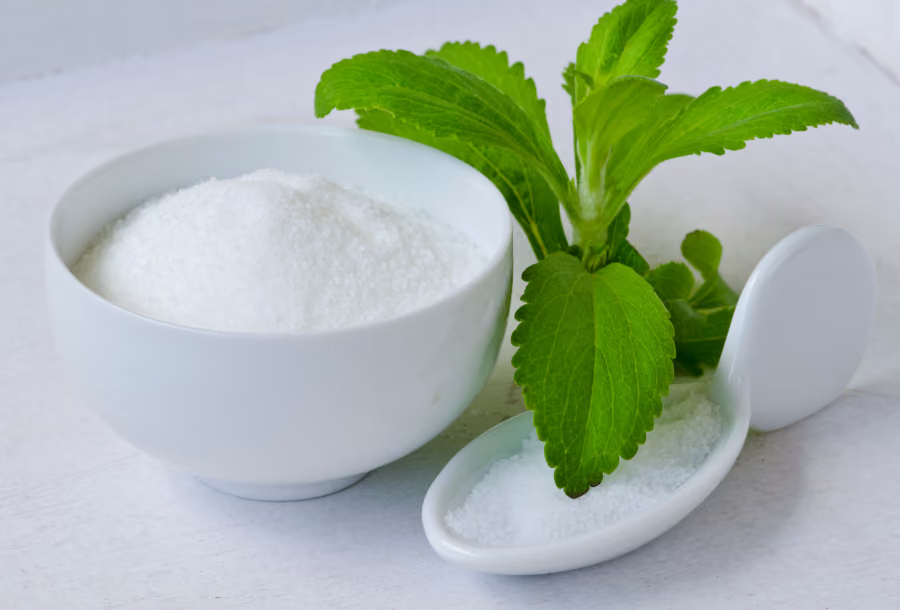
Stevia sweeteners are purified steviol glycosides from the leaves of Stevia rebaudiana, a plant from South America. In Australia they are a permitted food additive, number 960. FSANZ sets an acceptable daily intake of 4 mg per kg of body weight, measured as steviol equivalents: about 280 mg a day for a 70 kg adult. FSANZ's 2023 review of intense sweeteners found no public health and safety issues.
Check what is in the packet. Many stevia products on Australian shelves are mostly erythritol (968) with a little stevia for sweetness. CSR Smart is cane sugar blended with stevia, so it still contains sugar and will raise your glucose, though by less than the same sweetness from sugar alone. For how stevia stacks up against the other common tabletop sweetener, see sucralose vs stevia.
Does stevia raise blood sugar or insulin?
No, not in the amounts people use. The larger claim that stevia lowers blood sugar has weak support. A 2024 meta-analysis of 26 studies (Zare and colleagues, 1,439 people) found fasting glucose fell by about 0.2 mmol/L, rated low certainty, mostly at doses above 3 g a day, which is far more than anyone puts in their coffee. It found no effect on insulin or HbA1c. An earlier review of randomised trials (Bundgaard Anker and colleagues, 2019) found no significant change in fasting glucose or HbA1c.
“In the days prior to processed foods, sweet food meant the food was both safe and full of energy. There is no known poison that tastes sweet.”
Dr Michelle Woolhouse, Vively Medical Director
Allulose side effects and stevia side effects
The main side effect of allulose is in the gut. The part that is not absorbed draws water into the bowel, which can cause bloating, wind or diarrhoea. FSANZ's assessment suggests keeping it under 0.4 g per kg of body weight at one time (about 28 g for a 70 kg adult) and under 0.9 g per kg across a day.
Pure stevia rarely causes gut symptoms, but erythritol blends can, especially in people with irritable bowel syndrome. The other common complaint is the bitter or liquorice aftertaste, which is why many products blend stevia with other sweeteners.
Allulose vs stevia: which is healthier?
For your glucose, both are better than sugar, and there is no strong evidence that one is healthier than the other. The better choice is the one you will use in small amounts. Allulose suits baking. Stevia suits drinks.
Sweeteners do not fix the habit behind the sugar. In 2023 the World Health Organization advised against using non-sugar sweeteners to control weight, after reviewing evidence that they did not help with fat loss over the long term. That advice does not apply to people who already have diabetes, for whom a sweetener can be a sensible way to cut sugar. The WHO review also found that, in observational studies, long-term sweetener use was linked with a higher risk of type 2 diabetes, though studies of that kind cannot prove cause. Our post on diet soft drinks and diabetes looks at that link in detail.
“Good nutrition is not only what you put in, but also what you leave out.”
Dr Michelle Woolhouse, Vively Medical Director
If sweet cravings are what you are fighting, look upstream: poor sleep and stress both push them up, as we explain in stress and sugar cravings. And if you are weighing up other sugar swaps, our guide to inverted sugar covers one that does raise glucose.
Test it on your own glucose
The cleanest way to see what a sweetener does to you is to try it on its own and watch. With a continuous glucose monitor, have a drink sweetened with stevia or allulose mid-morning, at least three hours after eating, log it as the only item, and compare it with the same drink made with sugar on another day. Expect some background movement, as the water result above shows.
How Vively can help
If you are switching sweeteners because you worry about your blood sugar, measure it. The Vively Baseline blood test covers 70+ markers, including HbA1c and fasting insulin, read against optimal ranges, and a practitioner explains your results. The CGM program pairs a sensor with the app and dietitian support, so you can test your own swaps and see which ones matter.
Wear a CGM sensor for 14 days and see how drinks, meals, sleep and stress shift your glucose, with a dietitian to help you read the pattern.
Frequently asked questions
Is allulose better than stevia?
Not for blood sugar. Neither raises glucose in a meaningful way. Allulose is better for baking and cold desserts because it behaves like sugar, while stevia is better for drinks because a tiny amount goes a long way and it has no kilojoules. Allulose is more likely to cause bloating in large amounts.
What are the side effects of allulose?
Bloating, wind and diarrhoea are the main ones, because the unabsorbed part draws water into the bowel. FSANZ's 2024 assessment suggests keeping to under 0.4 g per kg of body weight at one time, about 28 g for a 70 kg adult. Foods with added allulose must carry a laxative warning in Australia.
Is allulose approved in Australia?
Yes. FSANZ approved D-allulose as a novel food under application A1247 in 2024. It can be sold as a tabletop sweetener and added to listed foods within set limits. For the first 15 months only one brand could be sold, and that exclusive period has now ended.
Does stevia spike insulin?
No. In the amounts people use, stevia does not raise glucose and has not been shown to raise insulin. A 2024 meta-analysis of 26 studies found no effect on insulin levels or HbA1c. Products that blend stevia with sugar, such as CSR Smart, are different: the sugar part still raises glucose.
What is allulose made from?
Commercial allulose is made from fructose, using an enzyme that changes the shape of the molecule. The FSANZ approval covers allulose made with a specific enzyme from the bacterium Microbacterium foliorum. Small amounts of allulose also occur naturally in some foods.
Sources
- Food Standards Australia New Zealand. A1247: D-allulose as a novel food (approval report, 2024).
- Food Standards Australia New Zealand. Intense sweeteners.
- Franchi F, et al. Effects of D-allulose on glucose tolerance and insulin response to a standard oral sucrose load. BMJ Open Diabetes Research and Care, 2021.
- Braunstein CR, et al. The Fructose and Allulose Catalytic Effects (FACE) trial. Nutrients, 2018.
- Zare M, et al. Effect of stevia on blood glucose and HbA1C: a meta-analysis. Diabetes and Metabolic Syndrome, 2024.
- Bundgaard Anker CC, et al. Effect of steviol glycosides on human health with emphasis on type 2 diabetic biomarkers. Nutrients, 2019.
- World Health Organization. Use of non-sugar sweeteners: WHO guideline. 2023.
The Baseline Health Check is a blood test covering 70+ markers at one of 3,700+ collection centres. Your dietitian goes through your results with you and builds your plan. $99$79 this Black Friday, ends 1 Dec. Then $99 a month, cancel anytime.