Brown rice usually raises blood sugar a little more gently than white rice, but variety matters more than colour. Brown rice has tested anywhere from GI 50 to 86, and common white rice 62 to 73. In Australia, SunRice Low GI white rice (Doongara) tests 53 to 54, lower than many brown rices.
Typical rise in blood sugar (mmol/L) when Vively members wearing a continuous glucose monitor ate each food on its own. Each food has at least 30 members behind it.
GI tables come from lab tests on small groups. Real responses vary a lot from person to person. See the curves on our glucose spikes page, or try a CGM to see your own.
The table puts the two side by side on the things that affect your glucose. Below it, the explorer shows the tested GI of each white and brown rice, so you can see how much the two overlap.
| White rice | Brown rice | |
|---|---|---|
| What is milled off | Husk, bran and germ | Husk only |
| Typical GI | 62 to 73 for common long grain and boiled white rice; jasmine 79 to 109 | 50 to 86; international average about 68 |
| Low GI option in Australia | SunRice Low GI White (Doongara), 53 to 54 | SunRice Low GI Brown, 54 |
| Highest GI types | Jasmine, sticky and low-amylose medium grain | Quick-cooking brown rice, 80 |
| Glycaemic load, 1 cup | 35 (boiled white, GI 66) | 20 (boiled brown, GI 50) |
| Fibre | Low, as the bran is removed | Higher, as the bran and germ are kept |
| Link with type 2 diabetes | Each extra daily serve linked to 11% higher risk, strongest in Asian populations | Two or more serves a week linked to lower risk in US cohorts |
Brown rice has a GI anywhere from 50 to 86, so it can be low, medium or high depending on the variety and how it was processed. International tables put the average at about 68, which is medium.
The spread comes from the grain inside the bran:
You will often see brown rice quoted online at a tidy 50 to 55. The tested data does not support one number like that, and some brown rice digests as fast as white.

Most white rice sold in Australia is medium to high GI: about 62 for long grain, 66 to 73 for boiled white rice in international tables, and 79 to 109 for jasmine. Basmati (43 to 69) usually sits in the medium range, and high-amylose Doongara white rice tests low at 53 to 54.
If you want every option ranked, including parboiled, Koshihikari, red and black rice, our low GI rice guide covers 16 types and the kitchen tricks that lower the glucose response, such as chilling and reheating.
Amylose content explains more of the difference between rices than whether the bran is on or off.
Rice starch comes in two forms. Amylose has long, straight chains that pack tightly and digest slowly. Amylopectin is branched and opens up quickly in hot water. In a University of Sydney comparison of 10 rice products, a low-amylose white rice scored 93, a high-amylose rice 64 and a quick-cooking brown rice 80. A high-amylose white rice can therefore beat a quick-cooking brown one.
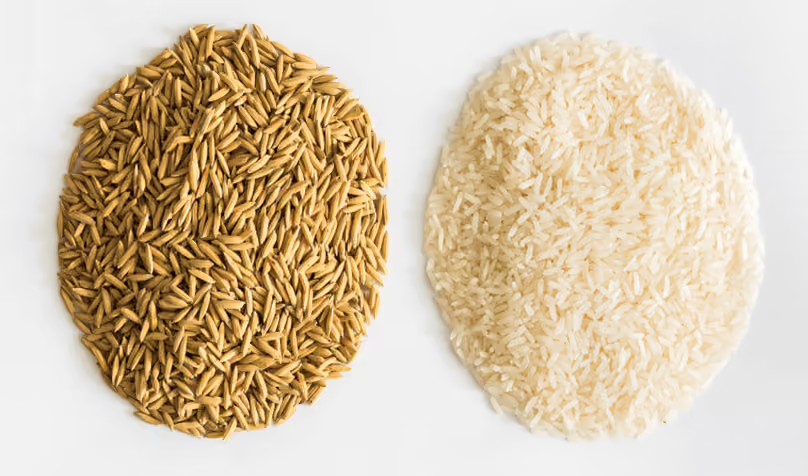
Milling is the other half of the story. All rice grows inside an inedible husk. Remove only the husk and you have brown rice, with the bran and germ still on. Mill those off too and you have white rice, which loses the fibre, B vitamins and minerals concentrated in those outer layers.
Yes, white rice can cause a fast, high rise in glucose, especially low-amylose types such as jasmine and sticky rice eaten in a large serve on their own. How high it goes depends on the rice, the serve and what you eat with it.
For people without diabetes, Diabetes Australia says glucose generally sits between 4.0 and 7.8 mmol/L across the day, including after meals. A rise after rice is normal. What deserves attention is a pattern of readings well above that range, which our guide to blood sugar after eating explains.
Serve size matters as much as the rice. Glycaemic load (GL) multiplies GI by the carbohydrate in a serve. A cup of boiled white rice has a GL of about 35 in the Linus Pauling Institute table, well into the high band of 20 or more. Half a cup roughly halves it.
Rice contains very little sugar, but its starch is built from glucose, and digestion breaks it back down into glucose. A low sugar figure on the label tells you little about how rice affects your blood glucose.
White and brown rice are both mostly starch. The numbers that predict your glucose response are the GI, which reflects how fast that starch is digested, and the size of the serve.
Brown rice is a reasonable choice for people with diabetes or prediabetes, especially a high-amylose type such as SunRice Low GI Brown, but a large serve of any rice will still raise glucose.
The long-term research leans towards brown. A 2012 BMJ meta-analysis of seven cohort analyses covering 352,384 people found each extra daily serve of white rice was linked to an 11% higher risk of type 2 diabetes. The link was strongest in Asian populations, where the highest intake carried a 55% higher risk than the lowest, and was not significant in Western populations.
In US cohorts (Sun 2010), eating white rice five or more times a week was linked to higher risk, and brown rice twice a week or more to lower risk, compared with less than once a month. Swapping 50 g a day of white rice for brown was estimated to cut risk by 16%. These are observational studies, so they show a link rather than proof, and people who choose brown rice may differ in other ways too.
If you have diabetes, Diabetes Australia's general targets are 4.0 to 7.0 mmol/L before meals and 5.0 to 10.0 mmol/L two hours after you start eating, and your GP or specialist sets your individual targets. If you are worried about your risk, the signs of prediabetes are often subtle, so a blood test is the surer check.
Pick the variety first, then get the serve and the plate right.
Rice choices matter most when your metabolism is already under strain, and a blood test can show that before you notice anything. The Baseline Health Check measures fasting glucose, HbA1c and fasting insulin among 70+ markers from one blood draw, with the doctor's referral arranged for you. A practitioner then explains your results against optimal ranges.
The Baseline Health Check measures 70+ markers, including fasting glucose, HbA1c and fasting insulin, from one blood draw at one of 3,700+ partner collection centres. Results land in the app within a few days, read against optimal ranges.
Usually, but not always. On average brown rice has a slightly lower GI (about 68 versus 73 in international tables) and more fibre. Variety matters more, though: high-amylose white rice such as SunRice Low GI (53 to 54) beats quick-cooking brown rice (80). Pick a low GI variety of either and keep the serve modest.
Often, yes. Common white rice tests at 62 to 73 and jasmine at 79 to 109, while brown rice averages about 68. A large bowl of jasmine or sticky rice on its own is the classic cause of a sharp rise. A low GI white rice, a smaller serve and plenty of vegetables and protein all soften it.
Very little. White rice is almost all starch, not sugar. But that starch is made of glucose and is digested back into glucose, which is why rice raises blood glucose despite its low sugar content. The GI of the rice and the size of the serve are better guides than the sugar line on the label.
Somewhat, depending on the type. The bran adds fibre, and high-amylose brown rice such as SunRice Low GI Brown (GI 54) digests slowly. Ordinary brown rice averages a medium GI of about 68, and quick-cooking brown rice tested at 80, which counts as fast. Check the variety rather than relying on colour.
They are close. Basmati has tested at 43 to 69, often quoted at about 58, and brown rice at 50 to 86 with an average of about 68. A typical basmati may digest a little more slowly than a typical brown rice, while brown keeps more fibre. A low GI version of either is a good pick.
START YOUR BASELINE
Vively includes a Baseline Health Check with 70+ biomarkers, a results report and practitioner support in the $99 a month membership. No minimum term.
Explore Baseline Health CheckSubscribe to our newsletter & join a community of 30,000+ Aussies

Start a PCOS assessment with your GP. Learn which blood tests matter, when ultrasound or AMH is useful, and how contraception affects results.


Know what to do about an unexpected high blood sugar reading, when to seek urgent help, and which everyday habits support longer-term glucose care.
.avif)


.svg)


Vively is a general wellness platform and does not provide medical advice, diagnosis, or treatment. Any information, insights or guidance offered through our app, website, programs, or coaches is for educational and informational purposes only and should not be considered a substitute for professional medical advice or care. Always consult a qualified healthcare provider before making any health-related decisions.
We acknowledge the Traditional Custodians of the lands where we live and work, the Gadigal of the Eora Nation. We pay our respects to their Elders past and present.
 Share
Share Tweet
Tweet Share
Share