


The best blood glucose monitor in Australia for most people is a continuous glucose monitor (CGM) such as FreeStyle Libre 2 Plus or Dexcom G7, which have the lowest published error of the sensors sold here (MARD 8.2%). The cheapest CGM is CareSens Air, at about $42 to $51 for 14 days of wear. If you only need an occasional check, a finger-prick meter such as the Accu-Chek Guide Me ($34.99) or Contour Next ($39.99) is far cheaper. Vively’s own CGM Program uses the Sibionics GS3 sensor (MARD 8.7%) with the Vively app, from $124.75 a sensor.
Below are seven CGMs and five blood glucose meters you can buy in Australia, with price, wear time and accuracy where the maker publishes it. We checked prices on 3 November 2026.
Cost per 14 days is the sensor price times 14, divided by the wear days, so a 10-day sensor costs more per fortnight than a 15-day one. MARD (mean absolute relative difference) is the average gap between sensor and lab readings: lower is more accurate.
| Sensor | Wear | MARD | Cost per 14 days |
|---|---|---|---|
| Vively CGM Program (ours): Sibionics GS3 with the Vively app8.7% | 14 days | 8.7% | $125 to $199 $199 for 1, $358 for 2, $499 for 4 |
| CareSens Air (Pharmaco)10.4% | 15 days | 10.4% | $42 to $51 $55 each, from $45 on subscription |
| Sibionics GS3, sensor only (Air Liquide Healthcare)8.7% | 14 days | 8.7% | $89 to $99 $99 each, $178 for 2 on subscription |
| Dexcom ONE+ (AMSL)Not published separately | 10 days | Not published separately | $94 $66.90 each |
| FreeStyle Libre 2 Plus (Abbott)8.2% | 15 days | 8.2% | $95 $102 each; NDSS co-payment $17.90 a box if eligible |
| Accu-Chek SmartGuide (Roche)9.2% | 14 days | 9.2% | $100 $99.95 each; adults 18+ |
| Dexcom G7 (AMSL)8.2% (arm) | 10 days | 8.2% (arm) | $154 $110 each; NDSS if eligible |
Both publish a MARD of 8.2%. Dexcom G7 measured 8.2% on the arm in a study of adults with diabetes, and Abbott quotes 8.2% for Libre 2 Plus. Libre 2 Plus lasts 15 days for $102, so it costs about $95 a fortnight. Dexcom G7 lasts 10 days (plus a 12-hour grace period) for $110, about $154 a fortnight. If you use an insulin pump, ask your diabetes team which sensor works with it.
CareSens Air costs $55 for a 15-day sensor, or from $45 on Pharmaco’s subscription, which works out at $42 to $51 for 14 days. Shipping is $12.50 to $15 an order. Its published MARD is higher, at 10.4% in a 2024 study of 83 adults.
Dexcom ONE+ costs $66.90 a sensor, and Dexcom describes it, alongside G7, as its most accurate CGM system. It lasts 10 days with a 12-hour grace period and a 30-minute warm-up. Dexcom markets it to people with type 2 diabetes who pay privately.
Roche’s SmartGuide is a 14-day sensor for adults with diabetes, at $99.95. Its companion app predicts glucose 30 minutes and 2 hours ahead and flags overnight lows. Roche publishes a MARD of 9.2%.
Air Liquide Healthcare sells the GS3 for $99, or $178 for two every 28 days on subscription. It lasts 14 days, is 2.9 mm thick and lists a MARD of 8.7%. The Sibionics app is built for diabetes care.
This is our product, so weigh our view accordingly. The Vively CGM Program uses the same Sibionics GS3 sensor and adds the Vively app, which shows your readings against a 4 to 6 mmol/L range instead of the 3.9 to 10.0 mmol/L range used in diabetes care. You log meals, sleep and activity next to your glucose, and you can see blood test results in the same app. It costs $199 for one sensor, $358 for two or $499 for four ($124.75 a sensor), with 12 months of app access. Dietitian coaching comes with the $99 a month Vively membership. If you only want the hardware and are happy reading the numbers yourself, the GS3 on its own is cheaper.

A meter tests a drop of blood from your fingertip. Every meter sold in Australia must meet the ISO 15197:2013 accuracy standard, which requires 95% of readings at or above 5.5 mmol/L to be within 15% of a lab result. That means the meter matters less than the ongoing cost of test strips.
| Meter | Price | Measures and where |
|---|---|---|
| LifeSmart Blood Glucose and Ketone Meter | $21.99 | Glucose and ketones. Chemist Warehouse |
| Accu-Chek Guide Me meter kit | $34.99 | Glucose; Bluetooth app. Chemist Warehouse; strips $47.99 for 100 |
| FreeStyle Optium Neo | $35.99 | Glucose and ketones. Discount Chemist |
| CareSens Dual | $37.85 | Glucose and ketones; Bluetooth. Discount Chemist (out of stock when checked) |
| Contour Next meter | $39.99 | Glucose. TerryWhite Chemmart |
Choose a meter whose strips are easy to buy, and a glucose and ketone meter (Optium Neo, CareSens Dual, LifeSmart) if you have type 1 diabetes or follow a very low carbohydrate diet. Keep a meter even if you use a CGM, to check readings that don’t match how you feel.
MARD figures come from different studies with different people, sensor sites and lab methods, so a gap of 0.5% between two brands is not a reliable ranking. Sensors read glucose in the fluid under your skin, which lags a few minutes behind blood, and lying on a sensor overnight can give a false low. Comfort, adhesive, app and cost matter as much as a few tenths of a percent.
The bigger reason to use a CGM is that glucose responses to the same food differ a lot from person to person, and a finger prick only shows one moment.
Our members’ CGM data shows how wide that spread is. We looked at Vively members who logged a single food as the whole meal.
Typical rise in blood sugar (mmol/L) when Vively members wearing a CGM ate each food on its own. Each food has at least 30 members behind it.
Lab tests and averages hide a wide spread between people. See the curves on our glucose spikes page, or try a CGM to see your own.
This is real-world app data, not a lab test. Portions weren’t measured, and members may have eaten something they didn’t log. The members don’t have type 2 diabetes. Data covers 1 January 2022 to 12 October 2026.
If you take insulin or other glucose-lowering medicine, choose your device with your diabetes team and don’t change your treatment based on app readings alone.
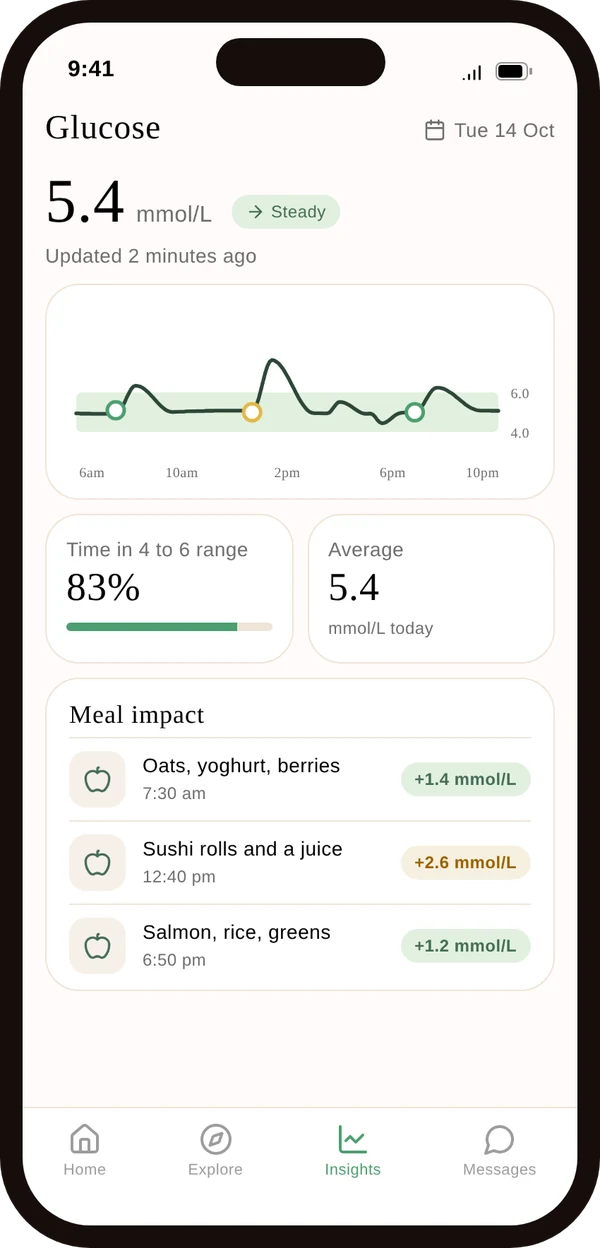
Wear a Vively CGM for 14 days and compare your readings after different meals in the Vively app.
For continuous readings, FreeStyle Libre 2 Plus and Dexcom G7 have the lowest published MARD (8.2%). Libre 2 Plus is cheaper per fortnight ($95 against $154). For finger-prick checks, any TGA-listed meter meets the same ISO accuracy standard, so pick on strip price.
CareSens Air, at $55 a sensor or from $45 on subscription, which is about $42 to $51 for 14 days of wear. Sibionics GS3 is next at $99 for 14 days.
People with type 2 diabetes aren’t eligible for NDSS-subsidised CGMs, so cost matters. FreeStyle Libre 2 Plus ($95 per 14 days) and Dexcom ONE+ ($94 per 14 days) offer good accuracy at a similar price. Ask your GP or diabetes educator which suits your treatment.
Any accurate sensor will measure your glucose, but apps built for diabetes use a 3.9 to 10.0 mmol/L range. The Vively CGM Program (ours) uses the Sibionics GS3 with an app set to 4 to 6 mmol/L and meal logging next to your readings.
Paying privately, Dexcom ONE+ costs $66.90 a sensor and Dexcom G7 costs $110 a sensor from AMSL, as of 3 November 2026. Each lasts 10 days. People with type 1 diabetes can get G7 through the NDSS.
Yes. A CGM reads glucose through a thin filament under the skin and sends it to your phone. Keep a meter for readings that don’t match how you feel.
No. CGM subsidies run through the NDSS, mainly for people with type 1 diabetes. Everyone else pays privately.
No. You can buy CGM sensors privately in Australia without a prescription. NDSS-subsidised sensors need an authorised diabetes health professional to approve access.
START YOUR BASELINE
Vively includes a Baseline Health Check with 70+ biomarkers, a results report and practitioner support in the $99 a month membership. No minimum term.
Explore Baseline Health CheckSubscribe to our newsletter & join a community of 30,000+ Aussies

Start a PCOS assessment with your GP. Learn which blood tests matter, when ultrasound or AMH is useful, and how contraception affects results.

Know what to do about an unexpected high blood sugar reading, when to seek urgent help, and which everyday habits support longer-term glucose care.





Vively is a general wellness platform and does not provide medical advice, diagnosis, or treatment. Any information, insights or guidance offered through our app, website, programs, or coaches is for educational and informational purposes only and should not be considered a substitute for professional medical advice or care. Always consult a qualified healthcare provider before making any health-related decisions.
We acknowledge the Traditional Custodians of the lands where we live and work, the Gadigal of the Eora Nation. We pay our respects to their Elders past and present.

 Share
 Tweet
 Share