


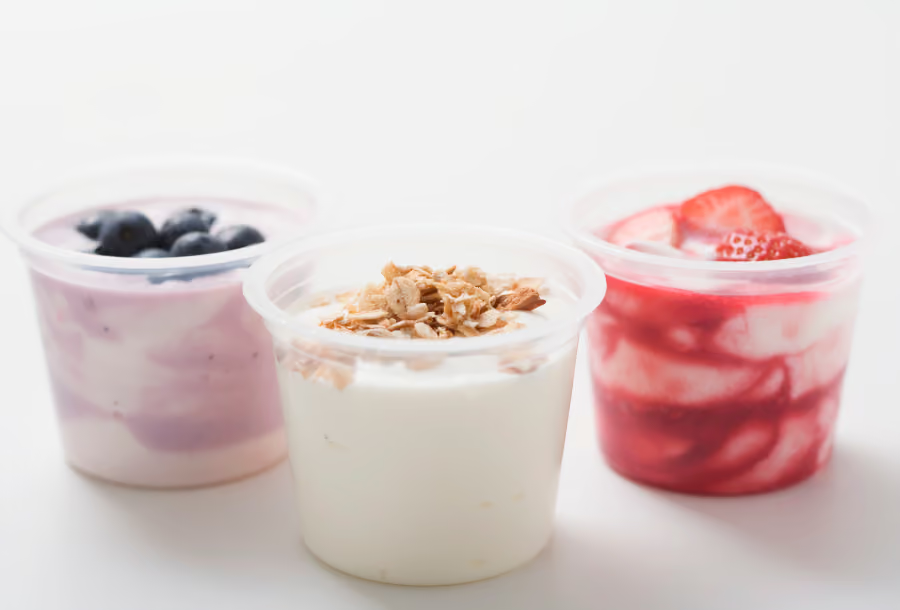
The lowest carb yoghurts in Australia are plain and unsweetened, with about 3.5 to 5.7 g of carbohydrate per 100 g. In dairy yoghurt almost all of that is lactose, the milk's own sugar. Of the labels we checked on 27 October 2026, YoPRO Plain had the least (3.5 g). A sweetened Greek style tub had 11 g.
We read the nutrition panels on plain, Greek, high protein, lactose free and coconut yoghurts sold in Australian supermarkets. One sweetened tub is in the table so you can see how far sugar moves the numbers.
| Yoghurt | Carbs / sugars | Protein | What to know |
|---|---|---|---|
| YoPRO Plain (700 g tub) | 3.5 g / 3.5 g | 10.6 g | Skim milk with lactase added. No sweetener. |
| Chobani Greek Natural (907 g) | 3.9 g / 2.7 g | 8.6 g | Strained, so more protein and less lactose. 4 g fat. |
| Chobani Greek Natural Light | 4.0 g / 3.3 g | 9.3 g | Strained and almost fat free. |
| YoPRO Vanilla (700 g tub) | 3.8 g / 3.2 g | 9.5 g | Sweetened with stevia (steviol glycosides). |
| Jalna Pot Set Lactose Free Greek Style (170 g) | 3.8 g / 3.1 g | 3.3 g | Lactose free. Not strained, so less protein. |
| Farmers Union Greek Style All Natural (2 kg) | 4.7 g / 4.7 g | 4.5 g | Made thick with milk solids and cream. |
| COYO Natural coconut (900 g) | 5.7 g / 0.7 g | 1.4 g | Dairy free. Carbs are mostly starch. 10.1 g saturated fat. |
| Jalna Pot Set Sweet & Creamy Greek Style (2 kg) | 11.0 g / 9.1 g | 3.5 g | Sugar added. Shown for comparison. |
Plain high protein and strained Greek yoghurts have the fewest carbs, at about 3.5 to 4 g per 100 g. YoPRO Plain, Chobani Greek Natural and Chobani Natural Light all sit in that range and carry 8.6 to 10.6 g of protein per 100 g.
The word Greek on an Australian label does not tell you much. Strained yoghurts lose some of their whey, and lactose goes with it, so they end up thicker, higher in protein and a little lower in sugar. Many tubs sold as Greek style are thickened with milk solids or cream instead. They are lovely to eat, but the protein line usually reads 3 to 5 g and the sugars line a bit higher.
So read two lines on the panel. Carbohydrate tells you how much will reach your bloodstream as glucose. Protein tells you how filling the yoghurt will be and how much it may soften the rise from anything you eat with it. If you are chasing protein generally, our list of high protein foods in Australia has more options.
Lactose free yoghurt has the same amount of sugar as regular yoghurt. The added lactase enzyme splits lactose into glucose and galactose, which is why it tastes a little sweeter, but the carbohydrate total barely changes. Choose it because lactose upsets your gut, not to cut carbs.
Coconut yoghurt is low in sugar but not low in carbohydrate once starch is counted, and it has very little protein. COYO Natural has 5.7 g of carbs, 1.4 g of protein and 10.1 g of saturated fat per 100 g. It works if you avoid dairy. It is a different food from a high protein dairy yoghurt.
Milk naturally contains lactose. When yoghurt is made, bacteria ferment some of that lactose into lactic acid, which gives yoghurt its tang, and the rest stays behind. That is why even the plainest tub shows 3 to 5 g of sugars per 100 g. Those sugars are not added sugar, and the ingredients list will confirm it: milk, cream, cultures, sometimes lactase.
You will often see the advice to pick a yoghurt with less than 5 g of carbs per 100 g. Treat that as a label shortcut. Plain dairy yoghurts land between about 3.5 and 5 g, so anything well above that almost always has fruit, honey or sugar in it. It is not a medical cut-off, and 6 g per 100 g of unsweetened yoghurt is not a problem for most people.
For anyone eating keto, the sums are simple. A 170 g pot of plain strained yoghurt has about 6 to 7 g of carbohydrate. A 170 g pot of sweetened Greek style has closer to 19 g.
“Good nutrition is not only what you put in, but also what you leave out.”
Dr Michelle Woolhouse, Vively Medical Director
Usually not by much. When Vively members wearing a continuous glucose monitor ate yoghurt on its own, the typical rise was 0.9 mmol/L across 2,074 members. That is smaller than the rise members saw from an apple (1.2 mmol/L) or a banana (1.6 mmol/L).
Eaten on its own, high protein yoghurt gave the smallest typical rise (0.7 mmol/L). Plain or Greek yoghurt came in at 0.9, flavoured and coconut yoghurts at 1.1.
Typical rise in glucose, yoghurt eaten on its own (mmol/L)
| Vively CGM members | |
|---|---|
| Protein | 0.7 (n=562) |
| Plain | 0.9 (n=1,203) |
| Flavoured | 1.1 (n=516) |
| Coconut | 1.1 (n=174) |
Typical rise in glucose, yoghurt as part of a meal (mmol/L)
| Vively CGM members | |
|---|---|
| Protein | 1.0 (n=1,136) |
| Plain | 1.2 (n=4,850) |
| Flavoured | 1.2 (n=1,147) |
| Coconut | 1.2 (n=851) |
The high protein tubs, most of them skim, gave smaller rises than plain or Greek yoghurt as a group, and their extra protein may be part of the reason. And once yoghurt was logged as part of a meal, the typical rise climbed to about 1.2 mmol/L, most likely because the muesli, fruit or toast alongside brought their own carbohydrate.
A rise like that is normal. Diabetes Australia gives 4.0 to 7.8 mmol/L as the usual range across the day for people without diabetes, after meals included. If you want to see where your own after-meal numbers sit, our guide to blood sugar after eating walks through it.
“Eat a breakfast loaded with protein: Greek yoghurt, eggs, tofu and meat are all good options.”
Dr Michelle Woolhouse, Vively Medical Director
Plain, unsweetened yoghurt is the best everyday choice if you have diabetes or prediabetes, and the brand matters less than the label. Diabetes Australia notes that yoghurt has a low glycaemic index, and the international GI tables put even fruit yoghurt at a GI of 41. The carbohydrate still counts, though, so a large bowl will raise glucose more than a small one.
Diabetes Australia counts three quarters of a cup (200 g) as one serve of dairy and suggests reduced fat or low fat varieties. Our member data points the same way for glucose: the skim, high protein tubs gave the smallest rises. Add your own berries or a few nuts for flavour rather than buying sweetened yoghurt, which can carry 9 g or more of sugar per 100 g.
If you take insulin or a sulfonylurea, ask your GP or diabetes educator how yoghurt fits your carbohydrate plan. A dietitian can help you find the portion that works with your medicines.
Flavoured high protein yoghurts such as YoPRO Vanilla use stevia rather than sugar, which keeps the carbs close to plain. That is a fair swap for many people. Some people find sweet tastes keep cravings going, so it is worth noticing how you feel. Our post on stevia and allulose covers what the research does and does not show.
Strained Greek or high protein yoghurt gives you the lowest carbs and the most protein per spoonful. A full fat Greek style tub is richer and still low in carbs, though lower in protein. Lactose free suits you if lactose causes bloating, and coconut if you avoid dairy, knowing it brings mostly fat rather than protein.
For breakfast, yoghurt with nuts and berries sits well beside the other ideas in our low GI breakfast guide.
Labels and member averages get you most of the way. A continuous glucose monitor shows how your own body handles your usual bowl, and responses differ a lot between people. Through the Vively CGM program you wear a sensor for 14 days, log meals in the app and see your rise after each one, with dietitian support available through the $99 a month membership. You can read more about how a CGM works first.
Glucose is only part of the picture. Fasting insulin often climbs years before glucose does, and the Baseline blood test measures it, along with 70+ other markers read against optimal ranges. Our fasting insulin test page explains what the number means.
Wear a CGM sensor for 14 days and see how yoghurt, muesli, toast and the rest of your meals move your glucose, with a dietitian to help you read it.
Plain high protein and strained Greek yoghurts are lowest. On 27 October 2026, YoPRO Plain had 3.5 g of carbohydrate per 100 g, Chobani Greek Natural 3.9 g and Chobani Natural Light 4.0 g. Any plain dairy yoghurt sits between about 3.5 and 5 g, so check the label for added sugar or fruit.
Yes, plain strained Greek yoghurt fits most keto plans in small amounts. A 170 g pot has about 6 to 7 g of carbohydrate, almost all of it lactose. Flavoured or sweetened Greek style yoghurt can have three times as much, so stick to plain and add your own toppings.
No single brand is best. Choose plain, unsweetened yoghurt with no added sugar, ideally reduced fat as Diabetes Australia suggests, and keep to about 200 g. In our member data, high protein yoghurts gave the smallest typical glucose rise (0.7 mmol/L). Ask your GP or dietitian how it fits your plan.
A little. Vively CGM members saw a typical rise of 0.9 mmol/L when they ate yoghurt on its own, smaller than for an apple or a banana. Flavoured yoghurt and big bowls with muesli or fruit raise glucose more, because they add carbohydrate.
No. Lactose free yoghurt has lactase added, which splits lactose into glucose and galactose. The carbohydrate total stays about the same, which is why it tastes slightly sweeter. Jalna's lactose free Greek style has 3.8 g of carbs per 100 g, much like regular plain yoghurt.
START YOUR BASELINE
Vively includes a Baseline Health Check with 70+ biomarkers, a results report and practitioner support in the $99 a month membership. No minimum term.
Explore Baseline Health CheckSubscribe to our newsletter & join a community of 30,000+ Aussies

Start a PCOS assessment with your GP. Learn which blood tests matter, when ultrasound or AMH is useful, and how contraception affects results.


Know what to do about an unexpected high blood sugar reading, when to seek urgent help, and which everyday habits support longer-term glucose care.





Vively is a general wellness platform and does not provide medical advice, diagnosis, or treatment. Any information, insights or guidance offered through our app, website, programs, or coaches is for educational and informational purposes only and should not be considered a substitute for professional medical advice or care. Always consult a qualified healthcare provider before making any health-related decisions.
We acknowledge the Traditional Custodians of the lands where we live and work, the Gadigal of the Eora Nation. We pay our respects to their Elders past and present.
 Share
 Tweet
 Share