


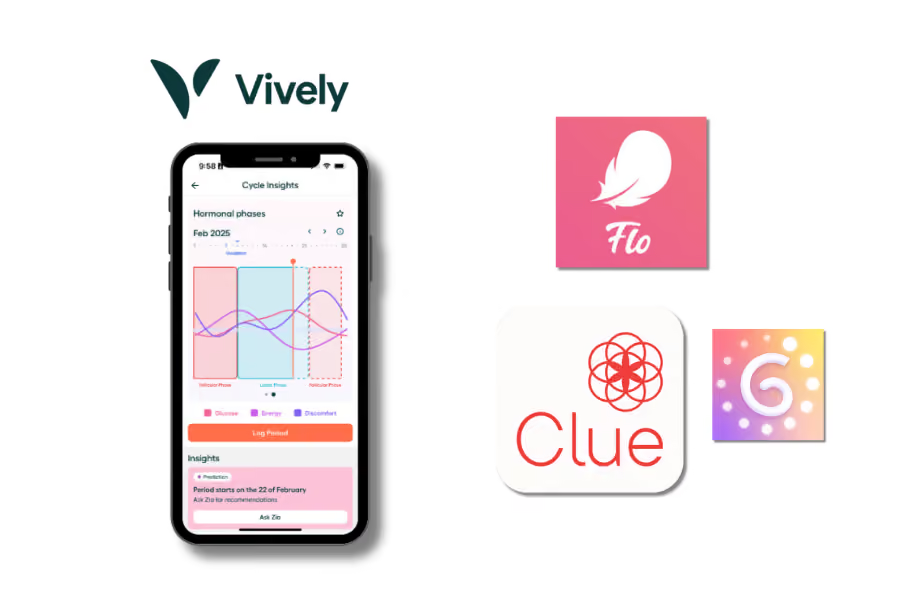
The best period tracking app in Australia is one that records the symptoms you need, makes its costs clear and gives you understandable privacy controls. Clue, Flo and Glow are current options. Their predictions are estimates, not diagnoses or contraception, and Vively should be considered separately as a health membership rather than a period predictor.
We checked Australian App Store listings and official developer information on 16 October 2026. The comparison describes current listing information, not an independent prediction-accuracy or security test. Start with your purpose, such as recording bleeding for a GP appointment, before choosing a subscription or connecting another health service.
| App | What the listing describes | Checked Australian price information | A decision to check |
|---|---|---|---|
| Clue | Period dates, symptoms and cycle insights | Free download; listed monthly $9.99 or yearly $39.99 options | Review which features need Plus and the research-consent toggle. |
| Flo | Period, symptom and pregnancy-related tracking | Free download; confirm the Premium checkout quote and billing period | Confirm the billing period and understand Anonymous Mode limitations. |
| Glow | Period and fertility-sign recording, plus community features | Free download; a yearly Premium option is listed at $99.99 | Check sharing settings and keep public community posts separate from private notes. |
A useful tracker helps you describe what happened rather than telling you what a symptom must mean. Recording the start and end of bleeding, flow and pain can make a medical appointment more productive. Choose symptom categories that fit your needs, and check whether you can review the record without buying an upgrade.
Ease of use matters more than the longest feature list. If logging takes too much effort, a paper diary or a simple calendar may suit you better. You do not need to enter sexual activity or fertility information merely because a field is available. Only record information you want to keep and understand how the app handles it.
We compare logging, price clarity, privacy information and the ability to use a record in a clinical conversation. We do not rank apps by customer ratings or claim they diagnose hormone problems. Our hormone results guide explains why symptoms, timing and life stage affect interpretation.
Clue’s Australian listing describes period and symptom tracking, with paid features under Clue Plus. It also describes options for different life stages. Check the current free version against the task you need before buying a subscription, and do not assume every graph or mode shown in promotional material is included without payment.
The Australian store explicitly labels monthly and yearly purchase options. Those are useful price examples, but confirm your offer and renewal before agreeing. Clue’s own listing states that it should not be used as contraception and does not replace professional medical advice. A prediction of fertile days cannot establish that unprotected sex is safe.
Clue’s privacy policy describes use of de-identified tracked health data for research when the relevant consent is enabled, with a setting to turn that off. Review that setting separately from permissions needed to run the app. De-identification and a European privacy framework should not be presented as a promise that no privacy risk exists.
Flo’s Australian listing describes period and pregnancy-related tracking with optional paid features. Several Premium amounts appear without a billing period, so we have not turned the cheapest displayed amount into a standard monthly price. Review what your offer includes and whether it renews automatically before starting a trial.
Flo offers Anonymous Mode. Its policy describes separating personal identifiers from health data, while also noting limitations such as unavailable connected features and difficulty providing account-specific support. It explicitly acknowledges that security measures can be bypassed in rare cases. This is a developer-described privacy option, not a guarantee of anonymity in every circumstance.
Read the current policy for the mode you choose, including what happens to an existing account if you switch. Consider whether you need wearable connections or notifications before enabling them. A feature that reduces the amount of linked identifying information may have practical trade-offs, so compare those against the way you plan to use the app.
Glow’s Australian listing includes period tracking and recording of fertility signs, such as temperature and cervical mucus. It also describes community features and a paid tier. The listing identifies a yearly Premium purchase option, but other listed amounts do not show a term. Confirm the exact plan before subscribing.
Glow states that its app is intended to assist conception rather than be used as contraception. Community discussion is also different from a private health record. Check what is visible to other users, including profile and sharing settings. Avoid posting information in a community that you would only want a treating clinician to see.
Glow’s privacy policy describes sharing with service providers and other parties, and transfers to the United States or other locations. It also says internet security cannot be guaranteed. Those details matter alongside any headline privacy statement. The fact that an app is available in Australia does not mean that Australian storage or Australian-only data handling is assured.
An app prediction depends on the information available to its software. It cannot observe every event in your body, and a familiar-looking calendar does not confirm ovulation. Missing entries, irregular bleeding and changes in life stage can make predictions less useful. Treat the predicted date as an estimate rather than a deadline your body has missed.
A record can still be valuable when predictions are unreliable. Note what actually happened and whether symptoms interfered with work, sleep or exercise. If you use hormonal contraception, tell your clinician which method because that affects how bleeding is interpreted. The app’s cycle label should not be used to diagnose PCOS or decide that fertility is normal.
Our PCOS article addresses food choices within existing care. For people noticing changes around midlife, the perimenopause testing guide explains why history often matters more than an isolated blood result. A tracker can support that conversation without needing to identify the cause itself.
Read beyond the front-page promise. Check what you provide, what the app collects automatically, which partners may receive information and whether optional research or advertising controls are available. App Store privacy labels are developer disclosures, not a full independent security audit. A paid subscription should not be assumed to remove all data sharing.
Use a screen lock and consider whether notification previews reveal information you would rather keep private. Review connected services before enabling them. If you leave an app, account deletion, removal of a shared record and cancellation of a subscription can be separate tasks. Save any information you need for care before requesting deletion.
These checks also apply to Vively’s privacy policy. We describe information collection and disclosures for service delivery there. A reader should use the same standard for every health service, including ours, and ask questions when an explanation does not match how they intend to use it.
Persistent pain, very heavy bleeding or new cycle changes deserve a GP conversation rather than endless changes to app settings. Bleeding after menopause also needs assessment. Seek urgent care for severe pelvic pain, fainting or heavy bleeding with marked weakness. Do not wait for an app’s predicted date if symptoms are concerning.
Tiredness has several possible causes. If it occurs with heavy periods, bring the bleeding record and any supplements to your appointment. Our iron deficiency article explains one possible line of assessment. It does not mean every person with fatigue needs iron or a broad hormone panel.
Avoid using an app to prescribe a different supplement or rigid diet for each cycle phase. A glucose graph is not evidence that a cycle-tracking approach relieves symptoms. A glucose reading cannot identify which hormone caused a symptom. Our hormone supplement comparison explains why specific assessment comes first.
Vively is an Australian preventative health membership with an app, blood-result analysis and practitioner support. The $99 a month membership has no minimum term and includes the Baseline Health Check with 70+ markers, a consultation to explain results, practitioner check-ins between tests and a targeted re-test after 3 months. It is not a guarantee of weight loss or a substitute for a GP assessment.
A GP from our network signs your request after a short telehealth consult, so you do not need to visit your own GP first. The Baseline lab tests can be Medicare-rebated; your membership pays for the analysis, your report, the app and your practitioner. See what Baseline includes and how the membership works.
Vively is not presented here as a period predictor, a fertility app or contraception. Selected blood results and practitioner discussion may be useful for a separate clinical question, but a membership does not replace a menstrual symptom diary. Choose a dedicated tracker if that is the task you need, and ask a clinician whether testing is appropriate.
Vively’s $99 a month membership has no minimum term and includes the Baseline Health Check of 70+ markers, a practitioner results consultation, check-ins between tests and a targeted re-test after 3 months. Explore what is included and decide whether it suits your needs.
There is no single best choice. Clue, Flo and Glow have Australian listings, but they differ in paid features, data handling and how much information you can record. Try the basic logging task first and compare your current offer. You may find a simple diary easier if your main purpose is a GP appointment.
Do not use these period predictions as contraception. A calendar estimate does not confirm ovulation or exclude pregnancy risk. Clue and Glow explicitly warn against contraceptive use. Speak with a GP or sexual health clinician about contraception appropriate to your circumstances rather than relying on an app’s fertile-window display.
Flo describes Anonymous Mode as separating personal identifiers from health data, with limitations for connected features and support. Its policy does not guarantee that security measures can never be bypassed. Review the current mode and policy before use, and consider how notifications, shared devices and information you voluntarily disclose affect your own privacy.
Vively is described here as a health membership, not a period prediction tool or a diagnostic shortcut. Its app helps present selected results with practitioner support. A symptom diary and GP assessment may still be needed for menstrual concerns. Blood testing should answer an appropriate clinical question rather than replace that assessment.
START YOUR BASELINE
Vively includes a Baseline Health Check with 70+ biomarkers, a results report and practitioner support in the $99 a month membership. No minimum term.
Explore Baseline Health CheckSubscribe to our newsletter & join a community of 30,000+ Aussies

Start a PCOS assessment with your GP. Learn which blood tests matter, when ultrasound or AMH is useful, and how contraception affects results.

Know what to do about an unexpected high blood sugar reading, when to seek urgent help, and which everyday habits support longer-term glucose care.





Vively is a general wellness platform and does not provide medical advice, diagnosis, or treatment. Any information, insights or guidance offered through our app, website, programs, or coaches is for educational and informational purposes only and should not be considered a substitute for professional medical advice or care. Always consult a qualified healthcare provider before making any health-related decisions.
We acknowledge the Traditional Custodians of the lands where we live and work, the Gadigal of the Eora Nation. We pay our respects to their Elders past and present.
 Share
 Tweet
 Share