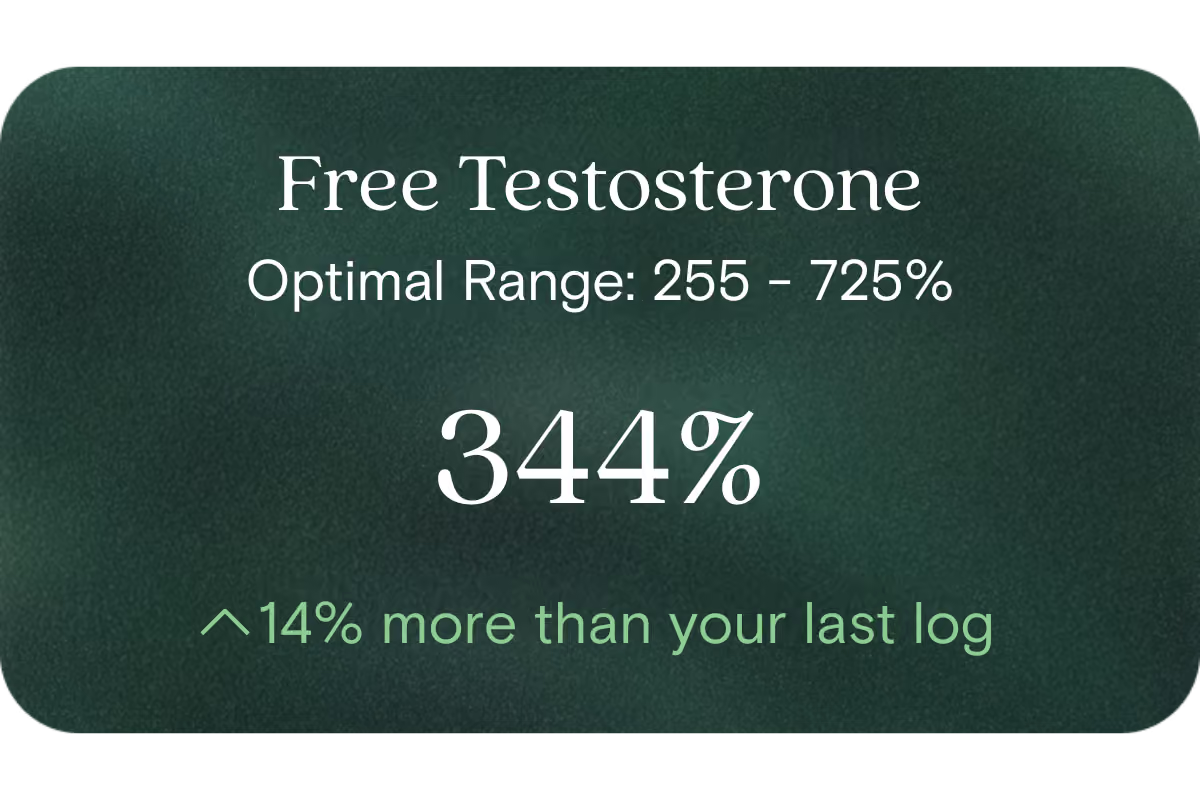
What is free testosterone?
Free testosterone is the testosterone in your blood that isn't bound to any protein, so it can move straight into cells and switch on androgen receptors. It is a small slice of your total, usually about 1 to 3%, and it is the part your tissues can use immediately. Men and women both have it, in very different amounts.
The rest is bound to proteins, tightly to sex hormone-binding globulin (SHBG) and loosely to albumin. Our bioavailable testosterone page explains the albumin-bound share and why SHBG matters so much.
Many Australian labs calculate free testosterone from your total testosterone, SHBG and albumin, often with the Vermeulen equation, because direct measurement (equilibrium dialysis) is slow and mostly done in specialist labs.
What does a free testosterone test show?
A free testosterone test shows whether your tissues are getting enough testosterone, which a total testosterone result alone can miss when SHBG is unusually high or low.
For men, free testosterone is the most useful companion to total testosterone. Two men can have the same total of 12 nmol/L, but the one with high SHBG has much less free, so low free testosterone can sit behind tiredness, low libido, erectile changes or loss of muscle even when the total looks fine.
For women, free testosterone helps check for androgen excess, as seen in polycystic ovary syndrome (PCOS). It is read alongside the free androgen index (FAI), a simpler ratio of total testosterone to SHBG.
Normal does not always mean optimal. A low-normal result in a 35-year-old man sleeping five hours a night tells a different story from the same number in a well-rested 70-year-old.
Free testosterone normal range
For adult men, free testosterone is usually 260 to 740 pmol/L. For adult women it is much lower, usually 3 to 37 pmol/L. Each lab sets its own range, so check the one printed on your report.
| Range |
|---|
| Typical lab reference range (adult men) | 260 to 740 pmol/L |
| Vively optimal range (men) | 350 to 740 pmol/L |
| Typical lab reference range (adult women) | 3 to 37 pmol/L |
| Vively optimal range (women) | No separate optimal range. We read your result with FAI, SHBG, your cycle and symptoms |
Optimal ranges are what we aim for to support long-term health, not diagnostic cut-offs.
What does high free testosterone mean?
In women, high free testosterone most often points to PCOS. In men, it usually means testosterone is coming from outside the body, such as prescribed therapy or anabolic steroids.
Common reasons in women:
- PCOS, the most common cause of high androgens in women, often with irregular periods, acne and excess hair.
- Low SHBG from insulin resistance or extra weight, which frees up more testosterone even when the total is normal.
- Testosterone or DHEA supplements or creams.
Less common causes include non-classic congenital adrenal hyperplasia (an inherited adrenal condition) and, rarely, an androgen-producing tumour, which tends to cause fast-developing symptoms such as a deepening voice.
For men, a high-normal result without any testosterone or steroid use is rarely a worry. Therapy and anabolic steroids push levels up and shut down your own production.
What does low free testosterone mean?
In men, low free testosterone is often linked to things you can change, such as excess weight, poor sleep and heavy drinking. A result that stays low on repeat morning tests needs a GP to look for a hormone problem.
Common reasons in men:
- An afternoon blood test, since testosterone peaks in the morning.
- Recent illness or hard training without enough food.
- Extra weight around the middle, insulin resistance and type 2 diabetes.
- Poor sleep, including sleep apnoea, and heavy drinking.
- High SHBG, which rises with age, an overactive thyroid and liver disease.
- Medicines such as opioids and long-term steroid tablets, or recently stopping anabolic steroids.
Medical causes include problems with the testes, such as Klinefelter syndrome or past chemotherapy, and problems with the brain's signal to them, such as a pituitary condition, high prolactin or iron overload. LH and FSH help tell these apart.
In women, low free testosterone is common and rarely acted on by itself. The combined pill, oral oestrogen and breastfeeding lower it, levels drift down with age, and removal of the ovaries lowers them sharply. International guidance doesn't use a testosterone blood level to diagnose low libido in women.
What can affect your free testosterone result
Time of day, cycle timing, the pill and anything that changes SHBG can shift free testosterone.
- Time of day (men). Book an early morning test, ideally before 10am. If a result is low, confirm it with a second morning test on a different day.
- Cycle timing (women). If you have periods, test on day 2 to 5 (day 1 is the first day of bleeding). Otherwise, any day is fine.
- Contraception and HRT. The combined pill raises SHBG and lowers free testosterone and FAI, so your result reflects the pill. Implanon may lower androgens. A hormonal IUD usually has little effect, and a copper IUD has none.
- Pregnancy and breastfeeding both change androgen levels.
- Supplements. Tell your practitioner about testosterone or DHEA products. High-dose biotin can interfere with some hormone tests, so ask your doctor about pausing it for a couple of days first.
Do you need to fast? Not strictly, but a pre-breakfast morning sample is preferred, as a meal can briefly lower testosterone. With your Baseline, you'll be fasting anyway.
How free testosterone fits with your other results
Free testosterone makes most sense next to total testosterone, SHBG and your pituitary and metabolic markers. For SHBG-driven patterns, see bioavailable testosterone.
| Pattern | What it can mean |
|---|
| Low total and free testosterone in a man, with high LH and FSH | The testes may not be responding to the brain's signal. Needs GP review. |
| Low total and free testosterone in a man, with low or normal LH and FSH | The brain's signal may be low, from weight, illness, sleep apnoea, opioids or a pituitary issue. Needs GP review. |
| Low free testosterone with high triglycerides, a large waist or high HbA1c | Weight and insulin resistance may be lowering testosterone. Often improves with weight loss. |
| High free testosterone and FAI in a woman, with low SHBG and high fasting insulin | A pattern often seen in PCOS with insulin resistance. |
How to support healthy free testosterone levels
For men with low-normal free testosterone, weight, sleep and alcohol are the biggest levers. Lifestyle won't fix a testicular or pituitary problem.
- Lose excess weight around your waist. For men carrying extra weight, this usually lifts testosterone.
- Lift weights two or three times a week, and eat enough to match your training, as heavy training on too little food lowers testosterone.
- Aim for 7 to 9 hours of sleep, and ask your GP about sleep apnoea if you snore or wake unrefreshed.
- Keep alcohol within the guidelines: no more than 10 standard drinks a week and no more than 4 on any day.
- Build meals around protein, vegetables and healthy fats, including zinc-rich red meat, seafood, legumes and pumpkin seeds. Very low fat diets have been linked with slightly lower testosterone (Whittaker and Wu, 2021).
- For women with high free testosterone and PCOS, regular movement and steady weight loss where needed can lower androgens and improve insulin sensitivity.
When to see your GP
See your GP if your free testosterone is below your lab's range on two morning tests, or if you have low libido, erectile problems, breast tenderness or enlargement, or fertility concerns.
See your GP promptly if a low result comes with headaches or vision changes, which can point to a pituitary issue. Women should see a GP for rapid hair growth, a deepening voice, no periods for three months without pregnancy, or a very high result. If you use testosterone or anabolic steroids, your GP should monitor your bloods.
Testing free testosterone with Vively
Free testosterone is included in our Male and Female Hormone Health Tests, Perimenopause and Menopause Hormone Tests, Weight Management Test and Full Body Health Check. You start with your Baseline Health Check and add the test that suits you. Exact markers can depend on the referring doctor's review.
We arrange your referral through our GP network, and you have one blood draw at one of 3,700+ accredited partner collection centres: early morning for men, day 2 to 5 for women who are cycling. Results arrive in the app, usually within a few days, read against optimal ranges. Your practitioner walks you through them, we build a personalised plan, and you retest to track change.
Order the Male Hormone Health Test, or the Female Hormone Health Test for women.
Frequently asked questions
Do I need to fast before a free testosterone test?
No, not strictly, but a morning sample before breakfast is best, as a meal can briefly lower testosterone. If your test is done with Vively's Baseline, you'll fast overnight anyway for glucose and insulin. Drink water as usual and take your usual medicines unless told otherwise.
What time of day should I have a testosterone test?
Men should test early in the morning, ideally before 10am, when testosterone is highest. Afternoon results can look falsely low, and a low result needs confirming with a second morning test. Women who are cycling should test on day 2 to 5.
Is a free testosterone of 220 pmol/L low?
For a man, yes, it is below the typical range of 260 to 740 pmol/L. One result isn't enough to diagnose low testosterone. Repeat it as an early morning test, and look at SHBG, LH, FSH, sleep, weight and symptoms. If it stays low, see your GP.
What is the difference between free and total testosterone?
Total testosterone counts everything, including the large share bound to SHBG and albumin. Free testosterone is only the unbound share, about 1 to 3% of the total, that tissues can use straight away. Free can be low when total looks normal, usually because SHBG is high.
Can I get a free testosterone test through Medicare?
Many blood tests can be Medicare-funded when a doctor orders them for a clinical reason. With Vively, we arrange the referral through our GP network, so you don't need a separate GP visit before your hormone test. You start with your Baseline Health Check and add the hormone test that suits you.
References
- Royal College of Pathologists of Australasia (RCPA). RCPA Manual: Testosterone (free).
- Pathology Tests Explained. Testosterone. https://www.pathologytestsexplained.org.au
- Healthy Male. Androgen deficiency: clinical summary guide. https://www.healthymale.org.au
- Yeap BB, Grossmann M, McLachlan RI, et al. Endocrine Society of Australia position statement on male hypogonadism (part 1): assessment and indications for testosterone therapy. Medical Journal of Australia. 2016;205(4):173-178.
- Vermeulen A, Verdonck L, Kaufman JM. A critical evaluation of simple methods for the estimation of free testosterone in serum. Journal of Clinical Endocrinology and Metabolism. 1999;84(10):3666-3672.
- Teede HJ, Tay CT, Laven JJE, et al. Recommendations from the 2023 International Evidence-based Guideline for the Assessment and Management of Polycystic Ovary Syndrome. Journal of Clinical Endocrinology and Metabolism. 2023.
- Davis SR, Baber R, Panay N, et al. Global Consensus Position Statement on the Use of Testosterone Therapy for Women. Journal of Clinical Endocrinology and Metabolism. 2019;104(10):4660-4666.
- Whittaker J, Wu K. Low-fat diets and testosterone in men: systematic review and meta-analysis of intervention studies. Journal of Steroid Biochemistry and Molecular Biology. 2021.