Insulin resistance with normal blood sugar: what our data shows
1 in 6 Vively members with normal HbA1c and glucose had insulin above the lab range, and 2 in 3 had a HOMA-IR above optimal. What it can mean.


On this page
In short
- Yes, you can show signs of insulin resistance with normal blood sugar, because the pancreas can make extra insulin to keep glucose in range for years.
- Fasting glucose and HbA1c only measure glucose, so a fasting insulin test or HOMA-IR is needed to see the extra effort.
- See your GP promptly if fasting glucose is 6.1 mmol/L or above, HbA1c is 6.0% or above, or you have strong thirst or unexplained weight loss.
From Vively member data
16%
Insulin above lab range
above 10 mIU/L, in 4,579 members with normal blood sugar
57%
Insulin above optimal
above 5 mIU/L, including 42% still inside the lab range
66%
HOMA-IR above 1.0
about 2 in 3 members with normal blood sugar
Yes, you can show signs of insulin resistance while your blood sugar is still normal. We looked at 4,579 Vively members whose HbA1c and fasting glucose were both inside the lab range. 16%, about 1 in 6, had fasting insulin above the lab range of 10 mIU/L. Against Vively's optimal range the share was much higher: 57% had fasting insulin above 5 mIU/L, and 66%, about 2 in 3, had a HOMA-IR above 1.0. A normal result is not always an optimal one.
Most people check for blood sugar problems with two tests: fasting glucose and HbA1c. Both measure glucose. Neither measures insulin, the hormone that keeps glucose in check. So we asked a simple question of our own data: when both glucose tests come back normal, how often is insulin already high?
What our members' results show
Vively is an Australian health membership. It starts with the Baseline Health Check, a blood test covering 70+ markers. For almost all members that includes fasting glucose, HbA1c, fasting insulin and HOMA-IR, all from the same morning blood draw.
We took each member's first test from January 2024 to October 2026 that had all four results. We left out anyone who told us they have type 2 diabetes. That gave 5,373 members.
Of those, 4,579 (85%) had normal blood sugar on both tests. We used the typical lab ranges: HbA1c 5.9% or lower and fasting glucose 5.4 mmol/L or lower. Among these members with normal blood sugar:
- 16% (about 1 in 6) had fasting insulin above the lab range of 10 mIU/L.
- 57% (more than half) had fasting insulin above Vively's optimal range of 3 to 5 mIU/L. That includes 42% whose insulin was inside the lab range, so their report would show it as normal.
- 66% (about 2 in 3) had a HOMA-IR above Vively's optimal of 1.0.
When glucose is in the normal range it varies little from person to person, so HOMA-IR mostly follows insulin. The chart shows each age group. Switch between the lab range and the optimal range to see the gap.
Against the lab range, high insulin was most common in women aged 18 to 29 (21%), men in their 40s and 50s (19% each) and women aged 60 and over (19%), and least common in men in their 30s (12%). Against the optimal range, the gap showed up in every group: at least 6 in 10 members in each age and sex group had a HOMA-IR above 1.0, from 63% of women in their 40s and men in their 30s and 40s to 75% of women aged 18 to 29. Every group shown had at least 136 members with normal blood sugar.
How insulin, glucose and HOMA-IR fit together
After you eat, glucose moves from your gut into your blood. Insulin, made by your pancreas, helps your muscles, liver and fat take that glucose in.
With insulin resistance, those tissues respond less well to insulin. To make up for it, the pancreas makes more. For a while that works: glucose stays normal, but it takes more insulin to keep it there. A fasting glucose or HbA1c test sees the normal glucose. A fasting insulin test can show the extra effort.
HOMA-IR puts the two together. It multiplies fasting glucose (mmol/L) by fasting insulin (mIU/L) and divides by 22.5. The formula comes from a 1985 study by David Matthews and colleagues. Most lab reports don't include HOMA-IR, so it is usually worked out from the two results. The Vively app calculates it for you, or you can work out your own score with our HOMA-IR calculator.
Why normal is not the same as optimal
A lab range shows where most results fall in the people the lab used as a reference. For fasting insulin it is typically 3 to 10 mIU/L, and a result inside it is reported as normal.
Vively's optimal ranges are narrower: fasting insulin 3 to 5 mIU/L and HOMA-IR 1.0 or below. They are there to show a drift early. Insulin resistance can build for 10 to 15 years before glucose tests pick up a problem, so a result can be normal on the report and still be heading the wrong way.
That is the gap in our data. 16% of members with normal blood sugar had insulin above the lab range, but 57% were above optimal. An optimal range is a target to track, not a diagnosis: a result above it is a prompt to look at your habits and retest, not a sign of disease.
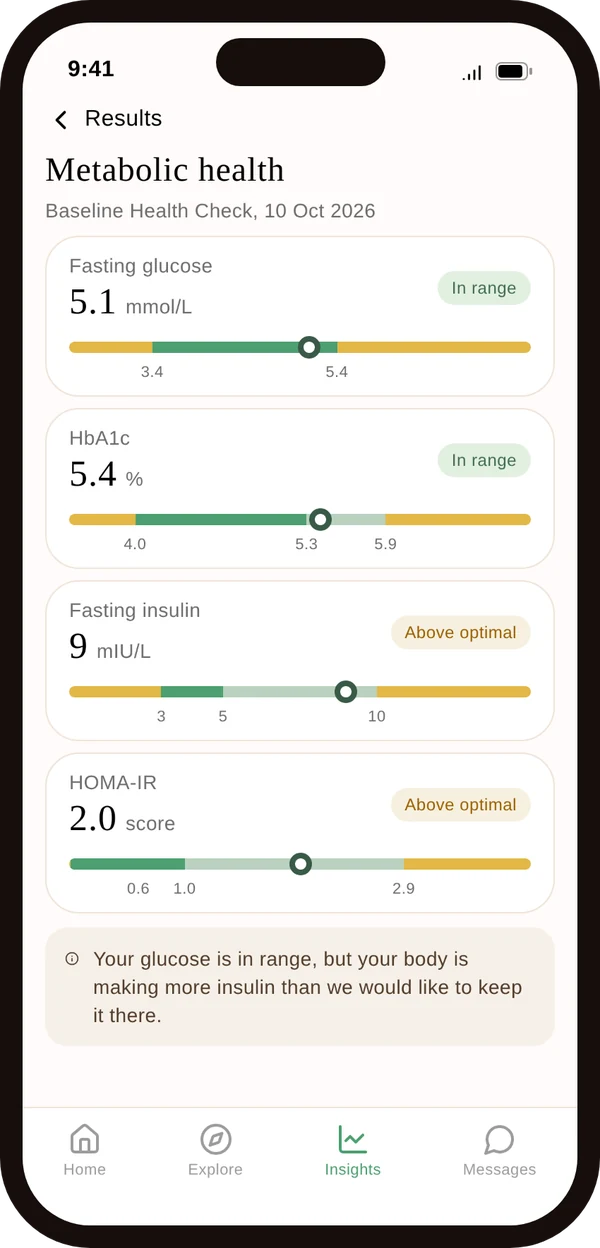
What a high insulin result with normal glucose can mean
Normal glucose with high fasting insulin can mean early insulin resistance is present. It is one reason a practitioner may look past glucose alone.
Insulin resistance is common, and it often comes before prediabetes and type 2 diabetes. The US National Institute of Diabetes and Digestive and Kidney Diseases lists extra weight or a large waist, low physical activity, smoking, a family history of diabetes and some medicines among its risk factors. It is also more common with polycystic ovary syndrome (PCOS), sleep apnoea and after gestational diabetes.
A high result is a reason to look closer. It doesn't mean diabetes is on the way, and it doesn't call for medicine or a strict diet on its own.
What our data can't tell you
- One test each. We used each member's first result. Insulin moves around more from day to day than glucose does, so a single high result can come down on a repeat test.
- Fasting matters. Insulin is only meaningful as a fasting result. A coffee with milk, a late snack or a short fast can push it up.
- Labs measure insulin differently. Methods vary between labs, so always read your result against the range on your own report.
- Cut-offs vary. There is no single agreed insulin or HOMA-IR cut-off for insulin resistance. The lab range is a cautious line and Vively's optimal range is a tighter one, so we show both. Being above optimal does not mean you have insulin resistance.
- Our members chose to test. Some joined because they were worried about their metabolic health, so these numbers describe Vively members, not all Australians.
What to do if your insulin is high and your glucose is normal
Start by checking that the test was a true fasting test. Then talk it through with your GP or practitioner. They will look at your waist measurement, blood pressure, triglycerides and HDL cholesterol, family history and any medicines, and may suggest a repeat test.
The habits linked with better insulin sensitivity are the familiar ones: regular movement (including strength training), meals built around protein, vegetables and high fibre carbohydrates, enough sleep, and less alcohol. Our guide to improving insulin sensitivity goes through them in more detail.
See your GP promptly if your fasting glucose is 6.1 mmol/L or above, your HbA1c is 6.0% or above, or you have symptoms such as strong thirst, passing a lot of urine or unexplained weight loss.
How to check your fasting insulin and HOMA-IR
Ask your GP whether a fasting insulin test makes sense for you. Or check it as part of a Vively membership: the Baseline Health Check measures fasting insulin and HOMA-IR alongside fasting glucose, HbA1c, triglycerides and HDL for almost all members, subject to the reviewing doctor. A GP in our network signs your request after a short telehealth consult, so you don't need to see your own GP first.
The fasting insulin test and HOMA-IR test pages explain each result. Our post on fasting insulin and insulin resistance covers what the test can and can't tell you.
Practitioners can find our guide to reading insulin resistance in blood tests, with ranges and worked examples.
Vively is an Australian health membership for $99 a month, with no minimum term. It starts with the Baseline Health Check: a blood test covering 70+ markers, including fasting insulin, HOMA-IR, HbA1c and fasting glucose, at one of 3,700+ collection centres. A practitioner goes through your results with you.
Frequently asked questions
Can you have insulin resistance with normal blood sugar?
Yes. Early on, the pancreas can make extra insulin and keep glucose in the normal range. In our data, 16% of members with normal HbA1c and fasting glucose had fasting insulin above the lab range of 10 mIU/L, and 57% were above Vively's optimal of 5 mIU/L. Only a test that measures insulin can show that pattern.
Can you have insulin resistance with a normal HbA1c?
Yes. HbA1c shows your average glucose over about three months. It does not measure insulin, so it can be normal while insulin is working harder than usual. A fasting insulin test, or HOMA-IR, adds the missing half of the picture. Our HbA1c levels by age guide shows how HbA1c changes as you get older.
What is a normal fasting insulin level?
A typical lab range for fasting insulin is 3 to 10 mIU/L, though labs set their own ranges, so use the one on your report. Vively's optimal range is 3 to 5 mIU/L. In our data, 42% of members with normal blood sugar had insulin inside the lab range but above optimal. A result above the lab range with normal glucose is worth discussing with your GP or practitioner.
What HOMA-IR score means insulin resistance?
There is no single agreed cut-off. Most lab reports don't include HOMA-IR: it is calculated from fasting glucose and fasting insulin. Vively's optimal is 1.0 or below, and 66% of our members with normal blood sugar were above it. Higher scores suggest more insulin resistance, but HOMA-IR is an estimate from two fasting results, so it is read alongside your other markers rather than on its own.
Does a normal blood test rule out insulin resistance?
Not if the test only measured glucose. A standard check usually includes fasting glucose and sometimes HbA1c, and both can be normal while insulin is high. If you want to know about insulin, ask for a fasting insulin test taken at the same time as fasting glucose.
Sources
- Vively: how we collect and publish member data.
- Matthews DR and colleagues. Homeostasis model assessment: insulin resistance and beta-cell function from fasting plasma glucose and insulin concentrations in man. Diabetologia, 1985.
- NIDDK: insulin resistance and prediabetes.
- Diabetes Australia: screening for type 2 diabetes.
- RACGP: general practice management of type 2 diabetes.
The Baseline Health Check is a blood test covering 70+ markers at one of 3,700+ collection centres. Your dietitian goes through your results with you and builds your plan. $99$79 this Black Friday, ends 1 Dec. Then $99 a month, cancel anytime.