


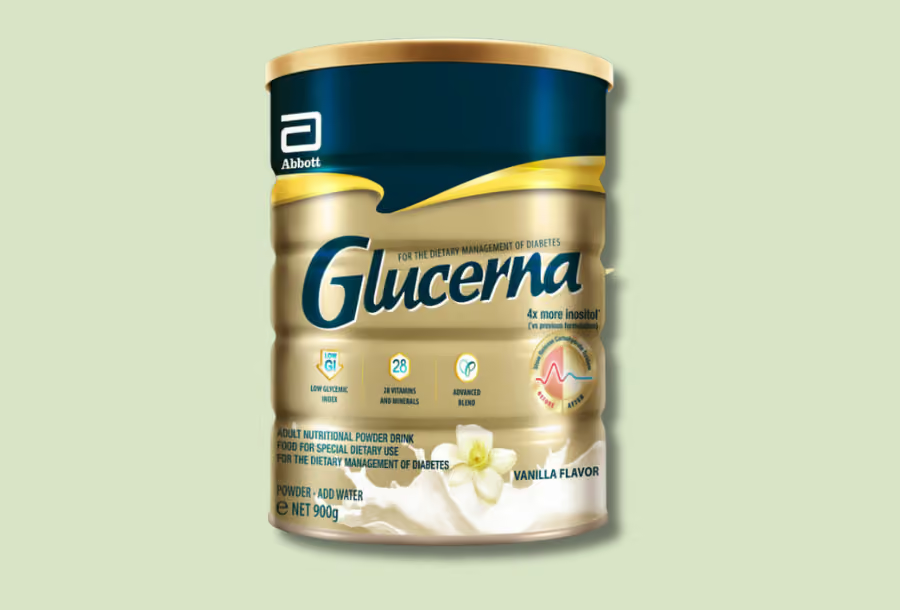
Glucerna can be a convenient, lower GI meal or snack for some people with diabetes, but the evidence doesn't show it beats a well-built whole-food meal. In Australia, Abbott sells it as a vanilla powder and a 220 ml ready-to-drink. Both are labelled Food for Special Medical Purposes, to be used under medical supervision.
Glucerna is made for people with diabetes or impaired glucose tolerance. Whether it suits you depends on your medicines, what you would otherwise eat, and whether you're using it once a week or twice a day. Start with this quick check.
Glucerna is a diabetes-specific nutrition drink made by Abbott. Its Australian website lists two products: Glucerna Vanilla powder (850 g tins, made up with water) and Glucerna Ready-to-Drink Vanilla in 220 ml bottles. US products such as Glucerna 1.5 Cal and Glucerna bars aren't listed on Abbott's Australian site.
The powder's main ingredients are maltodextrin, vegetable oils, milk and soy proteins, and a mix of slower sugars and sugar alcohols (maltitol, fructose, isomaltulose and sucromalt). It also has myo-inositol, oat fibre, fructo-oligosaccharides (a prebiotic fibre) and 28 vitamins and minerals. It contains milk, soy and oat.
Both products carry the label Food for Special Medical Purposes, "use only under medical supervision", and "not to be used as a sole source of nutrition". That wording comes from Abbott, and it's worth taking at face value.
Abbott's Australian pages give nutrition per 100 ml. We've multiplied those out to a full serve below.
| Per serve | Powder, 237 ml made up | Ready-to-drink, 220 ml |
|---|---|---|
| Energy | 957 kJ (229 Cal) | 891 kJ (213 Cal) |
| Protein | 10.2 g | 10.2 g |
| Fat | 8.7 g | 8.2 g |
| Carbohydrate | 26.1 g | 22.1 g |
| Sugars | 5.6 g | 5.3 g |
| Dietary fibre | 3.9 g | 4.5 g |
| Sodium | 211 mg | 187 mg |
| GI (Abbott) | 35 | 27 |
About 10 g of protein is a modest amount for something meant to stand in for a meal, and protein is a big part of what keeps you full until the next one.
“It is common to equate fullness with enough, but as we work towards optimising our metabolic health and immunity, we need to ask ourselves, did I just consume enough calories or did I consume enough nutrition?”
Dr Michelle Woolhouse, Vively Medical Director
Diabetes-specific drinks like Glucerna do cause a smaller glucose rise than standard nutrition drinks. They haven't been shown to beat a good whole-food diet, and most of the research is funded by the companies that make them.
A 2005 meta-analysis in Diabetes Care (Elia and colleagues) pooled 23 studies of oral supplements and tube feeds. Compared with standard formulas, diabetes-specific formulas cut the after-meal rise in glucose by 1.03 mmol/L on average. That comparison is with other formula drinks, often used by people who can't eat normally, not with a bowl of porridge or a sandwich.
Abbott's Australian page says Glucerna was shown to lower HbA1c by 1.1% in 6 months, as part of a structured lifestyle intervention. The trial that matches that figure is a Malaysian study of 230 people with type 2 diabetes and extra weight (Chee 2017). The 1.1% drop was in the group that had a low-kilojoule meal plan, diabetes-specific meal replacements, more exercise and motivational interviewing. A group with the same plan but standard counselling dropped 0.5%, and usual care dropped 0.2%.
At one year, the motivational interviewing group's HbA1c was still 0.5% lower than at the start. Abbott provided the formula and funded the study, as a 2020 follow-up paper declares. The counselling made the biggest difference between the two groups that both drank the shakes.
Australian guidelines do use meal replacements, in a specific way. The RACGP recommends low-calorie diets of 800 to 850 Cal a day using meal replacement products for 3 to 5 months for selected adults aiming for type 2 diabetes remission, with close support from their diabetes team. In DiRECT-Australia, a Sydney primary care service that used total diet replacement for 12 weeks, HbA1c fell by 1.1% at 12 weeks (32 people) and by 0.6% at one year (27 people) (Chimoriya 2024).
Those programs are planned, supervised and time-limited. Adding a Glucerna to your normal day is a very different thing. If weight loss is your goal, our comparison of weight loss shakes in Australia covers the products built for that.
Abbott markets Glucerna for impaired glucose tolerance as well as diabetes, but there is little trial evidence for it in prediabetes. The changes with the best evidence are losing some weight if you carry extra, moving more, sleeping well, and eating more fibre and less refined carbohydrate.
Prediabetes is also the stage where a blood test tells you the most. HbA1c and fasting insulin can show how hard your body is working to keep glucose in range, years before glucose itself rises. Our prediabetes symptoms guide explains what to look for, and an HbA1c test shows where you sit now. If you want a starting point for meals, try our 7-day meal plan for prediabetes.
“Prediabetes offers you a wake-up call, a chance to make lifestyle changes before it's too late.”
Dr Michelle Woolhouse, Vively Medical Director
Glucerna is safe for most adults, but there are a few things to know before you start.
At the prices we found, a Glucerna serve costs about $2.20 to $3.95. Two serves a day for a month comes to roughly $165 on the powder at $44.99 a tin.
| Product | Price seen | Cost per serve |
|---|---|---|
| Glucerna Vanilla powder 850 g (Direct Chemist Outlet, in stock) | $44.99 | About $2.80 (about 16 serves a tin) |
| Glucerna Vanilla powder 850 g (Discount Chemist, out of stock) | $35.95 | About $2.20 |
| Glucerna Vanilla ready-to-drink 220 ml (SuperPharmacyPlus) | $3.95 | $3.95 |
Abbott doesn't explain its pricing. Glucerna is a specialised medical food sold mainly through pharmacies, and you pay for it privately.
A breakfast or snack with protein, fibre and a lower GI carbohydrate does the same job as a shake for most people. The NDSS suggests filling half your plate with vegetables, a quarter with a high-fibre, lower GI carbohydrate and a quarter with lean protein.
Our guide to low GI breakfast options in Australia has more ideas.
Our members' sensors show how much breakfast choice matters. We wanted to show Glucerna here too, but fewer than 30 members have logged it, which is below our publishing threshold.
Adding protein or fat seems to help a little, though not for everyone. When 389 members ate a banana with only protein or fat alongside, 56% had a smaller rise than when they ate it on its own, and the typical difference was 0.2 mmol/L. The same comparison for porridge showed no clear difference. See the full numbers on our porridge glucose response page.
Whether a shake, a bowl of porridge or eggs on toast suits you best is something you can measure. The Baseline Health Check measures HbA1c, fasting glucose and fasting insulin among 70+ markers, read against optimal ranges, with a practitioner to explain them and a targeted re-test after 3 months included in your membership. Vively's CGM program shows your own response to meals, and dietitian support is available through the $99 a month membership. Read how a continuous glucose monitor works.
The Baseline Health Check covers 70+ markers, including HbA1c, fasting glucose and fasting insulin, from one blood draw at one of 3,700+ partner collection centres.
It can be, as an occasional meal or snack for an adult with diabetes. Glucerna is lower GI than many quick breakfasts and gives about 10 g of protein and 4 g of fibre a serve. It isn't better than a balanced whole-food meal, and Abbott says it shouldn't be your sole source of nutrition.
Glucerna causes a smaller rise than many drinks and standard formulas, which is what its low GI (35 for the powder, 27 for the ready-to-drink, per Abbott) reflects. It still has 22 to 26 g of carbohydrate a serve, so glucose will rise somewhat. A CGM or finger-prick meter shows your own response.
Not without a plan. Australian guidelines support meal replacements for weight loss and diabetes remission only inside a structured, supervised program. If you use insulin or a sulfonylurea, replacing meals can cause lows. Talk to your GP or an Accredited Practising Dietitian before swapping meals for shakes.
Only with your health team's advice. Abbott says pregnant and breastfeeding women should consult a healthcare professional, partly because its vitamins and minerals can add up with a pregnancy supplement. Women with gestational diabetes are usually guided on meals and carbohydrate choices by a diabetes educator or dietitian.
Abbott says it is appropriate for people with type 1 diabetes, but blood glucose should be checked regularly and insulin needs discussed with your healthcare professional. A shake has 22 to 26 g of carbohydrate, so it needs to be counted like any other food when you dose insulin.
START YOUR BASELINE
Vively includes a Baseline Health Check with 70+ biomarkers, a results report and practitioner support in the $99 a month membership. No minimum term.
Explore Baseline Health CheckSubscribe to our newsletter & join a community of 30,000+ Aussies

Start a PCOS assessment with your GP. Learn which blood tests matter, when ultrasound or AMH is useful, and how contraception affects results.

Know what to do about an unexpected high blood sugar reading, when to seek urgent help, and which everyday habits support longer-term glucose care.





Vively is a general wellness platform and does not provide medical advice, diagnosis, or treatment. Any information, insights or guidance offered through our app, website, programs, or coaches is for educational and informational purposes only and should not be considered a substitute for professional medical advice or care. Always consult a qualified healthcare provider before making any health-related decisions.
We acknowledge the Traditional Custodians of the lands where we live and work, the Gadigal of the Eora Nation. We pay our respects to their Elders past and present.
 Share
 Tweet
 Share