


Men's blood tests differ from women's in a few clear ways. In the first blood tests of about 2,300 men who joined Vively, 22% had ALT, a liver enzyme, above the lab range, against 8% of women. Total testosterone barely changed with age, but the typical free testosterone result was about a quarter lower in men aged 60 and over than in men in their 20s.
Vively is an Australian health membership. It starts with the Baseline Health Check, a blood test covering 70+ markers. We took each member's first result from January 2024 to October 2026 and compared men with women of the same age. Here are five things that stood out for men.
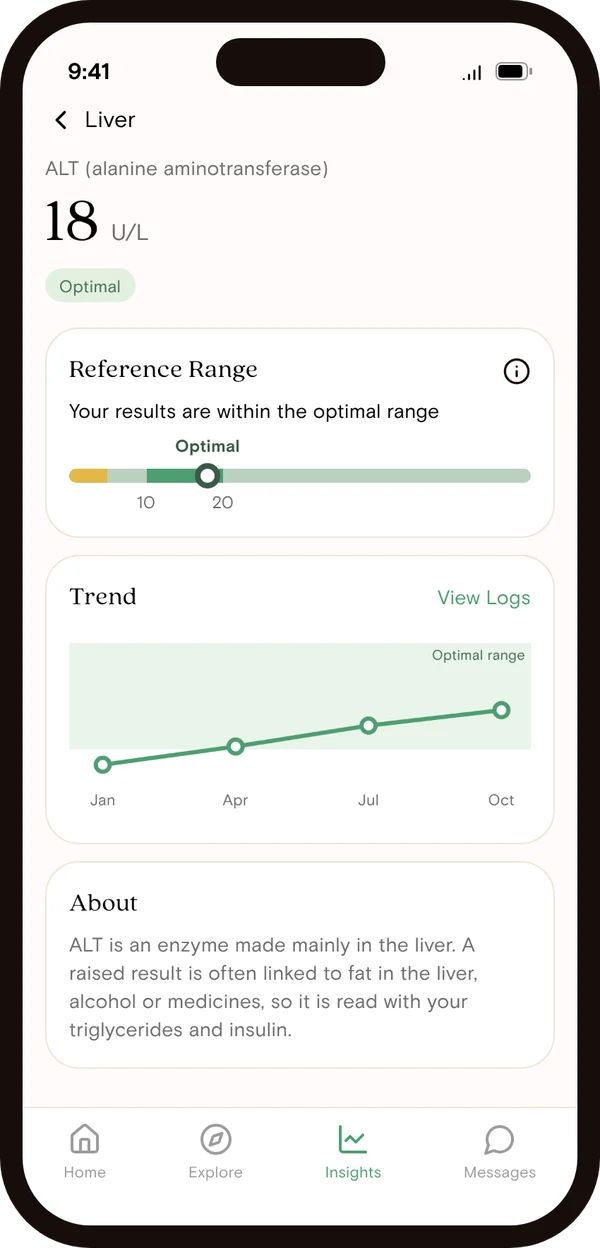
ALT (alanine aminotransferase) is an enzyme found mostly in the liver. When liver cells are under strain, more of it leaks into the blood. The typical lab range goes up to 40 U/L for men and 35 U/L for women.
22% of men had ALT above the lab range, against 8% of women. In men it was about the same from their 20s to their 50s (21% to 24%), then lower at 60 and over (12%).
ALT was above the lab range in 22% of men, against 8% of women.
| Women | Men | |
|---|---|---|
| 18 to 29 | 5% (n=271) | 21% (n=267) |
| 30 to 39 | 6% (n=1,008) | 24% (n=658) |
| 40 to 49 | 7% (n=1,182) | 24% (n=714) |
| 50 to 59 | 12% (n=881) | 22% (n=417) |
| 60+ | 8% (n=506) | 12% (n=267) |
A raised ALT is often linked to fat building up in the liver, alcohol, or some medicines and supplements. It doesn't point to one cause. Your GP or practitioner reads it with your other liver enzymes, triglycerides, insulin and alcohol intake. Our liver enzymes by age guide shows ALT and GGT for every age group, and the ALT test page explains the result.
Uric acid is a waste product your body makes when it breaks down purines, found in your own cells and in foods such as red meat, offal, seafood and beer. If it builds up, it can form crystals in the joints and cause gout.
10% of men had uric acid above the lab range (above 0.45 mmol/L for men), against 3% of women (above 0.40 mmol/L). Men aged 60 and over were highest, at 14%.
Uric acid was above the lab range in 10% of men, against 3% of women.
| Women | Men | |
|---|---|---|
| 18 to 29 | 1% (n=91) | 11% (n=101) |
| 30 to 39 | 3% (n=365) | 9% (n=223) |
| 40 to 49 | 2% (n=439) | 6% (n=270) |
| 50 to 59 | 5% (n=324) | 12% (n=178) |
| 60+ | 6% (n=218) | 14% (n=109) |
A high uric acid result without symptoms is not gout, and it isn't usually treated with medicine on its own. It is worth knowing about, because weight, alcohol, sugary drinks and some medicines all push it up. See the uric acid test page for more.
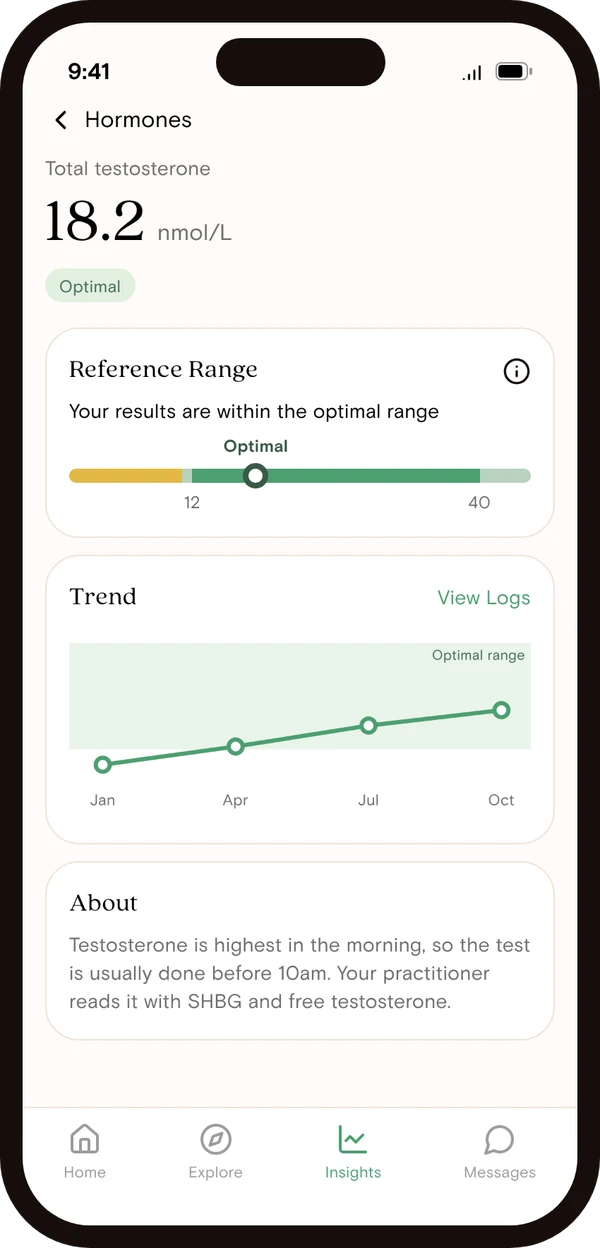
Total testosterone barely changed with age in our members. The typical (median) result was between 16.6 and 18.8 nmol/L in every age group, and 6% to 9% of men were below the range printed on their own lab report.
Free testosterone told a different story. This is the small share of testosterone that isn't bound to proteins in the blood. The median fell from 397 pmol/L in men in their 20s to 292 pmol/L at 60 and over, about a quarter lower. The share below the range on their own lab report rose from 7% of men in their 20s to 11% or 12% from 50 onwards.
From men in their 20s to men 60 and over, median free testosterone fell from 397 to 292 pmol/L. The share below the range on their own lab report rose from 7% in their 20s to 11% or 12% from 50 onwards, while for total testosterone it stayed between 6% and 9%.
% of men with free testosterone below their own lab range
| Men | |
|---|---|
| 18 to 29 | 7% (n=77) |
| 30 to 39 | 10% (n=208) |
| 40 to 49 | 10% (n=250) |
| 50 to 59 | 12% (n=127) |
| 60+ | 11% (n=62) |
% of men with total testosterone below their own lab range
| Men | |
|---|---|
| 18 to 29 | 7% (n=77) |
| 30 to 39 | 6% (n=211) |
| 40 to 49 | 7% (n=251) |
| 50 to 59 | 9% (n=129) |
| 60+ | 7% (n=62) |
The reason is a protein called sex hormone binding globulin (SHBG). It holds on to testosterone, and it rises with age. In our members, median SHBG went from 31 nmol/L in men in their 20s to 40 nmol/L at 60 and over. A large UK Biobank study that followed men aged 40 to 69 found the same pattern: total testosterone stable, SHBG up and free testosterone down.
A low free testosterone result is not a diagnosis of low testosterone. Testosterone is highest in the morning, so the test is done before 10am, and a low result needs repeating on another morning before anyone acts on it. Sleep, stress, alcohol, weight, training load and medicines all affect it. Our testosterone levels in men by age guide has the full table for total testosterone, free testosterone and SHBG.
PhenoAge is a biological age worked out from nine routine blood markers and your age. It was developed by Morgan Levine and colleagues in 2018. Most Vively members tested younger than their calendar age, which partly reflects who chooses to test.
Still, a gap opened with age. At 50 and over, 15% of men had a PhenoAge above their calendar age, against 6% of women. For men aged 60 and over it was 16%.
Aged 50 and over, 15% of men had a biological age (PhenoAge) above their calendar age, against 6% of women.
| Women | Men | |
|---|---|---|
| 18 to 29 | 9% (n=241) | 12% (n=236) |
| 30 to 39 | 7% (n=897) | 9% (n=596) |
| 40 to 49 | 5% (n=1,074) | 11% (n=656) |
| 50 to 59 | 7% (n=788) | 14% (n=393) |
| 60+ | 5% (n=465) | 16% (n=253) |
PhenoAge is an estimate, and one marker running high on the day can move it. It is most useful for tracking your own trend over time. Try the biological age calculator if you have your results, or see the biological age test page.
Among members who connected a wearable, 44% of men in their 40s and 44% in their 50s averaged under 7 hours asleep a night. For women in their 50s it was 30%. The Sleep Health Foundation says most adults need 7 to 9 hours.
Men in their 50s: 44% averaged under 7 hours asleep a night on their wearable, against 30% of women the same age.
| Women | Men | |
|---|---|---|
| 18 to 29 | 21% (n=288) | 37% (n=98) |
| 30 to 39 | 23% (n=999) | 34% (n=493) |
| 40 to 49 | 24% (n=1,434) | 44% (n=743) |
| 50 to 59 | 30% (n=1,121) | 44% (n=504) |
| 60 to 69 | 34% (n=402) | 42% (n=210) |
Wearables estimate sleep from movement and heart rate, so treat the hours as a guide. You can compare your own numbers with our sleep by age tool.
See your GP if a result is well outside the lab range, if ALT stays high on a repeat test, or if you have symptoms such as a hot, swollen and painful joint, or low sex drive, erectile problems and tiredness that don't go away. Men's health organisation Healthy Male has a clear guide to testosterone deficiency and when to get help.
The Baseline Health Check includes ALT and the other liver enzymes, cholesterol, HbA1c, fasting insulin and your biological age. Uric acid, testosterone, free testosterone and SHBG can be added. A practitioner goes through the results with you and builds a plan, and you re-test every 3 months to see what changed. Women's cholesterol catches up with men's after 50: our post on cholesterol after menopause shows the other side of that story.
Vively is an Australian health membership for $99 a month, with no minimum term. It starts with the Baseline Health Check: a blood test covering 70+ markers, including liver enzymes, cholesterol, fasting insulin and your biological age, at one of 3,700+ collection centres. A practitioner goes through your results with you.
A broad check usually covers cholesterol, blood sugar (fasting glucose and HbA1c), liver and kidney function, and a full blood count. Our member data suggests fasting insulin, uric acid and, if you have symptoms, testosterone with SHBG are also worth asking about. Your GP can advise based on your age and family history.
Total testosterone changes little in healthy men. In our members, the median stayed between 16.6 and 18.8 nmol/L at every age. Free testosterone does fall, because SHBG rises with age: the median went from 397 pmol/L in men in their 20s to 292 pmol/L at 60 and over.
Men have higher ALT on average, and the typical lab range is set higher for men (up to 40 U/L, against 35 U/L for women). Even so, 22% of our male members were above their range, against 8% of women. Fat in the liver and alcohol are common reasons for a raised result.
A typical lab range for men is about 0.20 to 0.45 mmol/L, though labs set their own. Among Vively members, the median for men was 0.35 mmol/L, and 10% were above 0.45.
START YOUR BASELINE
Vively includes a Baseline Health Check with 70+ biomarkers, a results report and practitioner support in the $99 a month membership. No minimum term.
Explore Baseline Health CheckSubscribe to our newsletter & join a community of 30,000+ Aussies

Start a PCOS assessment with your GP. Learn which blood tests matter, when ultrasound or AMH is useful, and how contraception affects results.

Know what to do about an unexpected high blood sugar reading, when to seek urgent help, and which everyday habits support longer-term glucose care.





Vively is a general wellness platform and does not provide medical advice, diagnosis, or treatment. Any information, insights or guidance offered through our app, website, programs, or coaches is for educational and informational purposes only and should not be considered a substitute for professional medical advice or care. Always consult a qualified healthcare provider before making any health-related decisions.
We acknowledge the Traditional Custodians of the lands where we live and work, the Gadigal of the Eora Nation. We pay our respects to their Elders past and present.

 Share
 Tweet
 Share