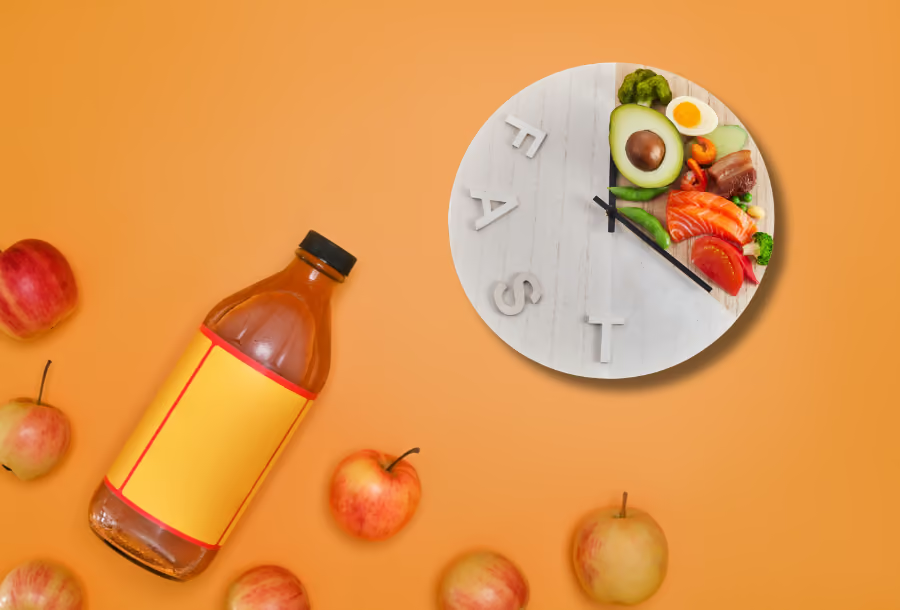



Normal blood sugar 2 hours after eating is under 7.8 mmol/L if you do not have diabetes. Among 4,871 Vively CGM members without diabetes (meals logged 2023 to 2026), the typical reading 2 hours after eating was 5.7 mmol/L, and 96% of 2 hour readings were 7.8 or lower. With diabetes, the usual 2 hour target is 5.0 to 10.0 mmol/L.
Type in a reading from a finger-prick meter or a CGM. You will see what the Australian guideline says about it, and how it compares with Vively members your age who wear a CGM.
Pick when you took the reading, then type it in. You will see the Australian guideline and how it compares with Vively members your age.
Median (middle 50%), mmol/L. Members per group are in the chart source.
| Group | 18 to 29 | 30 to 39 | 40 to 49 | 50 to 59 | 60+ |
|---|---|---|---|---|---|
| 1 hour after eating, no diabetes | 5.8 (5.2 to 6.6) | 5.9 (5.3 to 6.6) | 5.9 (5.3 to 6.7) | 6.0 (5.4 to 6.8) | 6.2 (5.5 to 7.0) |
| 1 hour after eating, prediabetes | 5.9 (5.3 to 6.7) | 6.2 (5.5 to 7.1) | 6.3 (5.6 to 7.3) | 6.4 (5.7 to 7.4) | |
| 2 hours after eating, no diabetes | 5.6 (5.1 to 6.2) | 5.6 (5.2 to 6.2) | 5.7 (5.2 to 6.3) | 5.7 (5.2 to 6.4) | 5.8 (5.3 to 6.6) |
| 2 hours after eating, prediabetes | 5.7 (5.1 to 6.3) | 5.8 (5.3 to 6.6) | 5.9 (5.4 to 6.7) | 6.1 (5.4 to 6.8) | |
| Highest reading after eating, no diabetes | 6.7 (5.9 to 7.5) | 6.7 (6.0 to 7.5) | 6.7 (6.0 to 7.6) | 6.7 (6.1 to 7.7) | 6.9 (6.2 to 7.8) |
| Highest reading after eating, prediabetes | 6.6 (6.0 to 7.5) | 6.9 (6.1 to 7.9) | 7.1 (6.2 to 8.1) | 7.2 (6.3 to 8.3) |
Two hours after you start eating, blood sugar in someone without diabetes is usually back under 7.8 mmol/L (140 mg/dL).
Time it from your first bite, not from when you finished. Diabetes Australia's targets and the oral glucose tolerance test are both timed that way.
Under 7.8 mmol/L. Most healthy people sit well inside the 4.0 to 7.8 mmol/L band at 2 hours, often close to where they started before the meal.
There is no separate Australian after-meal target for prediabetes. Prediabetes is found with lab tests: a fasting glucose of 6.1 to 6.9 mmol/L (impaired fasting glucose), or a glucose tolerance test result of 7.8 to 11.0 mmol/L at 2 hours (impaired glucose tolerance).
Many people with prediabetes use the usual 4.0 to 7.8 mmol/L range as their guide. Your GP can tell you whether a different goal suits you.
Diabetes Australia's general targets for type 1 and type 2 diabetes are 5.0 to 10.0 mmol/L two hours after starting a meal, and 4.0 to 7.0 mmol/L before meals. Your GP or specialist sets the targets that fit you, so theirs come first.
The 7.8 figure comes from the oral glucose tolerance test (OGTT). You drink a measured glucose drink after an overnight fast, and blood is taken 2 hours later. The Australian Diabetes Society bands are:
An ordinary meal is not a glucose drink. A home reading in the upper bands is a prompt to look closer, not a diagnosis.
There is no Australian cut-off for blood sugar 1 hour after eating, so treat any exact 1 hour target you see online with caution.
One hour is close to the peak for many meals, and the peak depends heavily on what you ate. The clearest picture of healthy people comes from CGM research.
In a 2019 study led by Viral Shah, 153 people without diabetes, aged 7 to 80, wore a blinded CGM for up to 10 days. They spent a median 96% of the day between 3.9 and 7.8 mmol/L, and about 30 minutes a day above 7.8. Average glucose was 5.4 to 5.5 mmol/L in most age groups.
So a short trip above 7.8 mmol/L around the 1 hour mark can happen in healthy people, especially after a carbohydrate-heavy meal. In the 2018 Glucotypes study, a breakfast of cornflakes and milk pushed glucose above 7.8 mmol/L in 80% of participants without diagnosed diabetes.
What tells you more is how often it happens, and whether you are back in the usual range by 2 hours.
Across 89,322 meals logged on their own by 5,390 Vively CGM members, the typical reading for members without diabetes was 5.9 mmol/L at 1 hour and 5.7 mmol/L at 2 hours.
Going above 7.8 at some point was common. Depending on age, 17% to 25% of meals took members without diabetes above it within 2 hours. At the 2 hour mark, only 2% to 7% of readings were still above 7.8. Members who reported prediabetes ran a little higher at every age.
The typical 2 hour reading barely moves with age: 5.6 mmol/L in members’ 20s and 5.8 at 60 and over, well under 7.8.
| Group (mmol/L) | Members | 5th | 10th | 25th | Median | 75th | 90th | 95th |
|---|---|---|---|---|---|---|---|---|
| No diabetes 18 to 29 | 351 | 4.4 | 4.6 | 5.1 | 5.6 | 6.2 | 6.9 | 7.4 |
| No diabetes 30 to 39 | 1,306 | 4.4 | 4.7 | 5.2 | 5.6 | 6.2 | 6.9 | 7.4 |
| No diabetes 40 to 49 | 1,584 | 4.5 | 4.8 | 5.2 | 5.7 | 6.3 | 7.1 | 7.6 |
| No diabetes 50 to 59 | 1,183 | 4.5 | 4.8 | 5.2 | 5.7 | 6.4 | 7.2 | 7.8 |
| No diabetes 60+ | 447 | 4.6 | 4.9 | 5.3 | 5.8 | 6.6 | 7.4 | 8.2 |
| Prediabetes 30 to 39 | 101 | 4.4 | 4.7 | 5.1 | 5.7 | 6.3 | 7.1 | 7.7 |
| Prediabetes 40 to 49 | 166 | 4.6 | 4.8 | 5.3 | 5.8 | 6.6 | 7.6 | 8.3 |
| Prediabetes 50 to 59 | 172 | 4.7 | 4.9 | 5.4 | 5.9 | 6.7 | 7.7 | 8.6 |
| Prediabetes 60+ | 80 | 4.8 | 5.0 | 5.4 | 6.1 | 6.8 | 7.6 | 8.6 |
Straight after eating, blood sugar is usually only starting to climb, so a reading taken then tells you little.
Glucose from food starts reaching your blood soon after the first mouthfuls, and for most mixed meals the peak comes somewhere in the first hour or so. Liquid sugar, such as juice or soft drink, gets there faster than a meal with fibre, protein and fat.
By 3 to 4 hours, people without diabetes are usually back near their pre-meal level, inside the 4.0 to 7.8 mmol/L band. A reading still above 7.8 mmol/L at that point, especially if it keeps happening, is worth raising with your GP.
Some people dip the other way and feel shaky, sweaty or foggy a few hours after a high-carbohydrate meal. That can be reactive hypoglycaemia, which we cover in our guide to low blood sugar after meals.
Each row below says what a reading means at 1 hour and at 2 hours after you started eating, against the Australian guideline.
| Reading (mmol/L) | 1 hour after eating% of readings higher | 2 hours after eating% of readings higher |
|---|---|---|
| 6.5117 mg/dL | Usual30% | Usual20% |
| 6.6119 mg/dL | Usual27% | Usual17% |
| 6.7121 mg/dL | Usual25% | Usual15% |
| 6.8122 mg/dL | Usual22% | Usual13% |
| 6.9124 mg/dL | Usual20% | Usual12% |
| 7.0126 mg/dL | Usual18% | Usual10% |
| 7.1128 mg/dL | Usual17% | Usual9% |
| 7.2130 mg/dL | Usual15% | Usual8% |
| 7.3131 mg/dL | Usual14% | Usual7% |
| 7.4133 mg/dL | Usual12% | Usual6% |
| 7.5135 mg/dL | Usual12% | Usual6% |
| 7.6137 mg/dL | Usual10% | Usual5% |
| 7.7139 mg/dL | Usual9% | Usual4% |
| 7.8140 mg/dL | Usual8% | Higher4% |
| 7.9142 mg/dL | Above 7.88% | Higher4% |
| 8.0144 mg/dL | Above 7.87% | Higher3% |
| 8.1146 mg/dL | Above 7.86% | Higher3% |
| 8.2148 mg/dL | Above 7.86% | Higher2% |
| 8.3149 mg/dL | Above 7.85% | Higher2% |
| 8.4151 mg/dL | Above 7.85% | Higher2% |
| 8.5153 mg/dL | Above 7.84% | Higher2% |
| 8.6155 mg/dL | Above 7.84% | Higher2% |
| 8.7157 mg/dL | Above 7.83% | Higher2% |
| 8.8158 mg/dL | Above 7.83% | Higher1% |
| 8.9160 mg/dL | Above 7.83% | Higher1% |
| 9.0162 mg/dL | Above 7.82% | Higher1% |
| 9.1164 mg/dL | Above 7.82% | Higher1% |
| 9.2166 mg/dL | Above 7.82% | Higherunder 1% |
| 9.3167 mg/dL | Above 7.82% | Higherunder 1% |
| 9.4169 mg/dL | Above 7.82% | Higherunder 1% |
| 9.5171 mg/dL | Above 7.82% | Higherunder 1% |
| 9.6173 mg/dL | Above 7.81% | Higherunder 1% |
| 9.7175 mg/dL | Above 7.81% | Higherunder 1% |
| 9.8176 mg/dL | Above 7.81% | Higherunder 1% |
| 9.9178 mg/dL | Above 7.81% | Higherunder 1% |
| 10.0180 mg/dL | Above 7.8under 1% | Higherunder 1% |
| 10.1182 mg/dL | Above 7.8under 1% | Higherunder 1% |
| 10.2184 mg/dL | Above 7.8under 1% | Higherunder 1% |
| 10.3185 mg/dL | Above 7.8under 1% | Higherunder 1% |
| 10.4187 mg/dL | Above 7.8under 1% | Higherunder 1% |
| 10.5189 mg/dL | Above 7.8under 1% | Higherunder 1% |
| 10.6191 mg/dL | Above 7.8under 1% | Higherunder 1% |
| 10.7193 mg/dL | Above 7.8under 1% | Higherunder 1% |
| 10.8194 mg/dL | Above 7.8under 1% | Higherunder 1% |
| 10.9196 mg/dL | Above 7.8under 1% | Higherunder 1% |
| 11.0198 mg/dL | Above 7.8under 1% | Higherunder 1% |
Postprandial glucose is your blood sugar after a meal, usually looked at over the 2 to 4 hours that follow.
When you eat carbohydrate, it is broken down into glucose and absorbed. Your pancreas releases insulin, which moves glucose into muscle, liver and fat cells, and blood sugar falls back towards where it started.
If your cells respond less well to insulin (insulin resistance), the pancreas makes more of it. For a while that extra insulin keeps after-meal glucose in range. Over time, after-meal readings creep up, and the American Diabetes Association's 2001 consensus statement describes raised after-meal glucose as one of the earliest changes in type 2 diabetes, often before fasting glucose moves.
Repeated high readings after meals also lift your HbA1c, the two to three month average your GP uses to check for diabetes. The same ADA statement links high after-meal glucose with a higher risk of heart disease.

The size and make-up of the meal matter most, but movement, sleep and stress shift the response too.
People also respond differently to the same food. In a 2015 Weizmann Institute study of 800 people, led by David Zeevi, responses to identical meals varied widely between people, while each person's own responses were fairly repeatable. That is why your own data can teach you more than a generic food list.
To see how everyday foods compare, look at how 38 common foods affected Vively members' glucose, from Weet-Bix to watermelon.
The typical rise when members ate each food on its own, as measured by their CGM. Tap a food for the full curve and swaps.
If you have a high reading right now, our guide on how to bring blood sugar down has practical first steps.
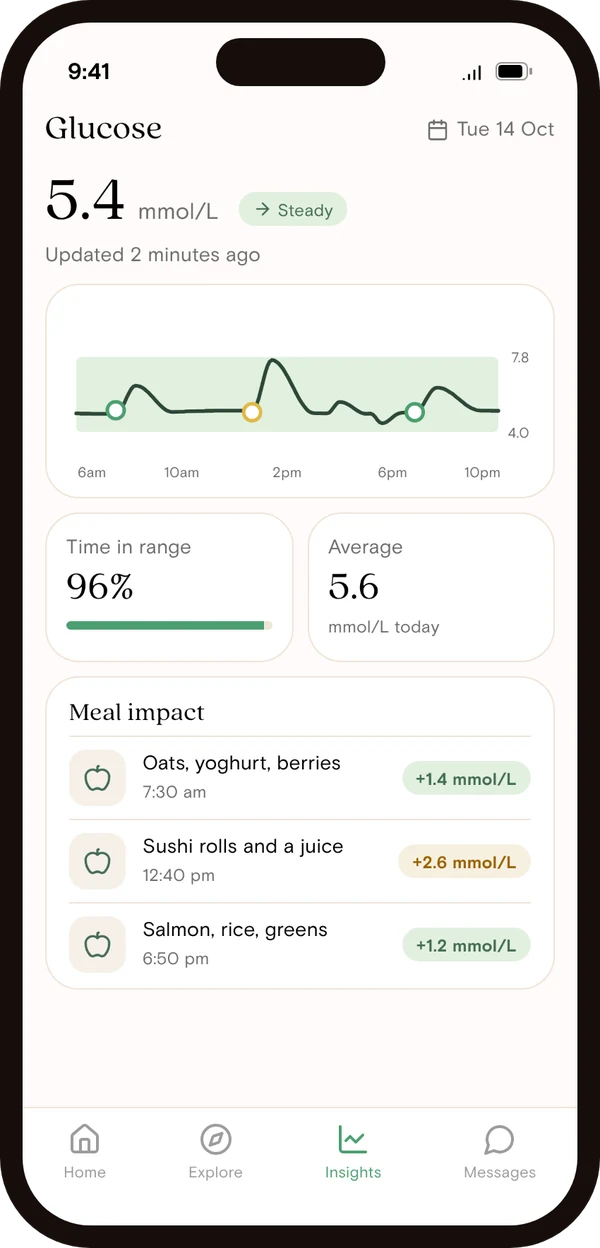
A finger-prick meter 2 hours after your first bite gives you one accurate snapshot, and a CGM shows the whole curve.
Wash and dry your hands first, because traces of food on your fingers can give a false high. The ISO 15197 standard for meters asks for 95% of results to land within 0.83 mmol/L of a lab value below 5.55 mmol/L, and within 15% above it. Our guide to blood sugar check kits in Australia compares the main meters.

A CGM reads glucose in the fluid under the skin every few minutes. That fluid trails blood by about 5 to 20 minutes, according to Australian Prescriber, so a CGM peak can look a little later and lower than a finger prick taken at the same moment.
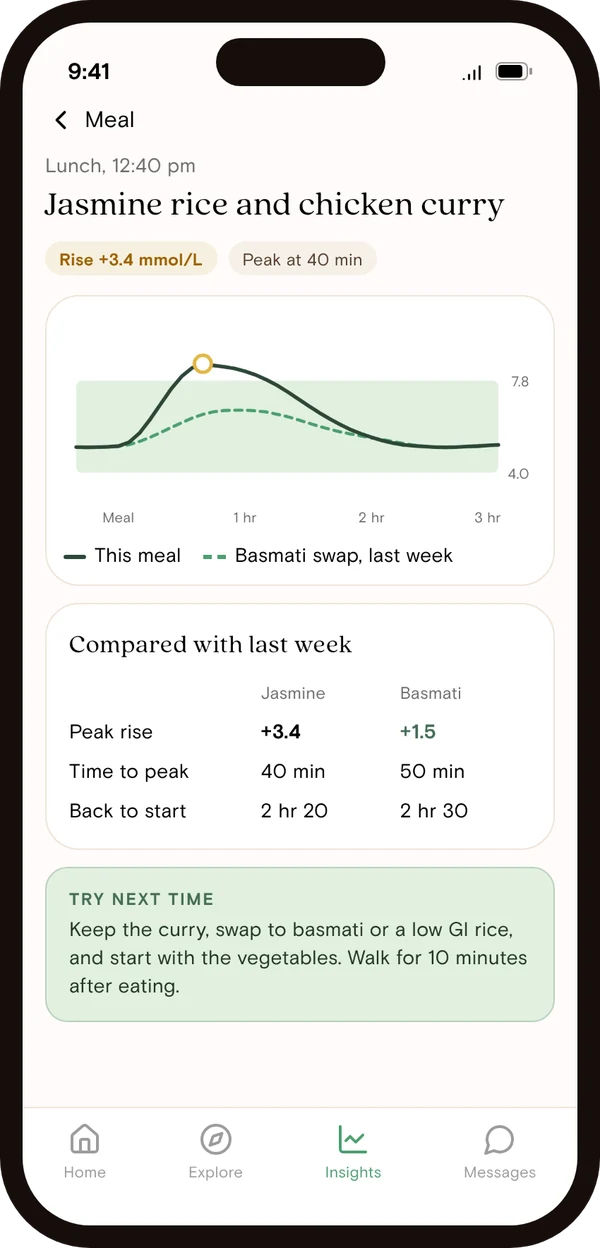
A 2026 review in JAMA Internal Medicine found no evidence they improve health in people without diabetes, and warned that normal ups and downs can be misread. We read the data with you so a normal rise is not mistaken for a problem. More on that in using a CGM without diabetes.
See your GP if your readings 2 hours after meals are often above 7.8 mmol/L and you do not have diabetes, or if you have diabetes and are regularly above the targets your team set.
Most people with prediabetes have no symptoms, so testing is how it is found (see the signs of prediabetes to watch for). Your GP can order an HbA1c, a fasting glucose or a glucose tolerance test. For fasting, HbA1c and diabetes ranges in one place, see our chart of normal blood sugar levels in Australia.
The Vively CGM program pairs a 14-day CGM sensor with the Vively app, so you can see how your own meals, exercise, sleep and stress affect your glucose. Our team then helps you work out what to change, starting with the meals that move you most. If you would rather start with a blood test, the Baseline Health Check measures fasting glucose, HbA1c, fasting insulin and HOMA-IR.
Wear a CGM sensor for 14 days and see how your meals, sleep, stress and movement shift your glucose, with clear guidance on what to change.
Yes. A reading of 7.7 mmol/L after eating sits just inside the usual 4.0 to 7.8 mmol/L range that Diabetes Australia gives for people without diabetes. At 1 hour it is a common peak. At 2 hours it is at the top of the range, so if you see it often, note what you ate and mention the pattern to your GP.
Not at 2 hours, though it can be at 1 hour. A brief reading of 8.2 mmol/L near the peak can happen in healthy people after a carbohydrate-rich meal. At 2 hours it is above 7.8 mmol/L, in the band a glucose tolerance test calls impaired glucose tolerance. One reading after an ordinary meal is not a diagnosis, but repeated readings like this deserve a GP visit.
Yes, for someone without diabetes. A reading of 10.2 mmol/L is above the usual 4.0 to 7.8 mmol/L range, and at 2 hours it sits in the 7.8 to 11.0 band. For people with diabetes it is just above the general 2 hour target of 5.0 to 10.0 mmol/L. If it happens more than once, see your GP and ask about an HbA1c test.
There is no separate Australian target, so most people use the usual 4.0 to 7.8 mmol/L range as a guide. Among Vively CGM members who reported prediabetes, the typical reading 2 hours after eating was 5.7 to 6.1 mmol/L, depending on age, a little higher than the 5.6 to 5.8 seen in members without diabetes. Your GP can set a goal that fits you.
Back near your pre-meal level. For people without diabetes that usually means somewhere inside the 4.0 to 7.8 mmol/L range, often close to a fasting reading. If you are still above 7.8 mmol/L three or four hours after eating, or regularly feel shaky and hungry at that point, talk to your GP about testing.
There is no set number, because blood sugar is still climbing straight after a meal. In people without diabetes it mostly stays within 4.0 to 7.8 mmol/L, with brief rises above that after carbohydrate-heavy meals. A reading taken right after eating is hard to interpret, which is why checks are usually done 2 hours after the first bite.
7.8 mmol/L is about 140 mg/dL. To convert, multiply mmol/L by 18. Australia, New Zealand and the UK use mmol/L, while the US uses mg/dL, so a 140 mg/dL cut-off in an American article is the same 2 hour line as 7.8 mmol/L here.
START YOUR BASELINE
Vively includes a Baseline Health Check with 70+ biomarkers, a results report and practitioner support in the $99 a month membership. No minimum term.
Explore Baseline Health CheckSubscribe to our newsletter & join a community of 30,000+ Aussies

Start a PCOS assessment with your GP. Learn which blood tests matter, when ultrasound or AMH is useful, and how contraception affects results.

Know what to do about an unexpected high blood sugar reading, when to seek urgent help, and which everyday habits support longer-term glucose care.





Vively is a general wellness platform and does not provide medical advice, diagnosis, or treatment. Any information, insights or guidance offered through our app, website, programs, or coaches is for educational and informational purposes only and should not be considered a substitute for professional medical advice or care. Always consult a qualified healthcare provider before making any health-related decisions.
We acknowledge the Traditional Custodians of the lands where we live and work, the Gadigal of the Eora Nation. We pay our respects to their Elders past and present.

 Share
 Tweet
 Share