


Watermelon has a high glycaemic index (GI) of 76 to 78, but a low glycaemic load of about 6 to 8 for a 150 g serve, because it is around 92% water. It raises blood sugar quickly but not by much: in 577 Vively members wearing a glucose monitor, it gave a typical rise of 1.4 mmol/L.
The member data below shows how watermelon behaved in real people, eating everyday portions, next to other fruit.
Typical rise in blood sugar (mmol/L) when Vively members wearing a continuous glucose monitor ate each food on its own. Each food has at least 30 members behind it.
GI tables come from lab tests on small groups. Real responses vary a lot from person to person. See the curves on our glucose spikes page, or try a CGM to see your own.
Watermelon has a GI of 76 in the international GI tables published by the University of Sydney team in 2008, and 78 in their GI shopping guide. Both are high, since anything 70 or above counts as high GI.
You may also see a GI of 50. In 2021 the University of Sydney's GI News reported that the newest international tables averaged four watermelon varieties tested in Malaysia at 50, a low GI. The researchers noted that varieties grown elsewhere may differ. Australian watermelons have not been retested, so we use 76 to 78 here and treat 50 as a sign that variety matters.
GI measures how fast the carbohydrate in a food reaches your blood, compared with pure glucose at 100. It says nothing about how much carbohydrate a normal serve contains, and that is where watermelon looks very different. Our guide to carbohydrates and the glycaemic index covers how GI is tested.
Glycaemic load (GL) multiplies GI by the grams of carbohydrate you eat, so it tells you more about a real serve. A GL of 10 or less is low.
Diabetes Australia lists watermelon at about 5 g of carbohydrate per 100 g, one of the lowest of any fruit. A 150 g serve, which is the Australian Dietary Guidelines serve of fruit, therefore has about 7.5 g of carbohydrate and a GL of about 6. Using the slightly higher carbohydrate figure in American tables (11 g per cup), the GL is about 8. Either way it is low. A medium banana, by comparison, carries around 22 g of carbohydrate.
The sugar in watermelon is a mix of fructose, glucose and sucrose, at roughly 5 to 7 g per 100 g depending on the variety and the source you read. That is less sugar per bite than grapes or mango.
Watermelon raises blood sugar quickly but modestly. In our members' CGM data, the typical rise after watermelon on its own was 1.4 mmol/L, the same as mango, a little more than apple (1.2) and less than banana (1.6). The middle half of members rose between 0.6 and 2.2 mmol/L, and 35% rose by less than 1 mmol/L.
It also comes down fast. When we lined up the glucose curves of 326 members eating watermelon alone, the typical curve peaked about 30 minutes after eating and was back near the starting level by 2 hours. That fits a high GI food with little carbohydrate: a quick, short bump rather than a long climb.
For people without diabetes, Diabetes Australia gives 4.0 to 7.8 mmol/L as the usual range across the day, including after meals. A 1.4 mmol/L rise from a normal fasting level stays well inside it. Our guide to blood sugar levels after eating explains what to expect.
“Remember, we're in no way demonising carbohydrates, they are an essential macronutrient!”
Dr Michelle Woolhouse, Vively Medical Director
Keep to a serve, eat it with something that has protein or fat, and enjoy it.
One serve is about 150 g, roughly a cup of diced watermelon or a thin slice. Diabetes Australia, following the Australian Dietary Guidelines, suggests two serves of fruit a day. Half a watermelon on a hot afternoon is a different story, because the carbohydrate adds up.
Our data backs this one up. Among 32 members who logged watermelon both on its own and with only protein, fat or vegetables alongside (yoghurt, nuts, cheese and similar), the typical rise was 1.2 mmol/L alone and 0.8 mmol/L paired, and 69% of them rose less when they paired it. It is a small group, so treat it as a pointer. Watermelon with feta and mint, or with a few almonds, is an easy start.
Juicing watermelon removes what little fibre it has and makes it easy to drink several serves in a minute. Diabetes Australia notes that juice can raise glucose quickly for exactly that reason.
Yes. Watermelon can be one of your two daily fruit serves if you have type 1 or type 2 diabetes or prediabetes. Its low glycaemic load makes a 150 g serve easier to fit into a meal plan than many people expect.
Count the carbohydrate as you would for any fruit, about 7 to 8 g per serve, and spread fruit across the day rather than eating it all at once. Your GP, diabetes educator or dietitian can tell you how fruit fits with your medicines and targets. If you check your glucose at home, testing two hours after a watermelon snack is a simple way to see your own response. Our list of low GI fruits has more ideas.
“But in those who average blood glucose levels remain in the normal range, some of those people are in fact experiencing highs and lows and this in itself can be an issue.”
Dr Michelle Woolhouse, Vively Medical Director
Averages hide a wide spread. Some members barely moved after watermelon, while more than a quarter (28%) rose by 2 mmol/L or more. Ripeness, portion, what else you ate that day, your sleep, stress and how insulin sensitive you are all change the result. The curves on our glucose spikes page, linked in the member data box above, show how much responses vary between people.
That variation is why we think a single number on a GI table is a starting point, not an answer. Insulin resistance can sit underneath normal glucose for years, and a fasting insulin result tells you more about it than any fruit list. The fasting insulin test page explains why.
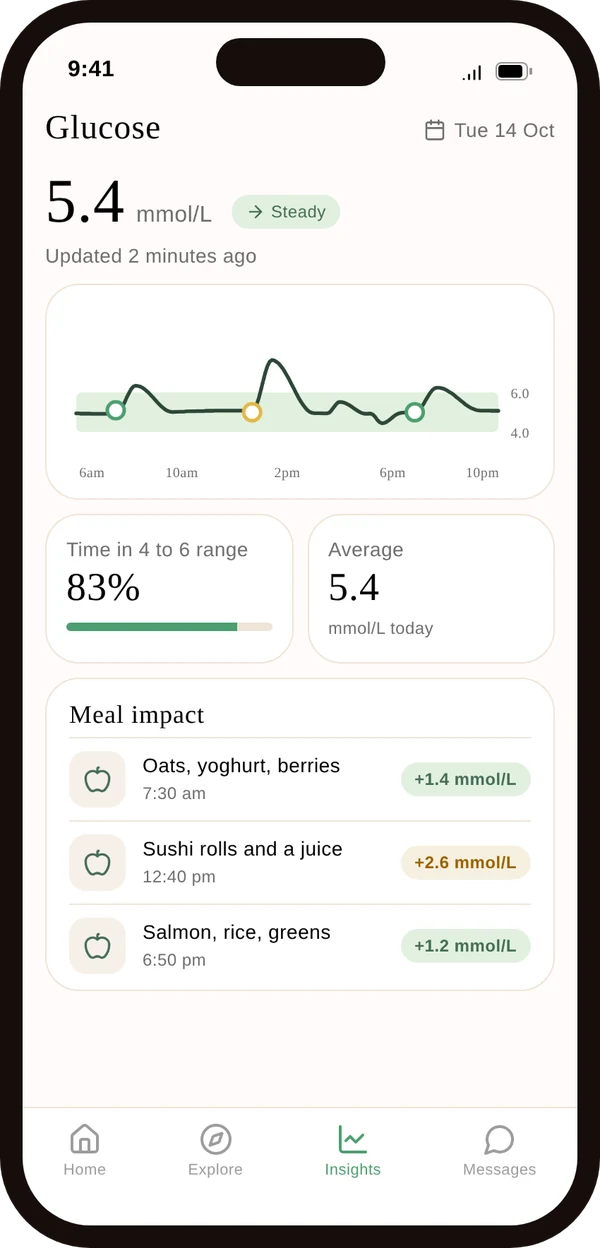
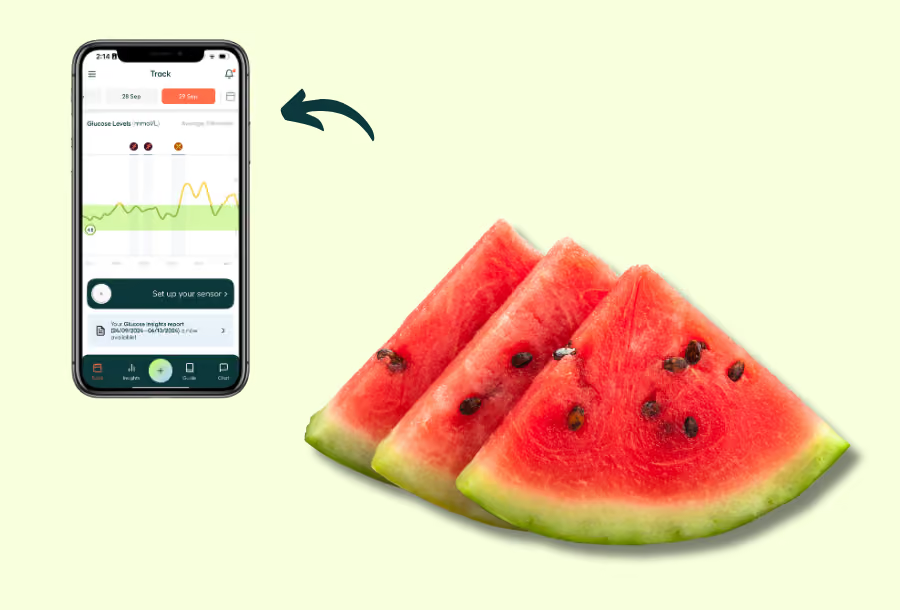
If you want to know what watermelon, or anything else, does to your own glucose, the Vively CGM program pairs a 14 day sensor with the app. You log meals, see your rise after each one and get dietitian support through the $99 a month membership. Start with our guide to continuous glucose monitors if you are new to them.
Wear a CGM sensor for 14 days and see how watermelon, bananas and the rest of your meals move your glucose, with guidance on what to change.
Watermelon has a high GI of 76 in the 2008 international tables and 78 in the University of Sydney's GI shopping guide. A 2021 average of four Malaysian varieties came out lower, at 50, so variety matters. Its glycaemic load is low, about 6 to 8 for a 150 g serve.
Only a little. Vively members wearing a CGM saw a typical rise of 1.4 mmol/L after eating watermelon on its own, similar to mango and less than banana. The rise peaked about 30 minutes after eating and was back near baseline by 2 hours.
About 5 to 7 g of sugar per 100 g, depending on variety and source. A 150 g serve has roughly 7.5 to 11 g of carbohydrate, less than a medium banana (about 22 g). Most of the rest of the fruit is water, around 92%.
Yes, in normal serves. A 150 g serve has a low glycaemic load and can count as one of the two fruit serves a day that Diabetes Australia suggests. Pair it with protein or fat, avoid juicing it, and ask your GP or dietitian how fruit fits your plan.
High GI but low GL. Its GI of 76 to 78 means its sugar is absorbed quickly, but because it is mostly water, a normal serve contains little carbohydrate. That is why a slice raises blood sugar less than its GI suggests.
START YOUR BASELINE
Vively includes a Baseline Health Check with 70+ biomarkers, a results report and practitioner support in the $99 a month membership. No minimum term.
Explore Baseline Health CheckSubscribe to our newsletter & join a community of 30,000+ Aussies

Start a PCOS assessment with your GP. Learn which blood tests matter, when ultrasound or AMH is useful, and how contraception affects results.


Know what to do about an unexpected high blood sugar reading, when to seek urgent help, and which everyday habits support longer-term glucose care.





Vively is a general wellness platform and does not provide medical advice, diagnosis, or treatment. Any information, insights or guidance offered through our app, website, programs, or coaches is for educational and informational purposes only and should not be considered a substitute for professional medical advice or care. Always consult a qualified healthcare provider before making any health-related decisions.
We acknowledge the Traditional Custodians of the lands where we live and work, the Gadigal of the Eora Nation. We pay our respects to their Elders past and present.
 Share
 Tweet
 Share