


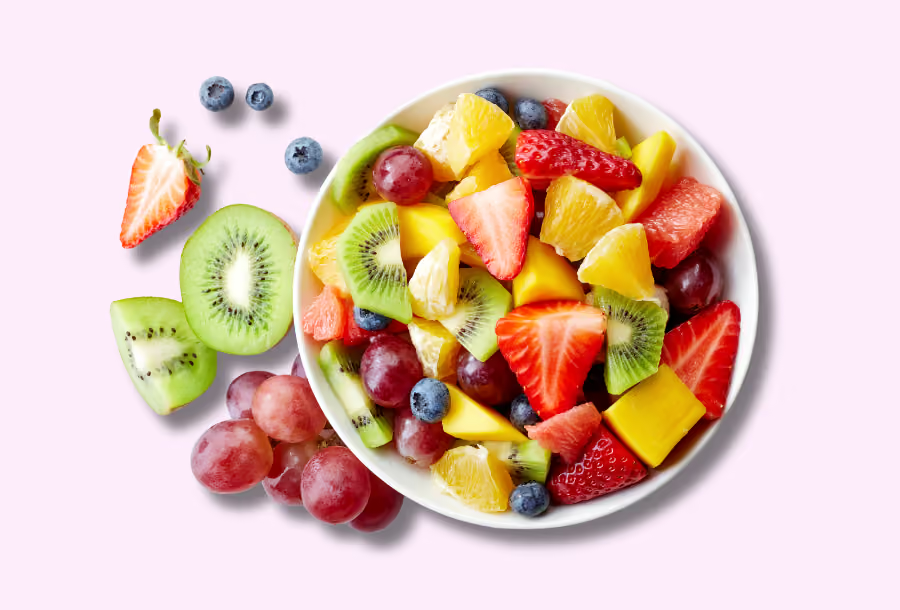
Low GI fruits have a glycaemic index of 55 or less, and most temperate fruits qualify: grapefruit (25), pears (29 to 38), apples (36 to 44), kiwifruit (38 to 39), plums (39), peaches (42) and oranges (42 to 45). Tropical fruits score higher but carry little carbohydrate per serve. Whole fruit beats juice.
GI tells you how fast a fruit's carbohydrate turns into blood glucose. Glycaemic load (GL) adds how much carbohydrate is in a normal serve, so we show both where the data exists.
A fruit is low GI if it scores 55 or less when tested against pure glucose, which scores 100. Medium is 56 to 69, and high is 70 or more.
Most fruit sits low because of the type of sugar and what comes with it. Much of the sugar in apples and pears is fructose, which has a low GI. Citrus brings acid, which slows stomach emptying, and fibre such as pectin slows absorption.
The University of Sydney's GI Foundation notes that temperate fruits such as apples, pears, citrus and stone fruit have low GI values. Tropical fruits tend to score higher, but most have little carbohydrate per serve.
Ripeness matters too. The NDSS notes that the GI of fruits such as bananas and mangoes rises as they ripen. A slightly under-ripe banana tested at 42 and a ripe one at 47 to 55, which our banana GI guide covers in detail.
The best low GI fruits for steady blood sugar combine a low GI with a modest amount of carbohydrate per serve.
Eat them whole rather than juiced, and pair them with low GI vegetables, grains and protein across the day. Our list of low GI vegetables fills out the rest of the plate.

Kiwi fruit is low GI: green kiwifruit tested at 39 and gold kiwifruit at 38.
Both results come from tests of Zespri Green and Zespri SunGold run by Glycemic Index Otago and reported in Zespri's own nutrition summary. Zespri commissioned the research and it has not been peer reviewed, so treat the numbers as a good guide rather than the final word. You may see other kiwi figures online; these are the tested values we could trace.
A 100 g serve has 9.8 g of carbohydrate for green and 11.1 g for gold. That puts the glycaemic load at about 4 for both, which is low.

GI measures how fast a fruit's carbohydrate raises glucose, while glycaemic load (GL) also counts how much carbohydrate a serve contains.
The formula is simple: GL = GI x grams of available carbohydrate, divided by 100. A GL of 10 or less is low, 11 to 19 is medium and 20 or more is high.
Watermelon has a high GI of 76 to 78, but it is mostly water. A cup holds about 11 g of carbohydrate, for a GL of about 8. Rockmelon is similar, with a GI of 68 and a GL of about 5 per cup. So a normal serve of melon ends up close to an apple (GL about 7) or an orange (about 5).
Dried dates go the other way. Their GI is 42 to 62 depending on the test, but about 57 g of dried dates holds 40 g of carbohydrate, a GL of about 25. That is high, whichever GI you use.
GI is measured in a lab. For real-world numbers, see how bananas and watermelon affected the glucose of Vively members wearing a CGM.
Fresh red cherries are probably not low GI: an Australian test gave them 65, in the medium band.
The figure of 22 still printed on many charts comes from an early European study, which the University of Sydney's GI News says may not be reliable. Montmorency tart cherries tested at 54 frozen and 58 dried.
Cherries are still a good fruit to eat in season. A handful with plain yoghurt is a sensible serve.

No fruit is bad for blood sugar, but dried fruit, juice and very ripe fruit in large serves raise glucose more than the same fruit eaten whole and fresh.
It comes down to form and amount:
| Fruit | Fresh or less ripe | Processed or riper |
|---|---|---|
| Grapefruit | 25 fresh | 47 canned, 48 juice |
| Banana | 42 slightly under-ripe | 47 to 55 ripe |
| Apricots | 38 fresh (GL about 2 per 60 g) | 42 to 44 dried (GL about 4 per 20 g) |
| Peaches | 42 fresh | 43 canned |
| Tart cherries | 54 frozen | 58 dried |
Long-term studies back whole fruit. In large US cohorts (Muraki and colleagues, BMJ, 2013), people who ate more whole fruit, especially blueberries, grapes and apples, had a lower risk of type 2 diabetes, while more fruit juice was linked to a higher risk.
Eat fruit whole, in a normal serve, and pair it with protein or fat when you can.
Fruit stays on the menu with diabetes. Diabetes Australia's general targets are 4.0 to 7.0 mmol/L before meals and 5.0 to 10.0 mmol/L two hours after starting a meal, and your GP or specialist sets your own. Our guide to blood sugar after eating explains the numbers, and the 7-day prediabetes meal plan shows fruit in real meals.
People also respond differently to the same food. In a study of 800 people (Zeevi and colleagues, Cell, 2015), glucose responses to identical meals varied widely between people, so your own numbers are the best guide. Our article on using a CGM without diabetes covers what you can and cannot learn from one.
Vively's CGM program pairs a 14-day sensor with the Vively app, so you can see how your usual fruit, juice or smoothie affects your glucose and test a swap the next day. You get guidance on what to change, based on your own data. If you want to know where you stand first, the Baseline Health Check measures fasting glucose, HbA1c, fasting insulin and HOMA-IR from one blood draw.
Wear a CGM sensor for 14 days and see how your fruit, meals, sleep and movement shift your glucose, with clear guidance on what to change.
Yes. Green kiwifruit tested at a GI of 39 and gold kiwifruit at 38, both in the low band of 55 or less. A 100 g serve has about 10 to 11 g of carbohydrate, a glycaemic load of about 4. These results come from tests commissioned by Zespri and reported by the company, so they have not been independently peer reviewed.
Yes. Apples test at 36 to 44 on the GI scale, depending on the study and variety, and one 140 g apple has about 17 g of carbohydrate, a glycaemic load of about 7. Much of an apple's sugar is fructose, which has a low GI, and pectin slows absorption. Eat the apple whole rather than as juice.
Yes. Oranges test at 42 to 45, and a 140 g orange has about 12 g of carbohydrate, a glycaemic load of about 5. The acidity and soluble fibre slow absorption. Juice is a different story: it removes much of the fibre and lets you drink several oranges at once, so a whole orange is the better choice for blood sugar.
Yes. Strawberries test at 40, with so little carbohydrate that a 150 g serve has a glycaemic load of about 2. Blueberries test at 51 to 53, near the top of the low band, but half a cup has only about 9 g of carbohydrate, a glycaemic load of about 5. Whole berries are a better choice than berry juice.
Yes. Fresh plums test at 39 and fresh peaches at 42, both comfortably low GI, and canned peaches average 43. Like other temperate stone fruit, they suit a low GI way of eating. A whole plum or peach with a handful of nuts or some yoghurt makes a snack that is easy on blood sugar.
Fresh grapefruit, at 25, is the lowest GI fruit tested so far according to GI News from the University of Sydney. Pears (29 to 38), apples (36 to 44) and fresh apricots (38) follow. If you take medication, check with your GP or pharmacist before eating grapefruit regularly, because it interacts with some medicines, including some statins.
START YOUR BASELINE
Vively includes a Baseline Health Check with 70+ biomarkers, a results report and practitioner support in the $99 a month membership. No minimum term.
Explore Baseline Health CheckSubscribe to our newsletter & join a community of 30,000+ Aussies

Start a PCOS assessment with your GP. Learn which blood tests matter, when ultrasound or AMH is useful, and how contraception affects results.


Know what to do about an unexpected high blood sugar reading, when to seek urgent help, and which everyday habits support longer-term glucose care.





Vively is a general wellness platform and does not provide medical advice, diagnosis, or treatment. Any information, insights or guidance offered through our app, website, programs, or coaches is for educational and informational purposes only and should not be considered a substitute for professional medical advice or care. Always consult a qualified healthcare provider before making any health-related decisions.
We acknowledge the Traditional Custodians of the lands where we live and work, the Gadigal of the Eora Nation. We pay our respects to their Elders past and present.
 Share
 Tweet
 Share