Hair Loss in Women: The Blood Tests Worth Doing
Most hair loss in women is either a gradual thinning at the part and crown (female pattern hair loss) or sudden, all-over shedding a few months after a stress on the body (telogen effluvium). Blood tests can help find causes that may be treatable: low iron stores, thyroid problems and, in some women, higher androgens such as in PCOS.
Seeing more hair in the shower or on your brush is unsettling, and it is very common. Losing up to about 100 hairs a day is normal. Shedding more than that for weeks, or seeing your part widen, is worth looking into.
This guide covers the two common patterns of hair loss in women, the blood tests that check for causes you may be able to do something about, and when to see a GP or dermatologist. If you're concerned about your hair loss, speak with your GP.
The Baseline Health Check covers 70+ markers, including iron studies, ferritin, thyroid and insulin. Add the Female Hormone Health Test to check androgens.
The two common kinds of hair loss in women
Knowing which pattern you have helps you work out how useful a blood test is likely to be.
Telogen effluvium (shedding). Hair comes out all over the scalp, often in handfuls, about 2 to 3 months after a trigger. Common triggers are a high fever or illness (including COVID-19), surgery, having a baby, a crash diet or fast weight loss, a big emotional stress, or starting or stopping a medicine. The shedding usually settles within about 6 months once the trigger has passed, and the hair usually grows back. If it keeps going, low iron or a thyroid problem may be playing a part.
Female pattern hair loss (thinning). Hair gets finer and thinner over months to years, mostly on top and at the part, while the hairline at the front stays. It runs in families and is linked to how hair follicles respond to androgens (hormones such as testosterone), even when blood androgen levels are normal. It is common, especially after menopause, and treatment tends to work better when started early.
Many women have a mix of both. A GP or dermatologist can usually tell the patterns apart by looking at your scalp.
Blood tests for hair loss
These are the tests that most often change what happens next.
| Test | Why it is checked |
|---|---|
| Ferritin and iron studies | Low iron stores are common in women with heavy periods, and low iron is linked with ongoing shedding |
| Full blood count | Checks for anaemia |
| TSH | Both an underactive and an overactive thyroid can cause hair loss all over the scalp. Hair usually recovers once the thyroid is treated |
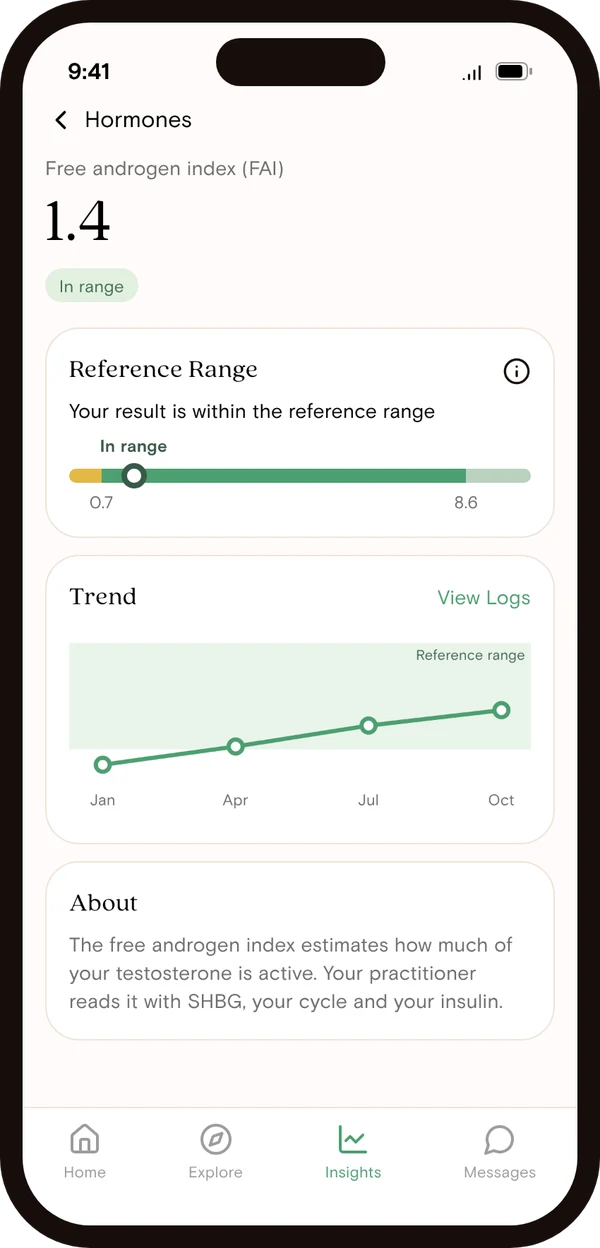
| Free androgen index (FAI), SHBG, free testosterone and DHEA-S | Checks for higher androgens, as in PCOS. SHBG is a protein that carries testosterone in the blood, and the FAI estimates how much testosterone is free to act. Most useful if you also have irregular periods, acne or extra facial or body hair |
| Fasting insulin and glucose | Insulin resistance is common in PCOS and can push androgens up |
| Vitamin D | Low levels are common, and some studies link them with hair loss. The evidence that vitamin D treats hair loss is weak |
| Zinc | True zinc deficiency is uncommon but can cause shedding. Taking zinc when you aren't low is unlikely to help hair, and too much can lower copper |
Your doctor may also check prolactin or other hormones if your periods have changed, and vitamin B12 if you eat little or no animal food.
Women aged 18 to 49 at their first Vively blood test. “In range” means inside the lab’s normal range. “Optimal” is the tighter range Vively aims for.
- Below range (under 15)6%
- In range, below optimal (15 to 70)62%
- Optimal (70 to 200)29%
- In range, above optimal (200 to 400)3%
About 2 in 3 were below Vively’s optimal range, and about 1 in 4 were under 30 µg/L, the level many Australian doctors use for low iron stores.
- Below range (under 50)17%
- In range, below optimal (50 to 75)41%
- Optimal (75 to 125)37%
- In range, above optimal (125 to 200)4%
Nearly 6 in 10 were below Vively’s optimal range.
- Below range (under 0.5)3%
- In range, below optimal (0.5 to 1)15%
- Optimal (1 to 2.5)66%
- In range, above optimal (2.5 to 4)13%
- Above range (over 4)3%
Most were in the optimal range. About 1 in 30 were above the lab range, which can point to an underactive thyroid.
Iron and hair loss
Low iron is the blood test finding most often linked with hair shedding in women. Studies disagree on how strong the link is, but low ferritin is common and can usually be treated, which may support your energy as well as your hair.
A ferritin below 30 µg/L usually means your iron stores are low. Many hair specialists like ferritin to sit higher than that before they expect regrowth. This is where normal doesn't always mean optimal: a ferritin of 20 µg/L is inside many labs' ranges but well below where hair specialists like it. The Vively optimal range for women is 70 to 200 µg/L. If your ferritin is low, the next question is why, usually heavy periods, diet or poor absorption. After menopause, or if there is no clear reason, low iron needs a GP check for hidden blood loss, for example from the gut. Our guide to iron deficiency signs and ferritin results explains how to read your result, and ferritin levels for women by age shows where most women sit.
Test before you take iron. Hair regrows slowly, so give it 3 to 6 months after your iron is back up before judging the result. Low iron can also leave you tired, and our guide to blood tests for being tired all the time covers that side.
Because the role of hair growth isn’t considered essential to survival, the body tends to give its energy to more vital functions, so … what happens with your hair will be somewhat delayed.

PCOS, androgens and hair loss
Polycystic ovary syndrome (PCOS) can cause thinning on top of the head, along with irregular periods, acne and extra hair on the face or body. The international PCOS guideline uses a blood test for androgens, best measured as free testosterone or the FAI, as part of the diagnosis.
Androgen results are hard to read if you take the combined pill, because it raises SHBG and lowers free testosterone. Testing on day 2 to 5 of your cycle is the usual approach if you have periods. Our articles on getting tested for PCOS and PCOS and insulin resistance go further, and the guide to testosterone levels in women by age shows typical results.
Hair supplements can upset your blood test
Many hair, skin and nail supplements contain high doses of biotin. Biotin can make some lab tests, including thyroid tests, read falsely high or low. Stop biotin 2 to 3 days before your blood test, or tell your doctor you take it.
Hair loss that needs a doctor, not a blood test
Some types of hair loss aren't explained by a blood result and need someone to look at your scalp:
- Round, smooth bald patches are usually alopecia areata, an autoimmune condition. A GP or dermatologist can talk you through treatment options.
- Itching, burning, redness, scaling or shiny skin where hair has gone can mean a scarring type of hair loss. See a dermatologist promptly, because hair lost to scarring may not grow back.
- Thinning at the temples or edges from tight ponytails, braids or extensions (traction alopecia) often improves if the pulling stops early.
- Sudden new facial hair, a deeper voice or rapid hair loss together can be a sign of high androgens from a less common hormone problem that needs prompt tests. See your GP soon.
What about men?
Most hair loss in men is male pattern baldness, a receding hairline and thinning crown that runs in families. A blood test rarely changes the answer for that pattern. Blood tests make more sense for a man with sudden, all-over shedding, patches, or other symptoms such as tiredness or weight change, and then iron studies, a full blood count and TSH are the usual starting point.
Testing with Vively
Start with the Baseline Health Check. It covers iron studies and ferritin, a full blood count, TSH, vitamin D, fasting glucose, fasting insulin and HbA1c. We read your results against Vively's optimal ranges as well as the lab's, so a ferritin that's "normal" but low gets picked up and explained. If you have irregular periods, acne or extra facial hair, add the Female Hormone Health Test, which checks free testosterone, FAI, SHBG, DHEA-S, prolactin and your other cycle hormones. Zinc and vitamin B12 come with the Essential Nutrients Test.
You don't need a referral from your own GP. A GP from our network signs your request after a short telehealth consult. You have one blood draw at one of our 3,700+ partner collection centres, with no appointment needed, and results arrive in the Vively app, usually within a few days. A Vively practitioner talks you through them, and your membership includes a targeted re-test after 3 months to see how your iron and other markers have moved.
The Baseline Health Check is included in the $99 a month membership, with no minimum term. Add-on tests are priced individually. Vively does not diagnose, manage or treat chronic conditions, including hair loss. If you're concerned about your hair loss, speak with your GP, who can refer you to a dermatologist if needed. Start with your Baseline.
Frequently asked questions
What blood tests should I get for hair loss?
Start with ferritin and iron studies, a full blood count and TSH. If you have irregular periods, acne or extra facial or body hair, add androgens: free testosterone or FAI, SHBG and DHEA-S. Vitamin D, zinc and B12 can be added depending on your diet and history. These check for the causes most often found.
Can low iron cause hair loss?
Low iron is linked with ongoing hair shedding in women, although studies disagree on how strong the link is. A ferritin below 30 µg/L usually means low iron stores, and many specialists like it higher before they expect regrowth. Treating low iron may also support your energy, but test first rather than taking iron just in case.
Can thyroid problems cause hair loss?
Yes. Both an underactive and an overactive thyroid can cause hair to thin all over the scalp. TSH is the first test. Hair usually recovers once thyroid levels are treated and stable, but regrowth takes several months, so it can lag behind the blood test results.
What is telogen effluvium?
Telogen effluvium is sudden, all-over shedding that starts about 2 to 3 months after a stress on the body, like illness, surgery, childbirth, a crash diet or a big emotional upset. It usually settles within about 6 months and the hair usually grows back. If it lasts longer, check iron and thyroid.
Does PCOS cause hair loss?
It can. Higher androgens in PCOS can cause thinning on top of the head, often with irregular periods, acne or extra facial hair. A blood test for free testosterone or FAI, with SHBG, is part of the diagnosis. Results are hard to read on the combined pill, so tell your doctor if you take it.
Do I need a referral for a hair loss blood test?
You don't need a referral from your own GP with Vively. A GP from our network signs your request after a short telehealth consult, because standard blood tests need a doctor's request. The Baseline lab tests can be Medicare-rebated. Hormone add-ons such as the Female Hormone Health Test are private tests, priced individually.
When should I see a dermatologist for hair loss?
See a dermatologist if you have bald patches, if your scalp itches, burns, scales or looks red or shiny where hair is lost, or if thinning keeps going despite normal blood tests. Scarring types of hair loss need treatment early, because hair lost to scarring may not grow back.
References
- Australasian College of Dermatologists. A-Z of skin: Telogen effluvium; Female pattern hair loss; Alopecia areata. https://www.dermcoll.edu.au
- Healthdirect. Hair loss. https://www.healthdirect.gov.au/conditions/hair-problems/female-pattern-hair-loss
- Teede HJ, Tay CT, Laven JJE, et al. Recommendations from the 2023 international evidence-based guideline for the assessment and management of polycystic ovary syndrome. Journal of Clinical Endocrinology and Metabolism. 2023;108(10):2447-2469.
- Trost LB, Bergfeld WF, Calogeras E. The diagnosis and treatment of iron deficiency and its potential relationship to hair loss. Journal of the American Academy of Dermatology. 2006;54(5):824-844.
- Almohanna HM, Ahmed AA, Tsatalis JP, Tosti A. The role of vitamins and minerals in hair loss: a review. Dermatology and Therapy. 2019;9(1):51-70.
- US Food and Drug Administration. Biotin (vitamin B7): safety communication, may interfere with lab tests. 2017, updated 2019.
- Jean Hailes for Women's Health. Polycystic ovary syndrome (PCOS). https://www.jeanhailes.org.au
Vively supports preventative health and health optimisation. It does not replace your GP, emergency care or specialist medical advice.
