Fasting Glucose Test: Normal Range, Prediabetes and What to Do Next
A fasting glucose test measures the sugar in your blood after 8 to 12 hours without food. Australian doctors use it to check for prediabetes and type 2 diabetes.
Your result shows where you sit against the Australian cut-offs. We also read it beside your fasting insulin and look at the pattern across your metabolic markers, because glucose can look normal for years while your body works harder behind the scenes to keep it there.
Included in the Baseline Health Check (70+ markers), part of the $99 a month membership. Targeted baseline re-test after 3 months.
Medicare
Medicare rebate available. A GP reviews your request in a short telehealth consult.
How to get it
Order online, then one blood draw at any of 3,700+ partner collection centres. Results arrive in the Vively app within a few days, explained against optimal ranges.
Fasting glucose is one of 70+ markers in Vively's Baseline Health Check, read alongside fasting insulin and HOMA-IR so you can see how hard your body is working to keep it steady.
Fasting glucose is the amount of glucose (sugar) in your blood after at least 8 hours without food. It reflects how much glucose your liver releases overnight and how well the hormone insulin keeps that release in check. It is measured in millimoles per litre (mmol/L). Australian doctors class a fasting result below 6.1 mmol/L as normal, though many labs flag results above about 5.4 mmol/L.
When your liver and muscles respond less to insulin (insulin resistance), your pancreas makes more insulin to compensate, and fasting glucose stays normal until it can no longer keep up.
What does a fasting glucose test show?
A fasting glucose test shows whether your body holds blood sugar in a healthy range when no food is coming in. GPs use it to screen for prediabetes and type 2 diabetes, which often cause no symptoms for years.
When the AusDiab study tested Australian adults aged 25 and over in 1999 to 2000, about one in six had impaired fasting glucose or impaired glucose tolerance, the stages before type 2 diabetes (Dunstan et al., 2002). This is the stage where lifestyle change does the most good.
Normal does not always mean optimal. Fasting glucose is a late marker, and insulin resistance can be present for many years, often a decade or more, before it moves out of range. A normal fasting glucose with a high fasting insulin is a very different picture from the same glucose with low insulin, so we never read it on its own.
Fasting glucose normal range
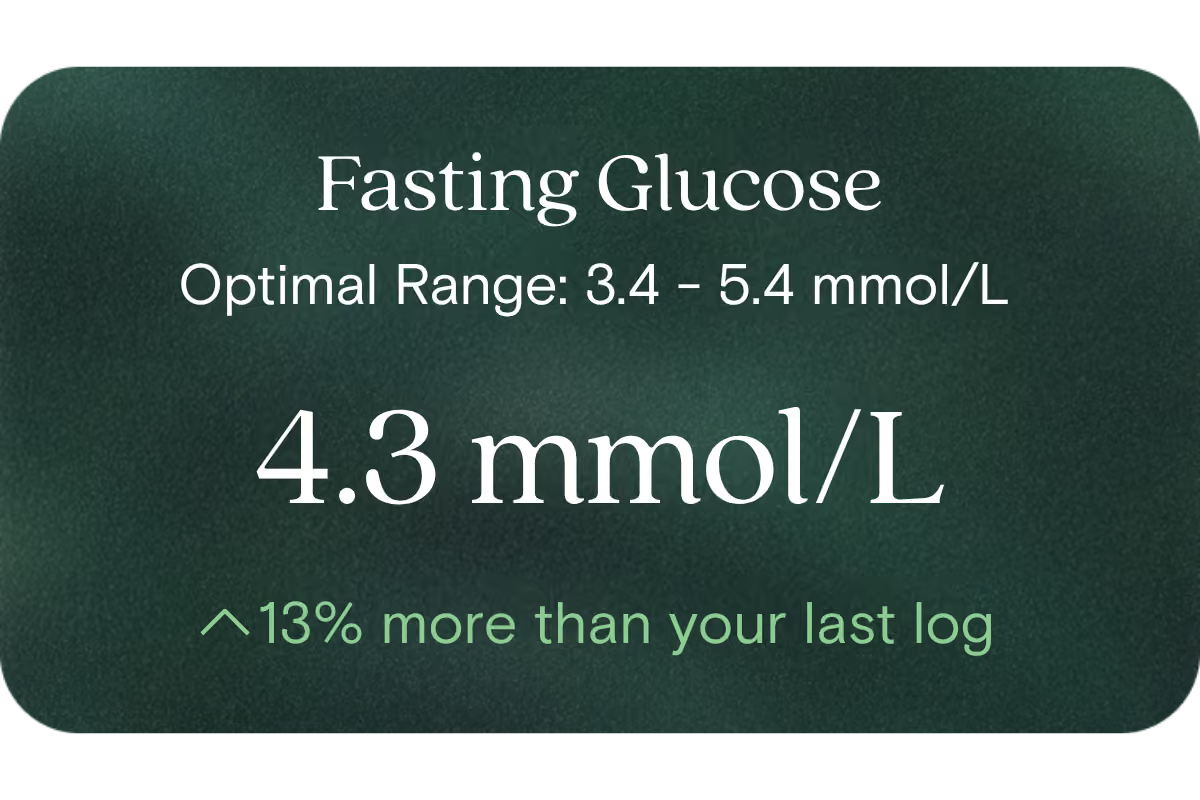
For adults, a typical lab reference range for fasting glucose is about 3.4 to 5.4 mmol/L, and doctors use cut-offs of 6.1 and 7.0 mmol/L to define impaired fasting glucose and the diabetes range.
Range
Typical lab reference range (adults, fasting)
3.4 to 5.4 mmol/L
Normal fasting glucose (Australian diagnostic cut-off)
Below 6.1 mmol/L
Impaired fasting glucose (a form of prediabetes)
6.1 to 6.9 mmol/L
Diabetes range (must be confirmed by a doctor)
7.0 mmol/L or above
Vively optimal range
No single target. We read it with your fasting insulin, HOMA-IR and HbA1c.
The diagnostic cut-offs are those used by Diabetes Australia and the RACGP. A result of 5.5 to 6.0 mmol/L sits above many lab ranges but is not prediabetes by Australian definitions. Australian GP guidance treats 5.5 to 6.9 mmol/L as a reason for further testing, usually an HbA1c or an oral glucose tolerance test.
US sources quote a lower cut-off, because the American Diabetes Association starts prediabetes at 5.6 mmol/L. Labs also set their own reference ranges, so check the one on your report.
What does high fasting glucose mean?
A mildly high fasting glucose is often a short-term rise from poor sleep, stress, illness or not fasting long enough, but a result that stays high usually reflects insulin resistance. A result of 7.0 mmol/L or above is in the diabetes range and needs a doctor to confirm it.
Common reasons for a one-off high reading:
Not a true fast. Eating within 8 hours, milk in your coffee or a late, heavy meal can lift the result.
The dawn phenomenon. In the early hours your body releases cortisol and growth hormone, and both raise glucose.
Poor or short sleep. Even one or two bad nights can make you less responsive to insulin the next morning.
Stress and illness. Infections, fever and acute stress push glucose up.
A hard workout before the test. Intense exercise briefly releases glucose from the liver.
Medicines, most often corticosteroids such as prednisolone.
Longer-term causes a doctor will think about:
Insulin resistance, often linked with weight around the waist, low activity, a family history of type 2 diabetes, polycystic ovary syndrome (PCOS) or past gestational diabetes.
Prediabetes and type 2 diabetes, confirmed with repeat testing and HbA1c.
Less common causes, such as type 1 diabetes, pancreas conditions and some hormone disorders.
Many people with high glucose feel nothing. Others notice thirst, passing more urine or blurred vision.
What does low fasting glucose mean?
A fasting glucose at the low end of the range, around 3.5 to 4.0 mmol/L, is often seen in well people after a long fast or hard training and is usually not a concern. A result below 3.5 mmol/L, or any low reading with symptoms, needs attention.
Everyday reasons include fasting well beyond 12 hours, long endurance exercise the day before, and alcohol the night before, which slows the liver's glucose release. A sample left too long before processing can also read falsely low, as the cells in the tube keep using glucose.
If you take insulin or certain diabetes tablets, Diabetes Australia counts anything below 4.0 mmol/L as a hypo that needs treating.
What can affect your fasting glucose result
Do you need to fast? Yes. Fast for 8 to 12 hours, ideally overnight with an early-morning appointment. Going much past 12 hours can skew the result.
Have water only. It helps the blood draw. Skip coffee, tea, juice, gum and mints until afterwards.
Skip your morning workout and avoid unusually hard training the day before.
Eat a normal dinner the night before, without heavy drinking.
Take your usual medicines unless your doctor says otherwise. If you take diabetes medicine, ask your GP how to fast safely.
Test when you are well. After an illness, wait a week or two once you have recovered.
Pregnancy uses different, lower glucose targets. Gestational diabetes is checked with a glucose tolerance test, usually at 24 to 28 weeks.
How fasting glucose fits with your other results
Fasting glucose makes most sense next to the markers for insulin and longer-term glucose control.
Often a one-off rise from sleep, stress or the dawn phenomenon. Repeat the test.
Fasting glucose 7.0 mmol/L or above, HbA1c 48 mmol/mol (6.5%) or above
Both in the diabetes range. Needs GP review.
Normal fasting glucose, raised HbA1c
Glucose may be running high after meals rather than overnight. Low iron can also push HbA1c up.
Fasting glucose is one moment and HbA1c is a three-month average. A continuous glucose monitor, as used in our CGM program, shows what happens in between, including how high you go after meals.
How to support healthy fasting glucose levels
Fasting glucose responds well to lifestyle change, especially early on.
Build meals around protein, fibre and healthy fats. Pair carbohydrates with protein and choose low GI options such as legumes, wholegrains and non-starchy vegetables.
Walk after meals. Even 10 to 15 minutes after dinner helps your muscles take up glucose.
Strength train at least twice a week. Muscle is where most glucose goes after a meal.
Aim for 7 to 9 hours of sleep. If you snore heavily or wake unrefreshed, ask your GP about sleep apnoea, which is linked with higher glucose.
Work on waist size if it's above target. Losing 5 to 10% of your body weight can bring fasting glucose down, sometimes back into the normal range.
Keep sugary drinks and alcohol low.
When to see your GP
See your GP within a few days if your fasting glucose is 7.0 mmol/L or above, so they can confirm it with a repeat test or HbA1c. Book a routine visit if you are in the 6.1 to 6.9 mmol/L range to agree a plan and a time to retest.
Seek care the same day if a high reading comes with marked thirst, passing a lot of urine, unexplained weight loss, vomiting, drowsiness or fast breathing. Also see your GP if your fasting glucose is below 3.5 mmol/L, or you get repeated shakiness, sweating or confusion that could be low blood sugar.
Testing fasting glucose with Vively
Fasting glucose is included in Vively's Baseline Health Check and the Full Body Health Check, alongside fasting insulin, HOMA-IR and your blood fats. Exact markers can depend on the referring doctor's review.
We arrange your referral through our GP network, you fast overnight, and you have one blood draw at one of 3,700+ accredited partner collection centres. Results arrive in the app, usually within a few days, read against optimal ranges. Your practitioner explains them, we build a personalised plan, and you retest every three months. If your glucose and insulin look healthy, we'll tell you that too.
Yes. Fast for 8 to 12 hours before the test, with water only, so no coffee, tea or juice until afterwards. Book an early-morning appointment so the fast happens overnight, skip exercise that morning, and avoid heavy drinking the night before.
Is a fasting glucose of 5.8 mmol/L high?
It is above many lab reference ranges (upper limit around 5.4 mmol/L) but below the Australian cut-off of 6.1 mmol/L, so it is not prediabetes. Australian GP guidance suggests further testing, such as an HbA1c, from 5.5 mmol/L. Check your fasting insulin too, as this can be an early sign your body is working harder to manage glucose.
What fasting glucose level is prediabetes in Australia?
A fasting glucose of 6.1 to 6.9 mmol/L is impaired fasting glucose, a form of prediabetes. A result of 7.0 mmol/L or above is in the diabetes range and needs confirming by a doctor. US sources start prediabetes at 5.6 mmol/L, which is why numbers differ online.
What is the difference between fasting glucose and HbA1c?
Fasting glucose is a snapshot of your blood sugar after an overnight fast. HbA1c measures glucose attached to the haemoglobin in your red blood cells, which reflects your average over about three months. One can be normal while the other is not, so they work best together.
Can I get a fasting glucose test through Medicare?
Many blood tests can be Medicare-funded when a doctor orders them for a clinical reason. With Vively, we arrange the referral through our GP network as part of your Baseline Health Check, so you don't need a separate GP visit first.
References
Royal College of Pathologists of Australasia (RCPA). RCPA Manual: Glucose.
Dunstan DW, Zimmet PZ, Welborn TA, et al. The rising prevalence of diabetes and impaired glucose tolerance: the Australian Diabetes, Obesity and Lifestyle Study. Diabetes Care. 2002;25(5):829-834.
Calculator:HOMA-IR calculator. Combine your fasting glucose with your fasting insulin to work out your HOMA-IR score. Fasting glucose is also one of the nine markers in the biological age calculator.
alongside iron studies, full blood count, inflammation, liver health, metabolic markers and 70+ other biomarkers, then turns your results into a personalised plan. Start My Baseline Health Check
How does your fasting glucose compare with Vively members your age?
Among 5,897 Vively members tested in 2024 to 2026, women aged 40 to 49 had a median fasting glucose of 4.8 mmol/L (middle half 4.6 to 5.1). Men the same age: 5.0 mmol/L. The lab range is 3.4 to 5.4 mmol/L. A member median is not a target.
Vively member data
Fasting glucose by age and sex
The line is the median member at each age. The shaded bands show where most members sit. The dashed red lines are the lab range.
See the numbers as a table
Group (mmol/L)
Members
Median
Middle 50%
5th to 95th percentile
Lab range
Women 18 to 29
258
4.7
4.5 to 5.0
4.1 to 5.5
3.4 to 5.4
Women 30 to 39
960
4.8
4.5 to 5.0
4.1 to 5.5
3.4 to 5.4
Women 40 to 49
1,125
4.8
4.6 to 5.1
4.2 to 5.7
3.4 to 5.4
Women 50 to 59
843
5.0
4.6 to 5.2
4.2 to 6.0
3.4 to 5.4
Women 60 and over
479
5.1
4.8 to 5.4
4.4 to 6.4
3.4 to 5.4
Men 18 to 29
259
4.8
4.6 to 5.1
4.2 to 5.5
3.4 to 5.4
Men 30 to 39
636
5.0
4.6 to 5.2
4.2 to 5.7
3.4 to 5.4
Men 40 to 49
682
5.0
4.7 to 5.3
4.2 to 5.9
3.4 to 5.4
Men 50 to 59
400
5.1
4.8 to 5.5
4.5 to 6.7
3.4 to 5.4
Men 60 and over
255
5.3
4.9 to 5.8
4.5 to 7.8
3.4 to 5.4
Vively members’ first blood test, January 2024 to October 2026 (5,897 members). Each group has at least 50 members. How we got these numbers.
Vively member data
Where you sit among Vively members
Pick your sex and age, then type your result.
Vively members’ first blood test, January 2024 to October 2026 (5,897 members). Each group has at least 50 members. How we got these numbers.
What is a normal fasting glucose level for my age?
Among 5,897 Vively members (first blood test, January 2024 to October 2026), the median fasting glucose for women was 4.7 mmol/L at 18 to 29, 4.8 at 30 to 39, 4.8 at 40 to 49, 5.0 at 50 to 59 and 5.1 at 60 and over. For men it was 4.8 mmol/L at 18 to 29, 5.0 at 30 to 39, 5.0 at 40 to 49, 5.1 at 50 to 59 and 5.3 at 60 and over.
The lab range is 3.4 to 5.4 mmol/L. A member median is not a target or a diagnosis. If your result is outside the range on your report, talk to your GP.
Vively is a general wellness platform and does not provide medical advice, diagnosis, or treatment. Any information, insights or guidance offered through our app, website, programs, or coaches is for educational and informational purposes only and should not be considered a substitute for professional medical advice or care. Always consult a qualified healthcare provider before making any health-related decisions.
We acknowledge the Traditional Custodians of the lands where we live and work, the Gadigal of the Eora Nation. We pay our respects to their Elders past and present.