What is HDL cholesterol?
HDL, or high-density lipoprotein, is a particle your body uses to transport cholesterol through the bloodstream. It is often called "good" cholesterol because it helps carry excess cholesterol from tissues and artery walls back to the liver, where it can be broken down and removed. This process is known as reverse cholesterol transport. HDL cholesterol (HDL-C) measures the amount of cholesterol carried inside HDL particles, and in Australia it is reported in mmol/L.
HDL is a standard part of a lipid panel and is used alongside LDL, triglycerides and total cholesterol to estimate cardiovascular risk. It is often most useful when read in combination with other markers, such as the total cholesterol to HDL ratio and non-HDL cholesterol. You can learn more in our guide to the total cholesterol to HDL ratio.
Why does HDL cholesterol matter for long-term health and wellbeing?
HDL has long been associated with lower cardiovascular risk. People with higher HDL, up to a point, tend to have lower rates of heart attack and stroke, and HDL is thought to have anti-inflammatory, antioxidant and vessel-protective effects. Low HDL is one of the key features of metabolic syndrome and typically clusters with high triglycerides, insulin resistance and abdominal fat, all of which raise cardiometabolic risk.
That said, HDL is more nuanced than a simple "higher is better" story. Research over the last decade suggests that HDL function (how well it does its job) matters as much as HDL level, and very high HDL is not necessarily protective. Understanding HDL in context, alongside other markers and lifestyle factors, is far more useful than chasing a single number. HDL is one of the lipid markers included in Vively's baseline health testing.
What is an ideal HDL cholesterol level?
Most Australian labs flag HDL below 1.0 mmol/L and give no upper limit. Labs set their own reference ranges, so check the range printed on your report.
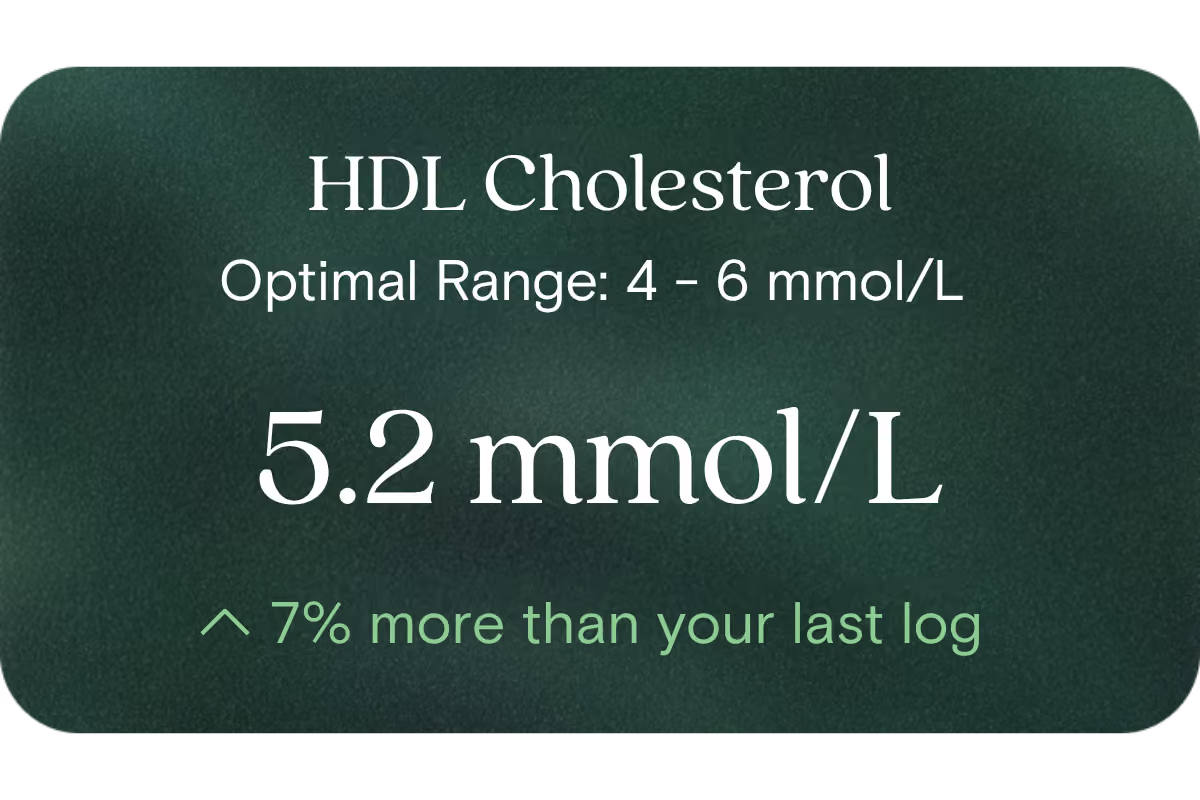
Vively’s optimal range is 1.0 to 2.5 mmol/L for men and 1.2 to 3.0 mmol/L for women. Low HDL is one of the criteria for metabolic syndrome. The upper limits come from large population studies that found a J-shaped curve: risk falls as HDL rises, then climbs again at very high levels. In two Copenhagen cohorts of about 116,000 adults, death rates were lowest at an HDL of about 1.9 mmol/L in men and 2.4 mmol/L in women, and rose again above that (Madsen and colleagues, 2017).
There is no single perfect number. Interpretation depends on your age, sex, ethnicity, family history, other lipid markers, blood pressure, smoking status, diabetes and overall cardiovascular risk. Your GP or cardiologist can help calculate your absolute cardiovascular risk and interpret HDL in that broader context.
What influences HDL cholesterol levels?
Lifestyle has a strong effect. Regular aerobic exercise, strength training, quitting smoking, achieving a healthy body composition and reducing visceral fat all tend to raise HDL. Diet also plays a role: unsaturated fats from olive oil, nuts, seeds, avocados and oily fish tend to support HDL, while diets high in refined carbohydrates and trans fats often lower it. Moderate alcohol intake is associated with modestly higher HDL, though this benefit does not outweigh the broader health risks of drinking.
Genetics have a significant influence on HDL, and some people naturally sit higher or lower than average. Hormones affect HDL too, with oestrogen tending to raise it (which is one reason many women see HDL fall after menopause). Certain medications, including anabolic steroids, beta blockers, some progestin-containing contraceptives and some retinoids, can lower HDL. Medical conditions such as type 2 diabetes, insulin resistance, chronic inflammation, liver disease and kidney disease can also affect HDL levels.
What are the symptoms of low HDL cholesterol?
Low HDL cholesterol does not cause symptoms directly, which is one of the main reasons routine testing matters. It is often only identified through a blood test. In many cases, low HDL travels alongside other features of metabolic syndrome such as high triglycerides, high blood pressure, elevated waist circumference and insulin resistance, which can carry their own subtle signs like fatigue, weight gain around the middle and energy dips after meals.
Because low HDL is a marker rather than a disease, checking it should always be part of a broader look at cardiovascular and metabolic health, including LDL, triglycerides, blood pressure, blood glucose and family history.
What causes low HDL cholesterol?
Common contributors include a sedentary lifestyle, excess visceral fat, smoking, poor diet quality (particularly high intake of refined carbohydrates, sugary drinks and trans fats), insulin resistance and type 2 diabetes. Low HDL often appears alongside high triglycerides and is a hallmark of metabolic syndrome. Chronic inflammation, liver disease and kidney disease can also lower HDL.
Genetics play a role, and some inherited conditions can cause very low HDL from an early age. Certain medications, including anabolic steroids, some beta blockers and some progestins, can also reduce HDL. In many cases, low HDL reflects a broader pattern of metabolic dysfunction, which is why it is often more useful to focus on improving overall metabolic health rather than trying to lift the HDL number alone. Our article on how to tell if you are insulin resistant explores this connection in more detail.
Can HDL cholesterol be too high?
Traditionally, higher HDL was seen as universally protective, but the picture is more nuanced. Large observational studies have shown a U-shaped relationship between HDL and mortality, with very high HDL (above about 2.5 mmol/L in men and 3.0 mmol/L in women) linked to higher cardiovascular and all-cause mortality. This may relate to changes in HDL function or underlying conditions rather than the HDL itself being harmful.
Very high HDL can also occur with heavy alcohol use, certain genetic conditions and some medications. If your HDL is unusually high, particularly alongside other unexpected results, your GP will consider the broader picture rather than assuming it is protective on its own.
What does it mean if HDL cholesterol is outside the optimal range?
A low HDL cholesterol is a well-recognised cardiovascular risk marker, particularly when it appears alongside high triglycerides, high LDL, high blood pressure or insulin resistance. It does not diagnose any single condition, but it may point to metabolic syndrome, insulin resistance or an underlying lifestyle or medical factor worth investigating.
A very high HDL is not automatically protective and, in some cases, may reflect underlying issues such as certain genetic conditions or heavy alcohol use. As with all lipid markers, patterns over time and the context of your other results matter more than any single reading.
Can HDL cholesterol be normal but something still be wrong?
Yes. HDL-C measures how much cholesterol HDL particles are carrying, but not how well they are functioning. Some people have a "normal" or even elevated HDL that does not perform reverse cholesterol transport effectively, which means the protective effect is reduced. This is one of the reasons HDL should not be viewed in isolation.
You can also have a normal HDL alongside high LDL, high triglycerides, elevated ApoB or high Lp(a), any of which can drive cardiovascular risk independently. Chronic inflammation, insulin resistance and poor metabolic health can all affect risk regardless of HDL. Our article on advanced lipid testing beyond LDL cholesterol explains how markers like ApoB and Lp(a) add depth to a standard lipid profile.
What other markers should be checked with HDL cholesterol?
HDL is most useful as part of a full lipid profile. LDL cholesterol shows how much cholesterol is being delivered to tissues, non-HDL cholesterol captures all atherogenic cholesterol in one number, and triglycerides add important insight into metabolic health. The total cholesterol to HDL ratio and the triglyceride to HDL ratio are simple but powerful summary markers, with the triglyceride to HDL ratio also acting as a useful proxy for insulin resistance.
Advanced markers add further depth. ApoB counts the actual number of atherogenic particles, and Lp(a) captures a largely genetic contribution to risk. HbA1c, fasting glucose and fasting insulin help assess metabolic health, hs-CRP measures low-grade inflammation, and liver enzymes such as ALT can flag fatty liver disease. Blood pressure, waist circumference, smoking status and family history are also essential context. You can see the full set of markers Vively looks at through our tests page and shop tests page.
How can you improve HDL cholesterol to a healthier level?
The most effective ways to support healthier HDL are also the ones that improve overall metabolic and cardiovascular health. Regular aerobic exercise, such as brisk walking, cycling or swimming, and resistance training a few times a week both tend to raise HDL and improve HDL function. Achieving a healthy body composition, particularly reducing visceral fat, and quitting smoking are two of the biggest levers.
Dietary changes can help too. Prioritising unsaturated fats from olive oil, nuts, seeds, avocados and oily fish, along with plenty of vegetables, legumes and whole grains, tends to support healthier lipids, while reducing refined carbohydrates, sugary drinks and trans fats helps. Alcohol modestly raises HDL, but drinking for that purpose is not recommended. Not every marker can or should be self-optimised, and the goal is a healthier overall lipid pattern rather than a single "perfect" HDL number. Vively's how it works page explains how testing, monitoring and dietitian coaching combine to make change practical.
When does HDL cholesterol need medical review?
See your GP if your HDL is persistently low, particularly if it appears alongside high triglycerides, high LDL, high blood pressure, insulin resistance or a family history of early heart disease or stroke. Clinical review is also important if HDL is very high without a clear reason, if you have established cardiovascular disease, diabetes, chronic kidney disease, PCOS or fatty liver disease.
Pregnancy, menopause and starting or stopping medications that affect lipids (such as hormonal therapies, beta blockers or anabolic steroids) are also good reasons to check in with your GP. HDL should never be self-diagnosed or interpreted in isolation, as it is one piece of a bigger clinical picture your GP or cardiologist can help you interpret through an absolute cardiovascular risk assessment.
How does Vively help you understand HDL cholesterol?
HDL cholesterol is one of the lipid markers included in the Vively Baseline Health Check, alongside LDL, non-HDL, triglycerides, cholesterol ratios, ApoB, Lp(a) and more than 60 other biomarkers spanning metabolic, liver, kidney, inflammation and hormonal health. Rather than looking at HDL in isolation, Vively interprets it in context with your other results, symptoms, lifestyle and family history.
An accredited practising dietitian reviews your results with you one on one, helping you understand what they mean and what changes may support your health goals. Because your markers are retested over time, you can see how nutrition, movement, sleep and other habits are shifting your lipid profile rather than guessing. Start at the Vively homepage or explore the full range of tests in the Vively shop.
References
- Heart Foundation of Australia. Australian guideline for assessing and managing cardiovascular disease risk. https://www.cvdcheck.org.au/
- Royal Australian College of General Practitioners. Guidelines for preventive activities in general practice (Red Book). https://www.racgp.org.au/clinical-resources/clinical-guidelines/key-racgp-guidelines/view-all-racgp-guidelines/red-book
- Royal College of Pathologists of Australasia. RCPA Manual: Lipids. https://www.rcpa.edu.au/Manuals/RCPA-Manual/Pathology-Tests/L/Lipids
- Healthdirect Australia. Cholesterol. https://www.healthdirect.gov.au/cholesterol
- Better Health Channel, Victorian Department of Health. Cholesterol. https://www.betterhealth.vic.gov.au/health/conditionsandtreatments/cholesterol
- Heart Foundation of Australia. Blood cholesterol. https://www.heartfoundation.org.au/your-heart/blood-cholesterol
- Australian Institute of Health and Welfare. Heart, stroke and vascular disease: Australian facts. https://www.aihw.gov.au/reports/heart-stroke-vascular-diseases/hsvd-facts
- Madsen CM, Varbo A, Nordestgaard BG. Extreme high high-density lipoprotein cholesterol is paradoxically associated with high mortality in men and women: two prospective cohort studies. European Heart Journal. 2017;38(32):2478 to 2486.
- Rader DJ, Hovingh GK. HDL and cardiovascular disease. The Lancet. 2014;384(9943):618 to 625.
- National Heart, Lung, and Blood Institute. HDL: The "good" cholesterol. https://www.nhlbi.nih.gov/health/blood-cholesterol
- Cleveland Clinic. HDL cholesterol. https://my.clevelandclinic.org/health/articles/23849-hdl-cholesterol
- Mayo Clinic. Cholesterol test. https://www.mayoclinic.org/tests-procedures/cholesterol-test/about/pac-20384601
- National Institutes of Health, MedlinePlus. HDL: The good cholesterol. https://medlineplus.gov/hdlthegoodcholesterol.html