



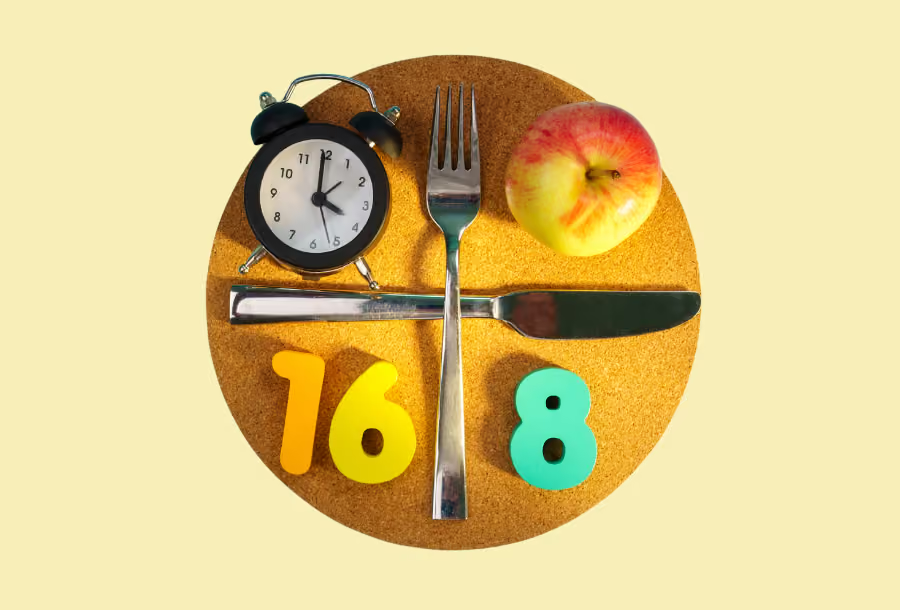
16:8 fasting means eating all your food within 8 hours and fasting for the other 16, for example eating between 10 am and 6 pm. In trials it helps some people eat less, but weight loss is about the same as ordinary calorie cutting, and changes in glucose, insulin and HbA1c are small or absent.
So 16:8 isn't magic, but it can be a useful structure. Before you start, it's worth checking that it's safe for you.
16:8 fasting is a form of time-restricted eating: you eat within the same 8 hours each day and have only water or drinks without kilojoules for the other 16. Diabetes Australia describes it as fasting for 16 hours and eating only in the remaining 8.
Most people do it by skipping breakfast and eating from about noon to 8 pm. Others eat earlier, from 8 am to 4 pm. Researchers often call the earlier version early time-restricted eating, and some of the more interesting results come from it.
16:8 doesn't set what or how much you eat. That turns out to matter a lot.
A little, mostly because a shorter window means fewer chances to eat. When trials compare it with eating the same amount on a normal schedule, the difference mostly disappears.
| Study | Who and how long | What happened |
|---|---|---|
| TREAT trial, JAMA Internal Medicine 2020 | 116 adults with overweight, 12 weeks, eating noon to 8 pm vs 3 meals a day | 0.94 kg lost on 16:8 vs 0.68 kg on 3 meals, no significant difference. No change in fasting glucose, fasting insulin or HbA1c. The 16:8 group lost more lean mass. |
| Liu et al, New England Journal of Medicine 2022 | 139 adults with obesity in China, 12 months, all cutting kilojoules, half eating 8 am to 4 pm | 8.0 kg vs 6.3 kg lost, not a significant difference. Waist, body fat, blood pressure and metabolic markers also similar. |
| Sutton et al, Cell Metabolism 2018 | Men with prediabetes, 5 weeks of each pattern, eating within 6 hours finishing before 3 pm, fed enough to keep weight steady | Better insulin sensitivity, blood pressure and oxidative stress, even without weight loss. A small study. |
| Semnani-Azad et al, BMJ 2025 | Review of 99 trials, 6,582 adults | All fasting styles and calorie cutting led to weight loss compared with no diet. Time-restricted eating did no better than calorie cutting, and nothing differed for HbA1c. |
| Cochrane review 2026 | 22 trials, 1,995 adults with overweight or obesity | Compared with regular dietary advice, intermittent fasting may make little to no difference to weight loss. |
In TREAT, people in the 16:8 group lost a small amount of weight, but so did the people eating three meals, and some of the 16:8 group's loss was muscle rather than fat. That is a good reason to keep protein up and keep doing strength work if you try it. Our guide to keeping muscle during weight loss explains how.
The Cochrane authors suggest the choice comes down to whether fasting is practical and sustainable for you.
Not much on average. In the larger trials, fasting glucose, fasting insulin and HbA1c barely moved, and the 2025 BMJ review found no difference in HbA1c between fasting and other approaches.
The one standout is the small 2018 trial in men with prediabetes. Eating early in the day, and finishing before 3 pm, improved how well their bodies responded to insulin even though their weight didn't change. The researchers timed it to line up with the body clock, which runs metabolism differently across the day. It hints that when you eat may matter as much as how long you go without food. Very few people can finish dinner by 3 pm, but bringing your last meal earlier is a realistic step.
The bigger point is that fasting glucose is a slow marker. Insulin often rises for years while glucose stays normal, so a normal glucose result doesn't tell you much about whether a fasting pattern is helping.
“Insulin moves decades generally... the thinking is around 10 to 15 years before glucose does. That's how much the body works to try and keep homeostasis intact.”
Dr Michelle Woolhouse, Vively Medical Director
Our member data shows how common this hidden stage is. Among members whose HbA1c and fasting glucose were both in the normal range, more than half had fasting insulin above our optimal range of 3 to 5 mIU/L.
If you want to know whether 16:8 is doing anything for your metabolism, fasting insulin and HOMA-IR are better markers to track than glucose alone. Our guide to insulin resistance with normal blood sugar explains why.
In people without diabetes, glucose stays fairly flat during a fasting window. The liver releases stored glucose to keep levels steady, so a CGM usually shows a gentle line within the usual range rather than a slow slide down.
Our members' first sensors give a sense of what steady looks like across a whole day, fasting windows included.
Where a CGM gets interesting with 16:8 is the first meal. Seeing how your glucose responds when you break the fast with toast and jam, compared with eggs and grainy toast, is more useful than watching a flat line overnight. Our guide on the healthiest way to break a fast covers what to eat first.
If you use a CGM through Vively, the app shows readings against a 4 to 6 mmol/L range. A dip a little under 4 on a long fast, without symptoms, is often sensor noise or pressure on the sensor. Lows with shakiness or sweating are a reason to eat and talk to your GP.
Diabetes Australia advises that some people should not follow intermittent fasting, and that anyone with diabetes should talk to their doctor first.
If you have a medical condition or take regular medicines, check with your GP. This is the advice that sat on this page before, from our Medical Director:
“If you have diabetes or a metabolic condition, it's important to consult your healthcare provider before trying intermittent fasting. Monitoring your glucose levels and adjusting your diet or medication as needed can help prevent unwanted fluctuations.”
Dr Michelle Woolhouse, Vively Medical Director
Australia's Physical Activity Guidelines suggest muscle-strengthening activity on at least two days a week, which matters more than usual if you're eating less. If you want to know whether a splash of apple cider vinegar or milk ends your fast, our post on whether apple cider vinegar breaks a fast covers it.
The honest test of any eating pattern is your own numbers before and after. The Baseline Health Check measures fasting insulin, HOMA-IR, fasting glucose and HbA1c among 70+ markers, read against optimal ranges, and a practitioner explains them. Your membership includes a targeted re-test after 3 months, which is about the right time to see whether 16:8 changed anything. The CGM program shows how your first meal lands, and dietitian coaching through the $99 a month membership helps you plan meals inside your window. You can also read how a CGM works first.
The Baseline Health Check covers 70+ markers, including fasting insulin, HOMA-IR and HbA1c, with a practitioner to explain them and a targeted re-test after 3 months.
16:8, also written 16/8 or 16+8, means 16 hours of fasting and an 8-hour eating window each day. A common version is eating from noon to 8 pm. During the 16 hours you have water, plain tea or black coffee. It's the most popular form of time-restricted eating.
It may help some people, but the evidence is mixed. A small trial in men with prediabetes found better insulin sensitivity when eating finished before 3 pm, while larger trials of noon-to-8 pm eating found no change in fasting insulin. The best way to know is to test your fasting insulin before and after.
Trials ran from 5 weeks to 12 months. Weight changes, if any, usually show within the first month or two. For blood markers like fasting insulin and HbA1c, wait at least 8 to 12 weeks before re-testing, because HbA1c reflects your average glucose over the past two to three months.
For most healthy adult women, yes, but it isn't recommended in pregnancy or while breastfeeding, or with a history of disordered eating. If long fasts leave you tired or overly hungry, a 12 to 14 hour overnight fast is a gentler option.
No. Black coffee and plain tea have almost no kilojoules, so most people drink them during the fasting window. Adding milk, sugar or creamer adds kilojoules, so keep those for your eating window if you want a strict fast.
START YOUR BASELINE
Vively includes a Baseline Health Check with 70+ biomarkers, a results report and practitioner support in the $99 a month membership. No minimum term.
Explore Baseline Health CheckSubscribe to our newsletter & join a community of 30,000+ Aussies

Start a PCOS assessment with your GP. Learn which blood tests matter, when ultrasound or AMH is useful, and how contraception affects results.


Know what to do about an unexpected high blood sugar reading, when to seek urgent help, and which everyday habits support longer-term glucose care.





Vively is a general wellness platform and does not provide medical advice, diagnosis, or treatment. Any information, insights or guidance offered through our app, website, programs, or coaches is for educational and informational purposes only and should not be considered a substitute for professional medical advice or care. Always consult a qualified healthcare provider before making any health-related decisions.
We acknowledge the Traditional Custodians of the lands where we live and work, the Gadigal of the Eora Nation. We pay our respects to their Elders past and present.
 Share
 Tweet
 Share